
- PRICING
- LIVE QUOTES
- LEARN
- HELP


EN
Meta (META.US) Muse has exploded for a month, how are subscriptions performing?
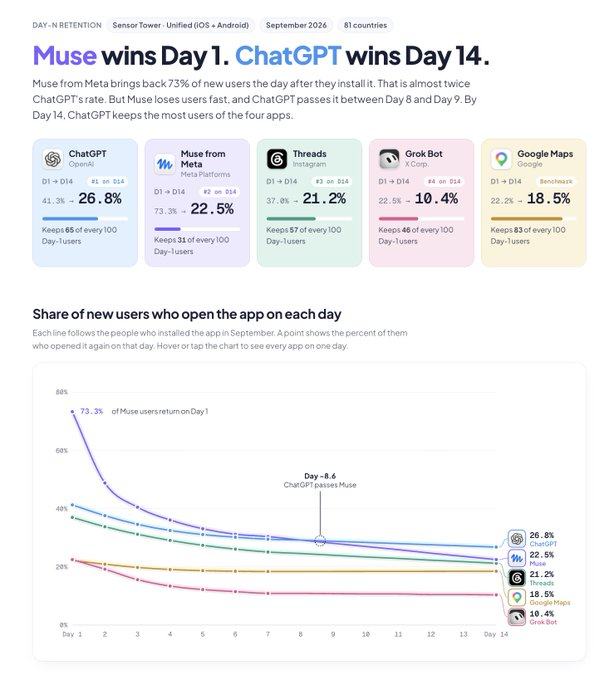
The Zhitong Finance App learned that Meta (META.US)'s personal AI assistant Muse is close to ChatGPT's level of retaining users. According to Silicon Valley venture capitalist Deedy Das quoting Sensor Tower data on X, Muse's user return rate is over 30% after 7 days, which is roughly the same as ChatGPT; the 14-day retention rate is 22%, which is slightly lower than ChatGPT. Retention rates measure the proportion of users returning to an app after a specified period of time.
However, if you unfold the entire retention curve, Muse's lead has only been maintained for a week. According to the same Sensor Tower data, Muse's first-day retention rate was 73.3%, a full 32 percentage points higher than ChatGPT's 41.3%; it remained above 30% on the 7th day, but ChatGPT gradually caught up and overtook between days 8 to 9; on day 14, Muse dropped to 22.5%, and ChatGPT remained at 26.8%. Over the same period, Muse still outperformed Threads (21.2%), Google Maps (18.5%), and Grok Bot (10.4%). This set of statistics shows new mobile installs added in September 2026, covering iOS and Android.
There is a decimal point difference between 22% on the 14th disclosed in the original text and 22.5% in the detailed data. The original text on the ChatGPT side did not give specific values, all of which are based on the caliber of the respective sources.
Compared horizontally to mature social apps, the stickiness gap for AI assistants is still obvious. According to Deedy Das's post, WhatsApp's 14-day retention rate is 67%, YouTube is 59%, Instagram is 54%, and TikTok and Snapchat are both 37%. In other words, even after leveling off ChatGPT, Muse is still a bit less frequent than Meta's mature products.
Downloads: Between 2.8 million and 3.7 million
Sensor Tower previously estimated that Muse had 2.8 million global downloads in the first two weeks of launch, 3.7 million ChatGPT during the same period, and 400,000 and 300,000 for Grok and Claude, respectively. Muse went live on September 8, and the initial markets are limited to the US and Canada. According to Sensor Tower statistics, the number of downloads exceeded 730,000 in 5 days of launch, and the total number of downloads exceeded 2.5 million in 13 days (about 1.5 million for iOS and 1.1 million for Android). By day 22, the cumulative number of downloads surpassed 5 million — according to industry data, only 23 apps in history have reached this rate.
The caliber of data vendors varies quite a bit: Apptopia estimates a cumulative total of 4.3 million times (of which iOS 2.6 million), Sensor Tower gave more than 3.4 million times, and Appfigures about 2.3 million times. BNP Paribas quoted third-party data as saying that since its launch in September, Muse has accumulated over 5.6 million downloads, and once reached the top of the Apple App Store rankings. These estimates are based on different sample panels, estimation models, and deduplication methods, and care must be taken when comparing horizontally.
An intelligent body, not a chat box
The difference between Muse and early chatbots is targeting. Meta describes it as a “personal AI agent,” rather than an assistant that only passively answers questions: it can browse the web, fill out online forms, place shopping orders, make restaurant reservations, generate images, create documents, and connect to services such as email, calendar, Spotify, Instagram, and OpenTable, running in Meta's own secure virtual machine. The underlying layer is driven by Meta's Muse Spark family of models, and distribution is directly linked to Facebook, Instagram, and WhatsApp.
The benefits of distribution are directly reflected in the data. French and Palestinian analyst Nick Jones pointed out in a customer report that Muse's early downloads in the US surpassed Sora and ChatGPT, “which is not surprising given the huge installs of Instagram, WhatsApp, and Facebook.” Compared to independent AI applications that require building a user base from scratch, Meta's existing ecosystem significantly reduces customer acquisition costs.
But the same report also shows the other side of the coin: Muse's app open rate has stabilized, yet it's still lower than Google, ChatGPT, Instagram, WhatsApp, and Facebook. Jones sees this as an indication that “initial interest is solid, but Muse is still early in establishing habitual use.” He maintained a “outperforming the market” rating and a target price of $885 for Meta.
From downloads to habits to revenue
Monetization is part of France and Pakistan's more cautious approach. Currently, the Muse basic tier is free, and higher usage amounts require a monthly subscription — the Power plan is $20 per month, the Maximum plan is $100 per month, and new users also have a promotion quota of 100 million free tokens; Meta also charges small fees to partners for some transactions completed through this smart device. Zuckerberg said earlier that he would eventually profit from the deal.
Jones judged that long-term monetization was still a question mark for investors, but he saw a path where “as engagement increases, ads may become quite attractive” — which fits well with Meta's established ad-based business model. Competition is also accelerating: OpenAI launched Dots, a consumer-grade smart device product this week, and whether Google, SpaceX, etc. will follow suit is also worth watching. Jones also believes that due to the lack of direct inventory, trading infrastructure and customer service capabilities, Muse will not pose a real threat to vertical market platforms in the short term.
Underpinning all this is Meta's rare intensity of investment. The company's 2026 capital expenditure guideline is $130 billion to $145 billion, mainly for data centers, servers, network equipment and specialty chips, and the recruitment and retention of AI researchers. Capital expenditure for the second quarter was US$31.1 billion, and free cash flow plummeted to US$784 million from US$8.55 billion in the same period last year; revenue for the same period was US$60.8 billion, up 28% year over year (ad impressions increased 14% and average price per ad rose 12%), but overall costs and expenses rose 55%, and net profit fell 14% to US$15.8 billion. Revenue guidance for the third quarter is $61 billion to $64 billion.
The market's reaction to this was not one-sided. After Muse went live, Meta's stock price rose 11.3% in a single day on September 21, closing at $741.25, increasing its single-day market value by about $1920 billion; the full month of September rose by about 36%, making it the strongest single month since July 2013. From September 10 to October 9, Meta shares rose from $644.38 to $718.67, or about 11.5%. Sellers are also stepping up: J.P. Morgan analyst Doug Anmuth raised the rating to gain on September 10, and the target price was raised from $640 to $820; Wells Fargo raised the target price from $796 to $1,000 on October 6 for the same reason. By the close of trading on October 9, Meta reported $718.67, down 0.31%, and its market capitalization was around $1.83 trillion.
Trust is another test of survival
For an intelligent entity that requires access to a user account to function, privacy and trust itself are reserved variables. When Muse went live, Meta had just agreed to settle a social media-related lawsuit for up to $18 billion; Amazon had reportedly actively blocked Muse from accessing its online store due to security concerns, unauthorized credential storage, and data scraping; Meta also experienced a backlash due to an Instagram feature linked to Muse Image that allows the generation of images involving public accounts, and then shut down the feature.