
- PRICING
- LIVE QUOTES
- LEARN
- HELP


EN
Should AI Cost Cuts Require Action From Globe Life (GL) Investors?
- Globe Life has rolled out artificial intelligence tools across administration, underwriting, and sales support to trim operating costs and lift agent productivity, tying these long-dated insurance operations even more closely to execution on internal efficiency targets.
- The key question now is whether AI driven process changes at Globe Life can offset hidden cost pressures that could otherwise erode net operating margins and long term value creation.
- We will now see how Globe Life's investment narrative could be reshaped by its push into AI supported underwriting and administration efficiency.
See how Globe Life's push into AI-supported efficiency compares with peers by reviewing a hand picked group of insurers and financials that screen well for balance sheet strength and fundamentals in the list of solid balance sheet and fundamentals (25 results).
Globe Life Investment Narrative Recap
To own Globe Life, you need to be comfortable with a slow and steady insurer that leans on long dated policies, tight cost control, and agent productivity. The recent push into AI supported underwriting and administration mostly reinforces that story rather than changing it. In the near term, the key swing factor is whether expense ratios actually come down while premium growth in core life and health lines holds up.
The biggest risk right now is execution friction. Direct to consumer life sales are already under pressure and health claims have been running hot, which squeezes margins and raises the bar for any AI driven savings. If those cost benefits prove modest or are delayed, earnings misses like those earlier in 2026 could continue and weigh on investor confidence.
The most relevant recent development is Globe Life rolling out AI applications across administration, underwriting, and sales support. That rollout directly targets the administrative expense ratio, which sits around 7.3% of premium, and ties closely to the firm’s stated goal of lifting agent productivity. For a middle income focused insurer, trimming even small slices of fixed cost can matter a lot for long term value creation.
That same announcement also intersects with existing catalysts around digital underwriting and higher conversion in the direct channel. If AI tools shorten underwriting cycles and free up agents for more selling time, the business has a clearer path to offset weakness in online acquisition and to absorb health claims volatility. The operational story then turns on how consistently management can apply these tools across legacy systems without creating new hidden costs.
Globe Life Analyst Expectations In Context
Globe Life's narrative, as sketched out by current analyst models, rests on steady top line expansion and a measured earnings climb rather than a dramatic reset. Consensus forecasts point to revenue growth of 6.2% a year over the next three years and earnings moving from about US$1.2b today to roughly US$1.3b by 2029. That earnings step up is about a US$0.1b increase, which is not huge in absolute terms but still meaningful for a mature insurer that leans on cost discipline and buybacks. Even with margins expected to ease from 19.6% to 17.9%, the forecast keeps Globe Life on a path where incremental efficiency gains and AI supported underwriting improvements play an important role in keeping that earnings trajectory intact.
Globe Life's narrative projects US$7.4b revenue and US$1.3b earnings by 2029. This is built on 6.2% yearly revenue growth and about a US$0.1b earnings increase from US$1.2b today.
Uncover why Globe Life's fair value indicates an 18% potential upside to its current price that could narrow quickly.
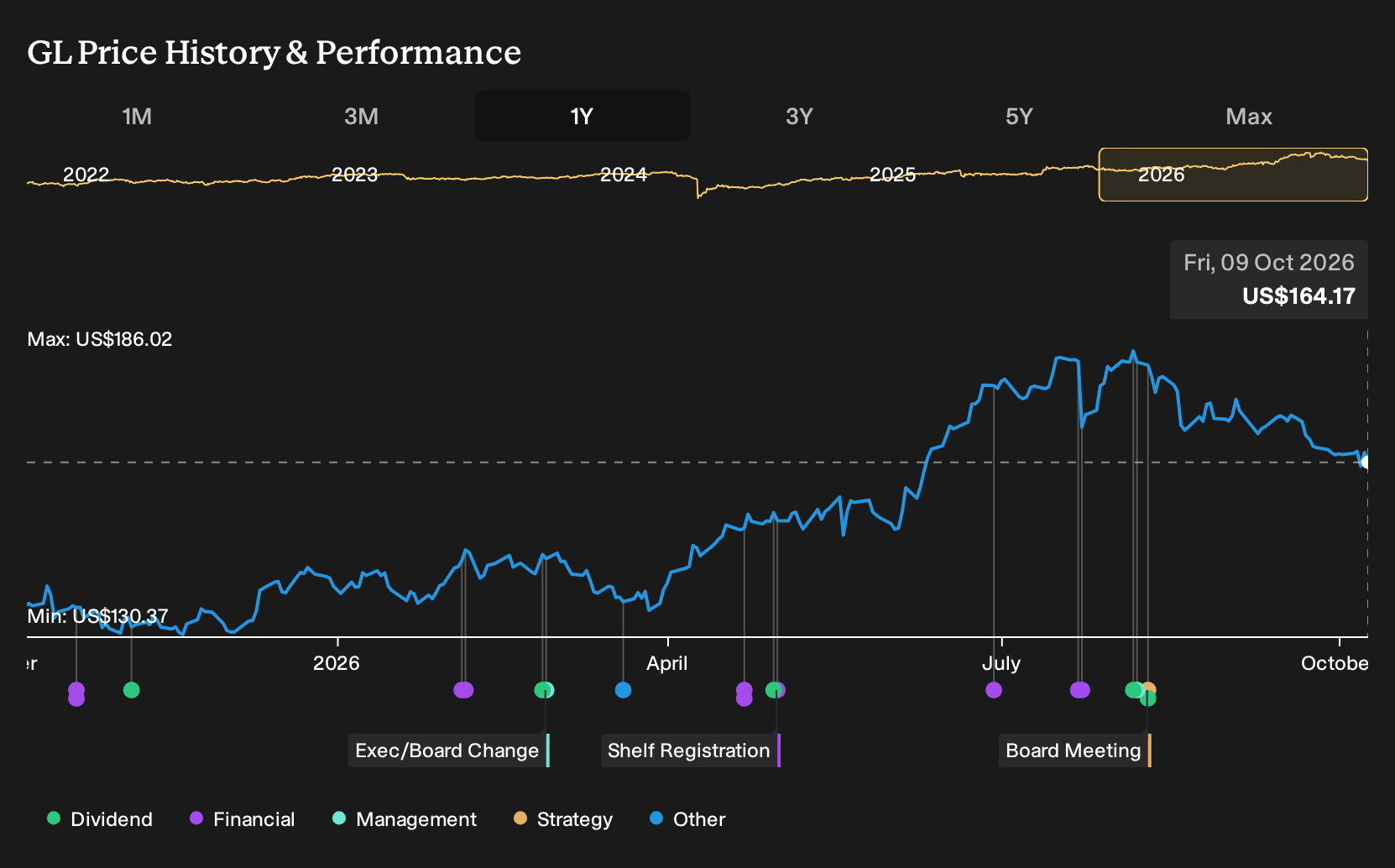
Exploring Other Perspectives
One alternate Globe Life story leans hard into the buyback catalyst. The most optimistic analysts were penciling in revenue of about US$7.8b and earnings of roughly US$1.4b by 2029, supported by heavier repurchases and steadier underwriting. You may view that as ambitious; this is exactly why exploring different forecasts after this AI update matters.
Explore 3 other Globe Life fair value estimates, including one that suggests potential upside of up to 115% from the current price.
Reach Your Own Conclusion
Disagree with existing narratives? Extraordinary investment returns rarely come from following the herd, so trust your own analysis.
- A great starting point for your Globe Life research is our analysis highlighting 2 key rewards and 1 important warning sign that could impact your investment decision.
- See our latest analysis for Globe Life. The report includes a comprehensive fundamental analysis summarized in a single visual, the Snowflake, making it easy to evaluate Globe Life's overall financial health at a glance.
Looking for more investment ideas beyond Globe Life?
Once you have formed a view on Globe Life, it can help to stress test your thinking by comparing it with other businesses that share similar qualities on value, balance sheet strength, or income potential.
- If you want potential bargains with strong foundations, start with a shortlist of 29 high quality undervalued stocks that combine quality fundamentals with attractive pricing.
- For investors who care about resilience as much as returns, you can focus on 31 resilient stocks with low risk scores that screen well on financial strength and business stability.
- If reliable income is your priority, build a watchlist around 8 dividend fortresses that pair higher yields with robust cash generation.
This article by Simply Wall St is general in nature. We provide commentary based on historical data and analyst forecasts only using an unbiased methodology and our articles are not intended to be financial advice. It does not constitute a recommendation to buy or sell any stock, and does not take account of your objectives, or your financial situation. We aim to bring you long-term focused analysis driven by fundamental data. Note that our analysis may not factor in the latest price-sensitive company announcements or qualitative material. Simply Wall St has no position in any stocks mentioned.
Have feedback on this article? Concerned about the content? Get in touch with us directly. Alternatively, email editorial-team@simplywallst.com