
- PRICING
- LIVE QUOTES
- LEARN
- HELP


EN
What Do the US President and I Have in Common?
- No, I did not win the Nobel Peace Prize in Economics this year. But I won't go off and start wars with other countries over oil either.
- Speaking of Energies, the attempt at manufacturing a selloff in diesel fuel took the futures market down double-digits overnight, though the market has recovered through early Monday.
- Grains are mixed, with the key point to last Friday's nonsense is that USDA did its job by generating record large trade volume in Corn.

Morning Summary: Though it is hard to believe, the US president and I actually have something in common. Neither of us has been awarded a Nobel Peace Prize. The first thing I noticed when I pulled up the financial news pre-dawn Monday was the “Breaking” headline at the top, “Nobel prize in economics awarded to…”, well, not me. I thought maybe there was a chance of me pulling it out late with my recent discussion of the Dos and Don’ts of the Diesel Fuel market[i] or at the very least my groundbreaking work relating USDA reports to casino Keno games[ii]. But alas, it was not to be. And no, in case you were wondering, I will not now go off and try to take over other countries or begin a personal war, all in the name of oil. Though I would like to visit my friends in Canada again and share some Maple Whisky over steak tartare and poutine. Speaking of diesel fuel, I mentioned it a couple minutes ago, the futures market was down 6.75 cents at this writing after dropping as much as 15.6 cents overnight. I had to chuckle at another of this morning’s headlines as it agreed with what I’ve said, “(The US president’s) diesel deal (with Russia) may offer little price relief ahead of midterms”.
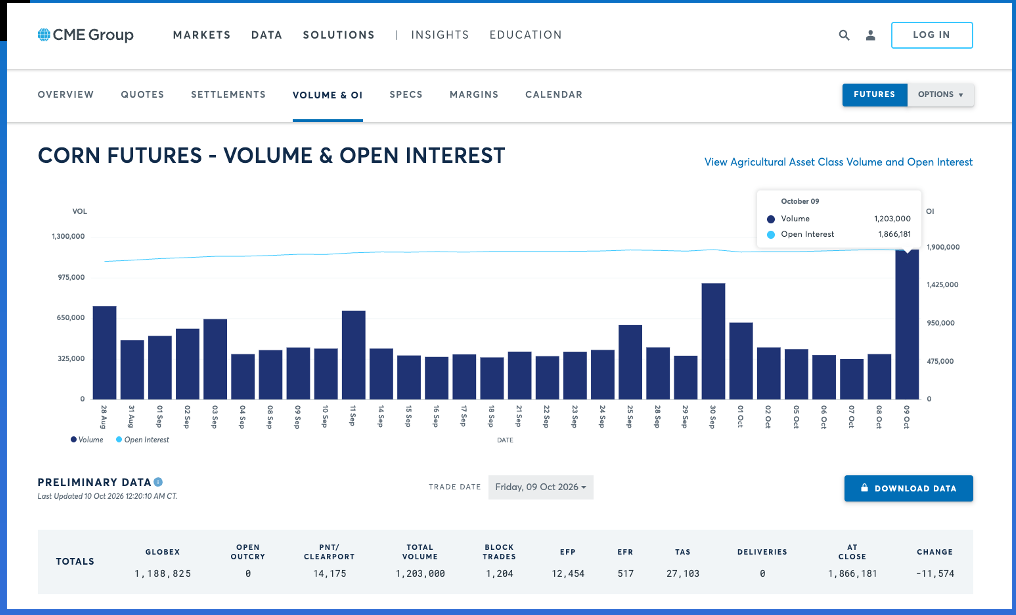
Corn: The corn market was higher to start the week, not overly surprising given the silly meltdown seen last Friday. Though you may have blocked it from your mind, the December contract fell the daily limit 30.0 cents after USDA’s latest Keno numbers were released, prompting the question of if I believed the numbers. In Weekly Analysis posted over the weekend I talked about how Dec26 had overshot its technical downside target, based on still neutral futures spreads, meaning the market was in position for a short-term rally. Overnight through early Monday morning saw Dec gain as much as 2.75 cents on trade volume of 40,000 contracts and was sitting 1.5 cents in the green at this writing. As for Watson, we know it was triggered into selling last Friday, so the latest Commitments of Traders report showing funds decreased their net-long futures position by 57,030 contracts as of Tuesday, October 6 was meaningless. A look at the change in open interest from last Friday and we see the corn market lost 11,570 contracts with December dropping 25,480 contracts. But USDA did its job as trade volume for Friday was reported at 1.203 million contracts, what looks to be a new record.
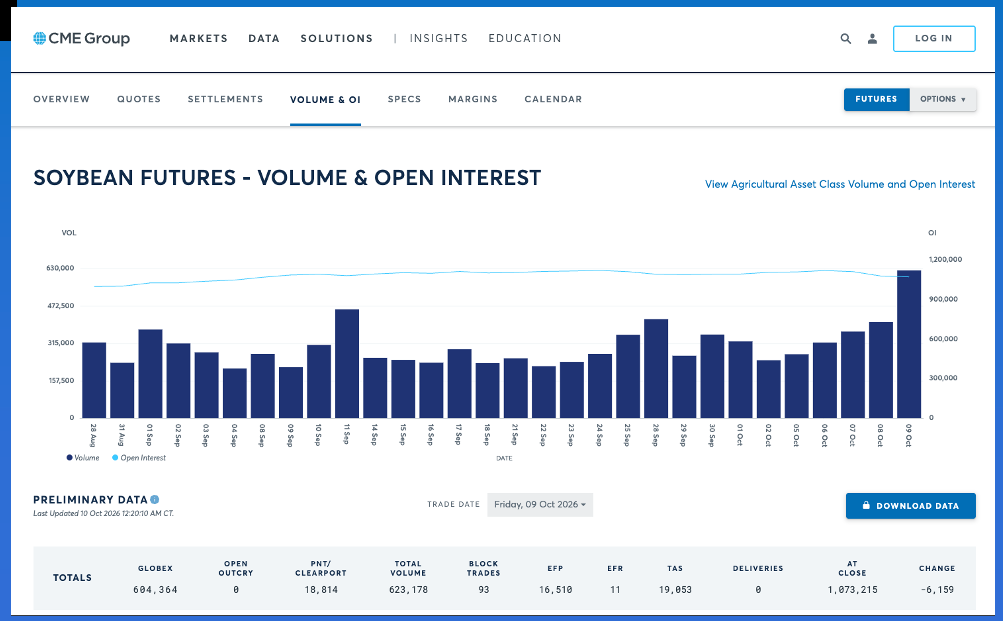
Soybeans: Given the attempt at manufacturing a selloff in diesel, it would not have been surprising to find the oilseed sub-sector red across the board pre-dawn Monday. And it was overnight, but as of this writing both canola and soybean oil have worked back into the green while soybeans have bounced off session lows, a move that has become standard operating procedure for the market. Another look at last Friday and we see November fell as much as 17.75 cents, taking out a line of technical support near $12.73 in the process, before rallying to close 4.5 cents higher for the day. Total trade volume for the market was reported at 623,180 contracts, the largest daily number since February 4, 5, and 6[iii] (930,020, 646,870, and 932,800 respectively). With the Golman Roll for this month nearing its end, the overnight session saw November fall as much as 14.0 cents while registering 42,000 contracts changing hands while January lost as much as 13.5 cents on trade volume of 22,000 contracts. As we make our way through this week, the key prices will be last Friday’s lows of $12.6975 (Nov26) and $12.8650 (Jan27) as these could be the next algorithm trigger points.
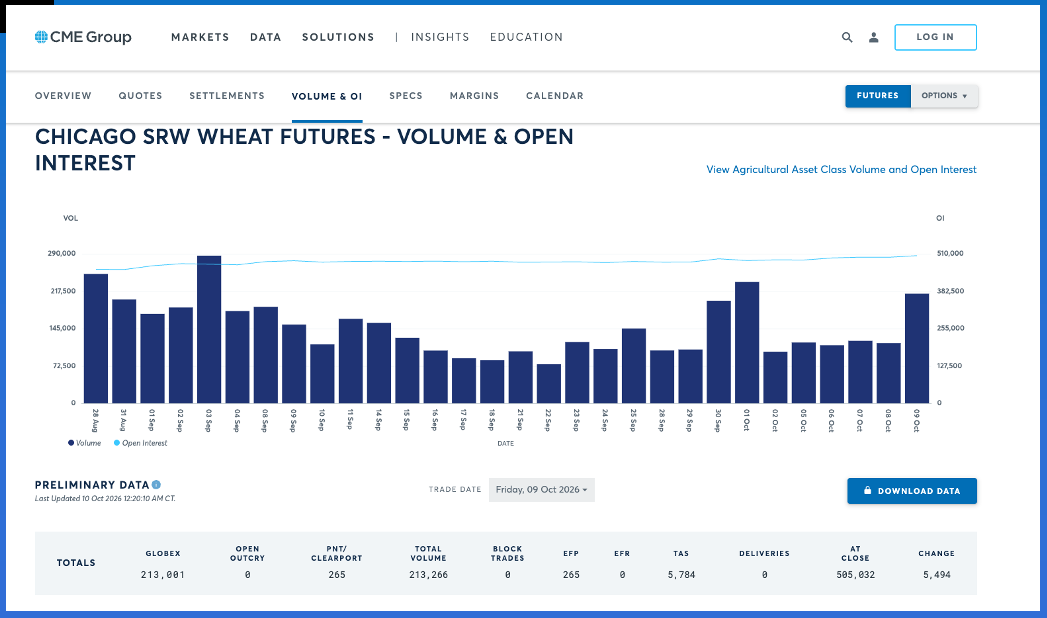
Wheat: The wheat sub-sector traded either side of unchanged overnight, with all three markets sitting in the green as of this writing. What can we make of this? We know fall planting of 2027 winter crops continues while the 2026 spring wheat harvest is wrapping up. We also know the world isn’t going to run out of wheat any time soon, and it has nothing to do with last Friday’s Keno numbers. The December-March SRW futures spread finished last week covering 59% calculated full commercial carry while the same spread in HRW covered 50% and the HRS spread was covering 60%. As for basis, the HRW market was bearish with both SRW and HRS neutral-to-bearish. In other words, there has not been a change in real fundamentals in a long, long time. One final look at last Friday’s numbers and we see trade volume for the more heavily traded SRW market is reported at 213,270 contracts, larger than it has been but still paling in comparison to what was registered around the previous set of USDA numbers, quarterly Grain Stocks on September 30. And with wheat closing lower across the board last Friday, open interest in SRW increased by 5,500 contracts.
[i] See my latest Weekly Column.
[ii] See any or all of what I posted last week.
[iii] I’ll have to go back in the Archives and read my Commentary from early February. Maybe it had something to do with Phil seeing his shadow.
On the date of publication, Darin Newsom did not have (either directly or indirectly) positions in any of the securities mentioned in this article. All information and data in this article is solely for informational purposes. For more information please view the Barchart Disclosure Policy here.