
- PRICING
- LIVE QUOTES
- LEARN
- HELP


EN
Musk shows the “AI ambition” of core construction and unmanned vehicle fleets: Terafab will test 10 chip designs a year, and Cybercab points to Dallas after expanding 8 times a month
The Zhitong Finance App learned that Tesla (TSLA.US) and SpaceX (SPCX.US) CEO Elon Musk sent out two messages in a row last weekend, with the same direction — taking back the most critical supply chain and the most critical operational links into their own hands. On October 11, at the X Takeover event at the Austin Gigafactory in Texas, he described Terafab's goal to make and test about 10 chip designs in a year; on the same day, Tesla's AI software's Ashok Elluswamy showed another line of progress on X—Austin's Cybercab fleet has surpassed 300 vehicles and expanded 8-fold in 30 days.
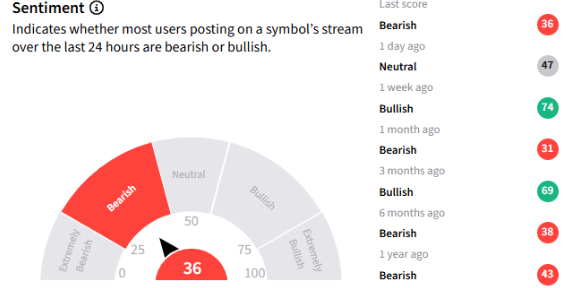
What the two lines have in common is that they are both questioned between “speed” and “certainty.” The market's response was lukewarm: before Monday, Tesla's stock price rose by about 0.6% overnight, and SpaceX (SPCX) rose by about 1.2%, but retail sentiment remained “bearish” on Tesla, and the stock was still down about 15% during the year.
10 designs a year, and that “uninterrupted iteration” building
Musk's “10 models” means testing and iteration are moving faster; it's not about advancing 10 designs to mass production every year. “What we want to do is more like 10 designs a year,” he said. An important chip usually takes two years from design to mass production, which is already quite fast in the industry.
The proposed Giga Texas R&D facility will place chip manufacturing, testing, packaging, and mask production in the same building. Musk said that the team can test a chip here, make a new mask, and then build the next version, so there's no need to stop iterating. “You build a complete computer in the same building, test it, then make a new mask, and then make a new chip” — he called this “complete closed loop” a powerful tool.
He doesn't hide his status as an outsider: “I don't even know how to make a chip, but we'll figure it out.” In terms of time, he didn't say: “It may take years, but looking at it longer, I'm pretty sure we can do it.” When he visited competitors' factories, he discovered that there was very little customized equipment, and Tesla and SpaceX were just good at customizing equipment; the path was to start with standard equipment, modify to improve throughput, and then develop their own machines at bottlenecks.
This R&D line is just the outpost of larger plans. Terafab itself has two factories, each with a chip design, to supply Tesla vehicles, Optimus, and AI data centers in space: The project was announced in March 2026, with an investment of over US$16.8 billion in the first phase, with a reported maximum of US$119 billion. The plan is to provide about 3,000 jobs, with an annual production capacity target of more than 1 terawatt of AI computing power; about 80% of which are facing space and 20% are used on the ground. The mass production landing window is expected from 2027 to 2029.
Why was TSM.US brought in and the situation of Intel (INTC.US)
The supply-side variables occurred in the same month. On October 2, technology reporter Tim Culpan reported in his newsletter Culpium that TSMC is exploring how to participate in Terafab's plant operation in Texas. The most likely structure is for TSMC to own and operate a new plant, Terafab as an anchor customer (close to its JASM in Japan and ESMC joint venture model in Germany); the other is that SpaceX has a majority stake and TSMC has less investment and technical and operational experience.
On October 3, Musk closed his mouth on X: “It's just a discussion, but maybe it will come to an end.” On October 7, he drew the line even more clearly: Tesla and SpaceX will build and operate Terafab on their own. “There is no doubt about this”. If TSMC wants to participate, it will sublease at most part of the factory area without involving an operational role. Intel CEO Chen Liwu stated on the same day that “we will continue to participate.”
TSMC was put on the table for two reasons. First, it has a bigger game in Texas — after the Arizona campus promised to expand the investment to $265 billion, it is evaluating a new campus in Texas and planning up to 6 fabs. Dallas and Northern Texas are candidate sites. Second, Terafab requires a second technology channel: Intel was designated to provide the 14A process (about 1.4 nanometers) when it joined in April, but industry insiders revealed that actual progress between the two parties was “quite limited”, and even the authorization for the 14A process design kit was unclear.
The market immediately read this news as bad news for Intel. TSMC shares closed up 3% on Monday (October 5), and US Depositary Receipts closed up about 2.8% to a record high of 485.80 US dollars; Intel closed down about 2.6% on the same day, falling for three consecutive trading days, then falling 3.18% on Tuesday. It didn't stabilize until Musk and Chen Liwu came forward to calm down. The magnitude of the response far surpassed the news itself—Intel rose more than 200% over the past year, and only $293 million of the OEM business's second-quarter revenue of $5.8 billion came from external customers. Terafab is the only “signature customer” in this business. The signboard is shared, and the valuation assumptions have to be recalculated. Intel will release the 14A design kit in October, which is another test point; the company itself acknowledged in its annual report that if 14A is unable to find important external customers, it may suspend this process.
The seller split into two factions. Mizuho's Jordan Klein believes that the Texas manufacturing center explored by TSMC “is likely to be part of this project, and Musk will be the anchor customer”; Wedbush's Matt Bryson reaffirms that TSMC “outperforms the market”; D.A. Davidson's Gil Luria believes Intel investors are “too optimistic”; well-known semiconductor analyst Lu Xingzhi's question is even more fundamental — if TSMC is responsible for funding and providing advanced manufacturing processes, the plant would not count as Musk's Terafab?
However, the physical clock that makes the core is not bent due to anyone's attitude. TSMC Chairman and CEO Wei Zhejia said at the April results meeting that “there are no shortcuts” — it will take 2 to 3 years to build a new fab, and 1 to 2 years to increase production capacity.
Cybercab expands 8x in a month, next stop in Dallas
The downstream line is much faster. On October 10, Tesla Robotaxi's official account claimed that Austin's Cybercab had “expanded to more than 300 cars and grew 8 times in 30 days”; Elluswamy retweeted and wrote “Two years until the 10/10 Cybercab WeRobot press conference, now Austin is full of these cars, Dallas is fast.” According to records from the Texas Motor Vehicle Administration, Tesla added 150 new registrations at once on October 8, increasing the total number from 169 to 319 vehicles — the biggest single-day increase since the first batch of 7 cars entered the registration system on August 31.
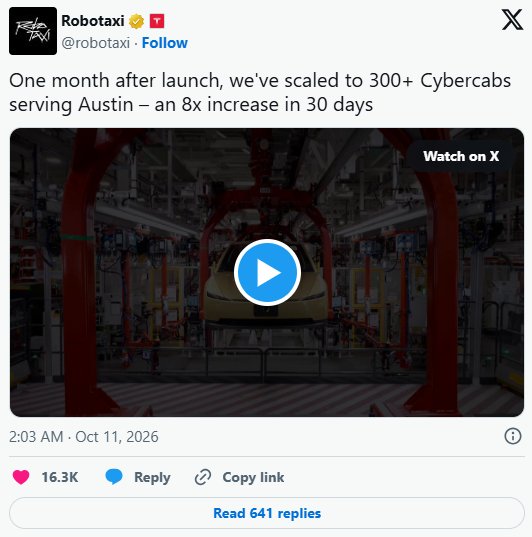
Currently, the speed is intuitive: there were only 45 registered vehicles in Texas at the time of the commercial debut at the beginning of this month, 169 vehicles, and 319 vehicles a week later; in the same period, Waymo's authorized commercial operation in Texas was 1,154 vehicles (including 359 new Ojai), more than 4,000 unmanned vehicles across the US, more than 500,000 paid orders per week, and a total of 270 million miles of fully autonomous driving miles, covering 15 US markets. Amazon's Zoox is also testing in Austin.
One thing needs to be clarified: the number of registrations is not equal to the amount of traffic in transit. The Texas registration system only lists vehicle identification numbers, model year and model, and does not show the location or number of passengers; the community tracking website RoboTaxiTracker counted 275 unsupervised vehicles in Austin last Saturday, including 105 Cybercab vehicles, which is significantly lower than Tesla's caliber. Also, Tesla has not announced the launch time of Dallas, and local passengers are still being picked up by Model Y; California has not issued a driverless road test license to it.
The regulatory line ushered in an exact date. The US National Highway Traffic Safety Administration (NHTSA) conducted an audit of how Cybercab passed federal safety certification without a steering wheel and pedals. The special order of September 10 required that 21 questions be answered in the form of an oath, including how a vehicle without foot control met braking standards requiring foot control. Tesla applied for an extension of the period of eight weeks to November 20; the NHTSA approved it for only 30 days — the new deadline is October 30, and the response must be accompanied by an affidavit from a responsible Tesla official. The two elements of the previous draft still hold: the number of vehicles covered by the audit was listed as “about 1,000 (estimated)”, more than 20 times the number running on Austin roads at the time; an incomplete response could result in Justice Department lawsuits and fines of up to $27,874 per day.
“Grey Cats, Railroad Crossing, and Tent Production Lines”
After the first month, the murmur of the car-side experience also piled up. Complaints from paying passengers focused on waiting times (often longer than 45 minutes at the beginning of the launch), incorrect pick-up and disembarkation points, and minor problems with the butterfly door and trunk; an Austin passenger who had ridden about 30 times gave an assessment that “the boarding and boarding experience hasn't been polished yet,” believing Waymo is still more mature. Austin Fire Chief Matt McEearney wants regulations to require such vehicles to provide emergency takeover capabilities and “dynamic certification” throughout the life cycle. According to a September survey, 50% of Americans said they wouldn't want to ride a robot taxi without a steering wheel.
Musk's response to these criticisms was “slow is fast.” He said the expansion seemed slow, but the month-on-month increase was actually very high. “The reason is that we want to ensure that there are no accidents.” “We don't want to cause casualties. “Tesla Robot Taxi makes global headlines once something like this happens.” He mentioned that they will investigate dangerous intersections before entering a new city, “Be especially careful at railway crossings,” and also mentioned the problem of identifying small animals under low visibility — “At night, gray asphalt roads, gray kittens on asphalt joints, can we not run past them? By the way, we actually solved this problem.”
In the same interview, he took a rare look back at an empty face. At the time of the 2018 Model 3 capacity crisis, “We had to do 5,000 cars a week or we would go bankrupt.” “The bears are actually right,” Musk said. “They killed us.” He recalled that Tesla used a tent to set up a third assembly line at the Fremont factory and used waste equipment to push the car off the line, “increasing production by 30% within three weeks.”
Market and valuation: Weekly increase of 3%, still down 15% during the year
What the two story lines left in stock prices was divergence. Tesla closed up 2.05% to $382.70 on October 9, up 3.27% in a single week, the best week since the end of August; however, it is still down about 15% from the beginning of the year, making it the worst performer among the “Big Seven.” The company has a market capitalization of approximately $1.51 trillion and a rolling price-earnings ratio of approximately 355 times. SpaceX is at the other end — up about 1% during the year and 2% last week.
The fundamental fulcrum was delivery in the third quarter: Tesla delivered 486,532 vehicles in the third quarter, exceeding expectations by about 25,000 vehicles, but the year-on-year decline was about 2%. On the day the delivery data was released, the stock price was boosted by nearly 5%. The automobile business is under pressure, and investors are waiting for AI and Robotaxi to pay, which is a basic fact of the current valuation structure — the average price target price given by analysts is about $396.57 for a period of about $396.57, with less than 5% implied space. The company will release its third-quarter earnings report after the market on October 21, and the market's consensus estimate for earnings per share is $0.23.
Retail sentiment did not keep up with stock prices. On the Stocktwits platform, TSLA sentiment slipped from “neutral” last day to “bearish,” the volume of messages was “normal,” and the SPCX sentiment was “neutral” but the volume of messages was “high.” Some acknowledged the pace of execution: “Cybercab's expansion strategy, logistics, and engineering all worked... the team probably completed the task ahead of schedule”; others were reluctant: “Fully autonomous driving is still not here.”
The macro side also added a layer of pressure: the three major indices closed higher (Dow 0.83%, S&P 500 0.59%, NASDAQ 0.64%) on Friday (October 9), but oil prices are still in the three digits — the Brent December contract reported $102.91 per barrel, down nearly 2%, and WTI reported $90.03.
Back to the two lines themselves: one to push the five-year factory construction cycle into the rhythm of “10 designs per year,” and the other to spread a fleet of cars still under scrutiny from one city to two before the federal deadline of October 30. Mizuho's Klein believes that the roles of TSMC and Intel are ultimately shared and split, D.A. Davidson's Luria is worried that Intel investors are selling the story too much, and Wedbush's Bryson voted for the definitive one — the world's largest foundry. On Tesla's side, the valuation is betting on the fleet that hasn't reached scale yet.