
- PRICING
- LIVE QUOTES
- LEARN
- HELP


EN
Does Smoke Free Shift Change The Bull Case For Philip Morris International (PM)?
- Philip Morris International recently presented at the American Growth Summit in Washington DC, where SVP Marian Salzman outlined the move away from cigarettes toward smoke free products such as heated tobacco and nicotine pouches.
- The shift asks investors to focus less on the protected cigarette moat created by advertising bans and more on the higher cost, more competitive smoke free categories that now carry much of the growth burden.
- This article examines how Philip Morris International's investment narrative changes as heated tobacco competition increases and the transition away from cigarettes continues.
Philip Morris International Investment Narrative Recap
To own Philip Morris International, you need to believe the cigarette cash engine can fund a credible shift into smoke free products without eroding profitability too quickly. The near term swing factor is whether IQOS, ZYN and other reduced risk formats can keep delivering double digit revenue and gross profit expansion at roughly 70% gross margin while heated tobacco competition builds.
The biggest risk is that cigarette volume declines eventually outweigh 9.2% combustible pricing and a 67.7% combustible gross margin before smoke free categories are large enough to fill the gap. Marian Salzman’s American Growth Summit comments mainly sharpen that tension rather than changing it. The event itself does not look like a material near term catalyst.
The most relevant disclosure around this conference is Philip Morris International’s emphasis on the U.S. rollout of ZYN and the planned IQOS ILUMA launch. Management is backing this with a US$1.2b ZYN facility in Colorado and Modified Risk Tobacco Product status for 20 ZYN variants. Taken together, these point to a much bigger American reduced risk footprint.
For you as an investor, the operational question is execution. Heavier U.S. spending on ZYN branding, portfolio expansion and IQOS ILUMA preparation can support future smoke free mix. At the same time, it also raises SG&A and could delay the benefit of those roughly 70% gross margins. That is where the current catalyst and risk now intersect.
Philip Morris International's current analyst narrative points to revenues of US$49.8b and earnings of US$15.4b by 2029. That profile is built on forecast revenue growth of 5.4% per year and an earnings increase of about US$4.6b from US$10.8b today.
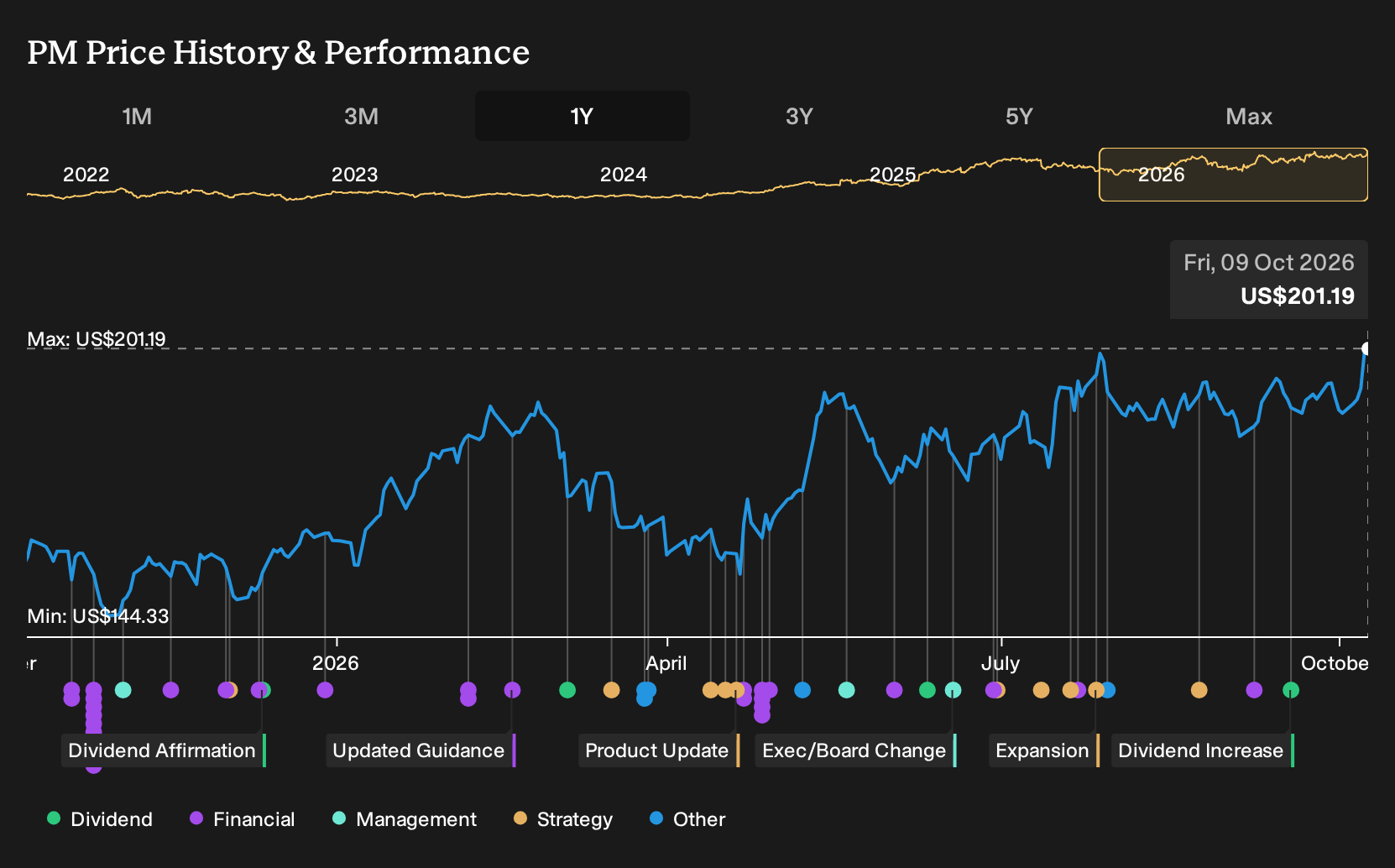
Uncover why Philip Morris International's fair value indicates a 3% potential upside to its current price that could narrow quickly.
Exploring Other Perspectives
One alternate angle around Philip Morris International focuses on regulation rather than execution. The most cautious analysts worry that tighter rules on heated tobacco and nicotine pouches could squeeze those roughly US$49.4b revenue and US$15.2b earnings forecasts for 2029. Their view ahead of the summit is already more conservative, and this week’s news could eventually push opinions further apart.
Explore 5 other Philip Morris International fair value estimates, including one that suggests as much as 86% downside from the current price.
Form Your Own Verdict
Don't just follow the ticker; dig into the data and build a conviction that's truly your own.
- A great starting point for your Philip Morris International research is our analysis highlighting 3 key rewards and 1 important warning sign that could impact your investment decision.
- See our latest analysis for Philip Morris International. The report includes a comprehensive fundamental analysis summarized in a single visual, the Snowflake, making it easy to evaluate Philip Morris International's overall financial health at a glance.
Looking for more investment ideas beyond Philip Morris International?
Once you have a view on Philip Morris International, it can help to cross check that thesis against other opportunities that share similar qualities or offer a very different risk profile.
- For investors who want income with fewer surprises, scan a curated set of resilient payers through the 8 dividend fortresses that might fit a long term dividend watchlist.
- If capital preservation ranks high on your checklist, filter for companies with stronger balance sheets using the list of solid balance sheet and fundamentals (25 results) and see which ones match your risk comfort.
- To spot future Philip Morris International style pivots earlier in the story, review the 20 high quality undiscovered gems and look for businesses quietly building strong fundamentals before they hit the mainstream.
This article by Simply Wall St is general in nature. We provide commentary based on historical data and analyst forecasts only using an unbiased methodology and our articles are not intended to be financial advice. It does not constitute a recommendation to buy or sell any stock, and does not take account of your objectives, or your financial situation. We aim to bring you long-term focused analysis driven by fundamental data. Note that our analysis may not factor in the latest price-sensitive company announcements or qualitative material. Simply Wall St has no position in any stocks mentioned.
Have feedback on this article? Concerned about the content? Get in touch with us directly. Alternatively, email editorial-team@simplywallst.com