
- PRICING
- LIVE QUOTES
- LEARN
- HELP


EN
Did CMO Hire Just Shift Salesforce's (CRM) Investment Narrative?
- Salesforce has appointed Virginia Sharma as chief marketing officer of Missionforce, giving her responsibility for global public sector marketing after more than 25 years across IBM, LinkedIn, JioSaavn and Google.
- Her long track record building integrated campaigns and public sector focused programs at Google and LinkedIn indicates a focus on data driven, AI infused marketing for government and education clients at Salesforce.
- Attention now shifts to how Salesforce's investment narrative could evolve as Virginia Sharma takes charge of Missionforce's global public sector marketing.
Salesforce Investment Narrative Recap
To own Salesforce, you need to believe its push into AI agents, data platforms and bundled editions can keep CRM, Data 360 and Slack deeply embedded inside customers, even as industry revenue growth expectations sit at 9.1% a year and earnings forecasts slow to 3.3% annually. The key near term swing factor is how effectively AIforce and Agentforce usage converts into subscription and usage based revenue without eroding long standing retention.
Virginia Sharma’s appointment looks important for the public sector story but does not change the main short term catalyst, which still sits in broad based AI monetisation. The largest immediate risk remains around security incidents and outages tied to Agentforce and Slackforce, alongside customer sensitivity to AIforce pricing. Any of these factors could restrict upgrades into bundles such as Agentforce 1 Edition.
The most relevant recent development for this hire is Salesforce’s decision to lean heavily into AI agent interfaces like AIforce, Claudeforce and Agentforce Coworker across its portfolio. Sharma’s remit over global public sector marketing essentially plugs that agentic vision into government and education buyers, where procurement cycles are long and references carry weight.
For investors watching catalysts, the test is whether that focus helps Missionforce and adjacent clouds translate AI products into larger, stickier contracts with public agencies while managing the well flagged risks. Security robustness around Agentforce, reliability after the Dreamforce access issues and clear value for AIforce pricing tiers will likely matter more to that outcome than the appointment on its own.
Salesforce's current analyst narrative points to revenues of US$58.7b and earnings of US$10.7b by 2029, built on assumed yearly top line expansion of 10.1%. That path starts from earnings today of about US$9.7b, which means the consensus implies an earnings increase of roughly US$1b over the period.
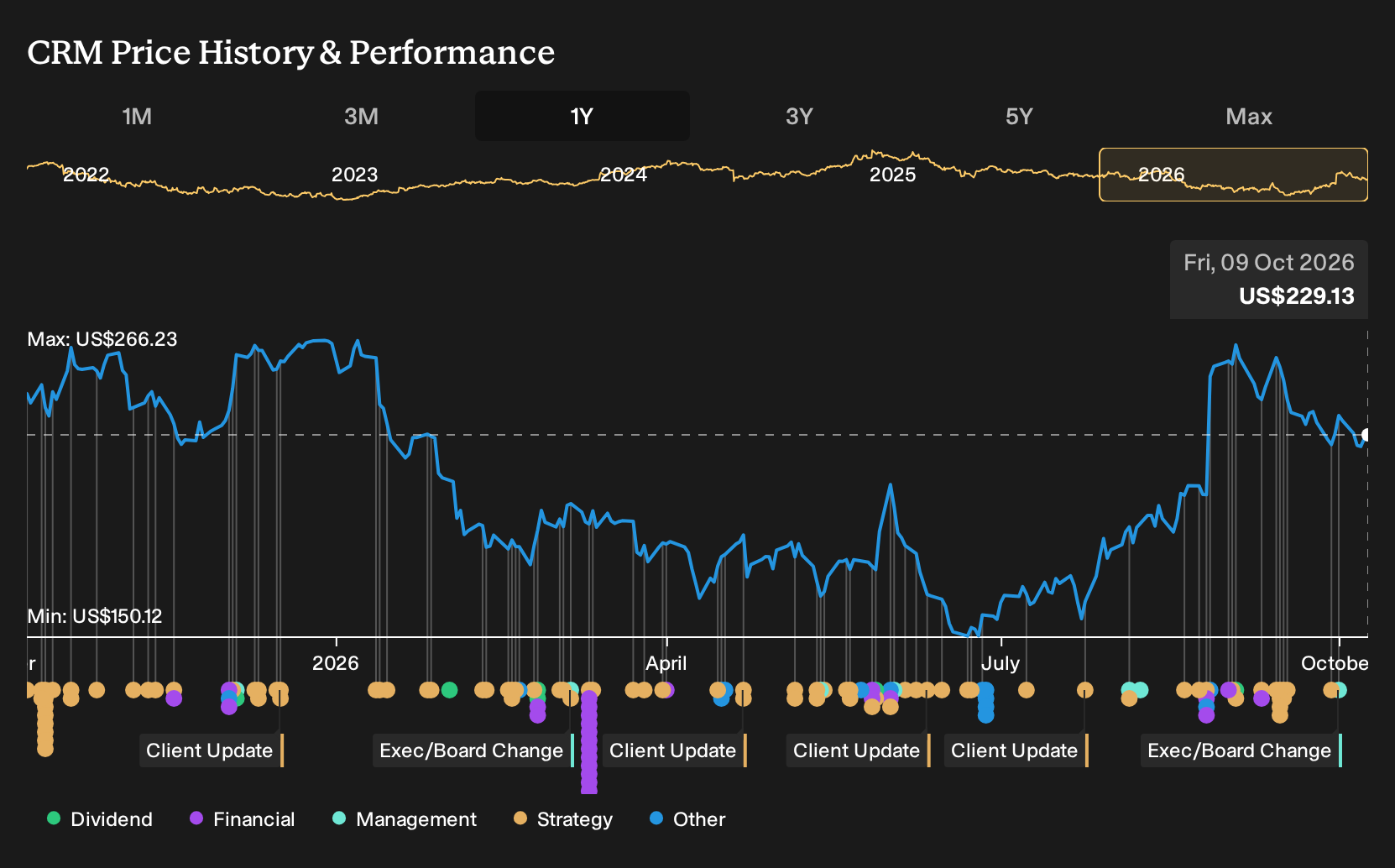
Uncover why Salesforce's fair value indicates a 23% potential upside to its current price that could close more quickly than investors expect.
Exploring Other Perspectives
One alternate take on Salesforce leans hard into security risk. That bearish group thinks repeated AI agent issues could keep margins under pressure, which is why they only pencil in about US$56.9b of revenue and US$8.8b of earnings by 2029. Those estimates were set before Virginia Sharma arrived, so opinions may evolve as her public sector playbook unfolds.
Explore 19 other Salesforce fair value estimates, including one that suggests it could be worth just $255.90.
The Verdict Is Yours
Don't just follow the ticker; dig into the data and build a conviction that's truly your own.
- A great starting point for your Salesforce research is our analysis highlighting 3 key rewards and 3 important warning signs that could impact your investment decision.
- See our latest analysis for Salesforce. The report includes a comprehensive fundamental analysis summarized in a single visual, the Snowflake, making it easy to evaluate Salesforce's overall financial health at a glance.
Looking For More Ideas Beyond Salesforce?
If the Salesforce story has you thinking about where else AI, cash generation and balance sheet strength might align, the Simply Wall St Screener can help you quickly surface other candidates that fit your style and risk tolerance.
- For investors who want income strength up front, scan through a curated group of 8 dividend fortresses that prioritize higher yields alongside resilience.
- If capital protection matters most to you, focus on a 31 resilient stocks with low risk scores set that aims to keep volatility and business risk in check.
- When you are hunting for overlooked opportunities with solid fundamentals, start with a 20 high quality undiscovered gems that might not be on every watchlist yet.
This article by Simply Wall St is general in nature. We provide commentary based on historical data and analyst forecasts only using an unbiased methodology and our articles are not intended to be financial advice. It does not constitute a recommendation to buy or sell any stock, and does not take account of your objectives, or your financial situation. We aim to bring you long-term focused analysis driven by fundamental data. Note that our analysis may not factor in the latest price-sensitive company announcements or qualitative material. Simply Wall St has no position in any stocks mentioned.
Have feedback on this article? Concerned about the content? Get in touch with us directly. Alternatively, email editorial-team@simplywallst.com