
- PRICING
- LIVE QUOTES
- LEARN
- HELP


EN
Thomson Reuters (TSX:TRI) Could Be 17% Undervalued On AI And Subscription Focus
AI focus and subscription trends move Thomson Reuters into view
Thomson Reuters (TSX:TRI) is drawing fresh attention as investors weigh the progress of its AI enabled workflow tools alongside how well recurring subscriptions are holding up across legal, tax, and corporate clients.
The recent jump in Thomson Reuters' share price, including a 1-day share price return of 1.97% and a 30-day share price return of 9.17% to CA$147.3, has arrived after a year-to-date share price return that is down 16.49%. Over the same period, the 1-year total shareholder return has fallen 28.72%. This combination hints that enthusiasm around AI tools is meeting a still-cautious view on longer term execution and risk.
Scan beyond Thomson Reuters to compare its AI focused peers with our hand picked 39 profitable AI stocks that aren't just burning cash, which combine real earnings power with ongoing investment in intelligent workflow tools.
After a sharp rebound yet a weaker 1-year return, Thomson Reuters now sits in an awkward middle ground. Does it make more sense to commit at this price, or to wait for a clearer valuation reset next?
Most Popular Narrative: 17.4% Undervalued
On the most followed view, Thomson Reuters carries an estimated fair value of CA$178.25 against a last close of CA$147.3, which puts the spotlight squarely on how its AI tools and subscription footing could justify that gap.
The company's proprietary, authoritative content and integrated product suite positions it as a trusted platform, benefiting from the global proliferation of data and increasingly complex regulatory environments. This "category leader" status, combined with tight workflow integration, supports higher client retention and market share gains, boosting long-term recurring revenues.
See why 27 investors see Thomson Reuters as 17% undervalued.
Result: Fair Value of CA$178.25 (UNDERVALUED)
Still, the bullish Thomson Reuters narrative depends on AI tools gaining real traction, while fast moving rivals and integration missteps do not chip away at pricing power.
Find out about the key risks to this Thomson Reuters narrative.
Another View: Multiples Paint A Pricier Picture For Thomson Reuters
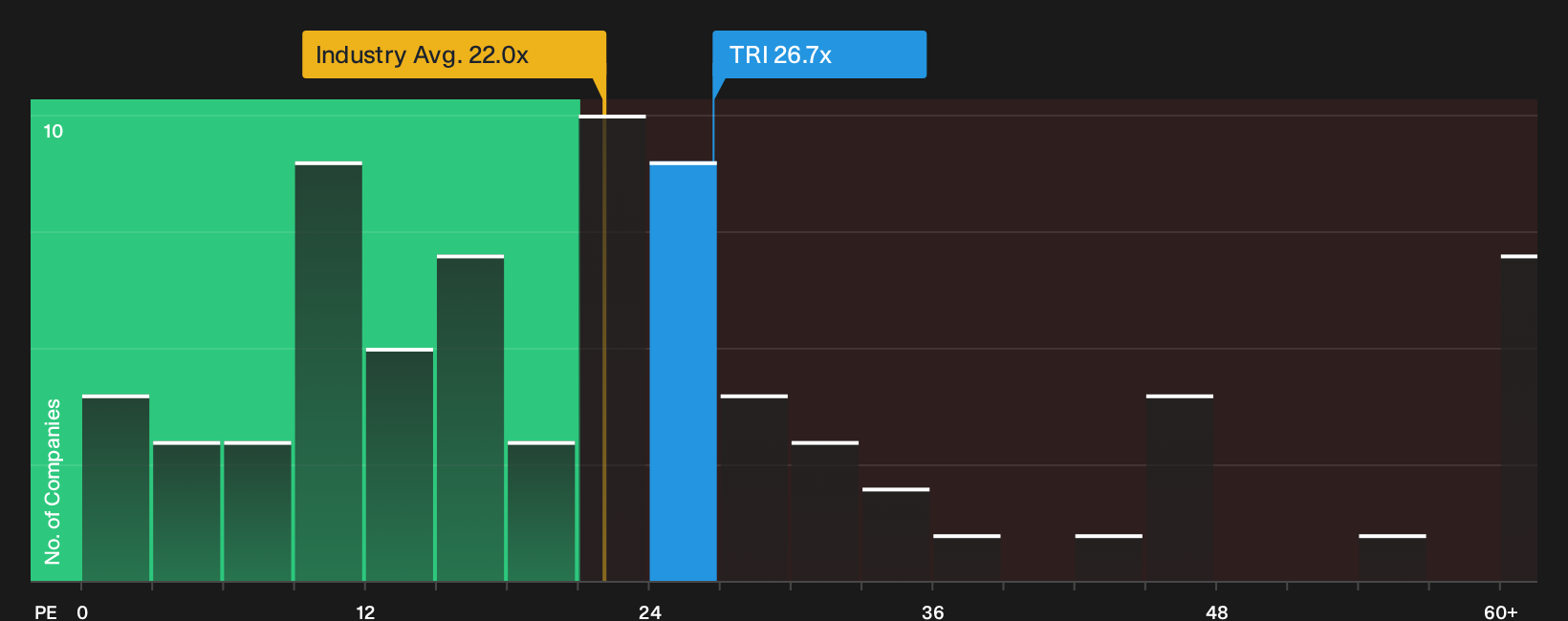
The story changes once you stop at plain P/E. Thomson Reuters trades on roughly 26.7x earnings, which is higher than both peer averages at 22x and its own fair ratio of 28.9x. That mix points to limited margin for error rather than a clear bargain, so which signal do you trust more?
For a closer look at how this earnings multiple stacks up against peers and the fair ratio the market could move toward, See what the numbers say about this price — find out in our valuation breakdown.
Next Steps
There have been mixed messages on Thomson Reuters so far. If that feels familiar, consider moving quickly, reviewing the detailed data, then weighing the 3 key rewards and 1 important warning sign.
Looking for more investment ideas beyond Thomson Reuters?
If Thomson Reuters has caught your attention, now is the time to widen your watchlist and pressure test your thinking against other high quality opportunities on Simply Wall Street.
- Target stronger value by scanning a curated 8 high quality undervalued stocks that combine solid fundamentals with prices that may not fully reflect their underlying strength.
- Strengthen your income stream by focusing on 3 dividend fortresses that offer higher yields while still putting balance sheet strength under the microscope.
- Dial down portfolio stress by concentrating on 7 resilient stocks with low risk scores that score well on resilience and financial robustness.
This article by Simply Wall St is general in nature. We provide commentary based on historical data and analyst forecasts only using an unbiased methodology and our articles are not intended to be financial advice. It does not constitute a recommendation to buy or sell any stock, and does not take account of your objectives, or your financial situation. We aim to bring you long-term focused analysis driven by fundamental data. Note that our analysis may not factor in the latest price-sensitive company announcements or qualitative material. Simply Wall St has no position in any stocks mentioned.
Have feedback on this article? Concerned about the content? Get in touch with us directly. Alternatively, email editorial-team@simplywallst.com