
- PRICING
- LIVE QUOTES
- LEARN
- HELP


EN
The S&P 500 Is Near Record Highs. So Why Does Your Portfolio Feel Like a Bear Market?
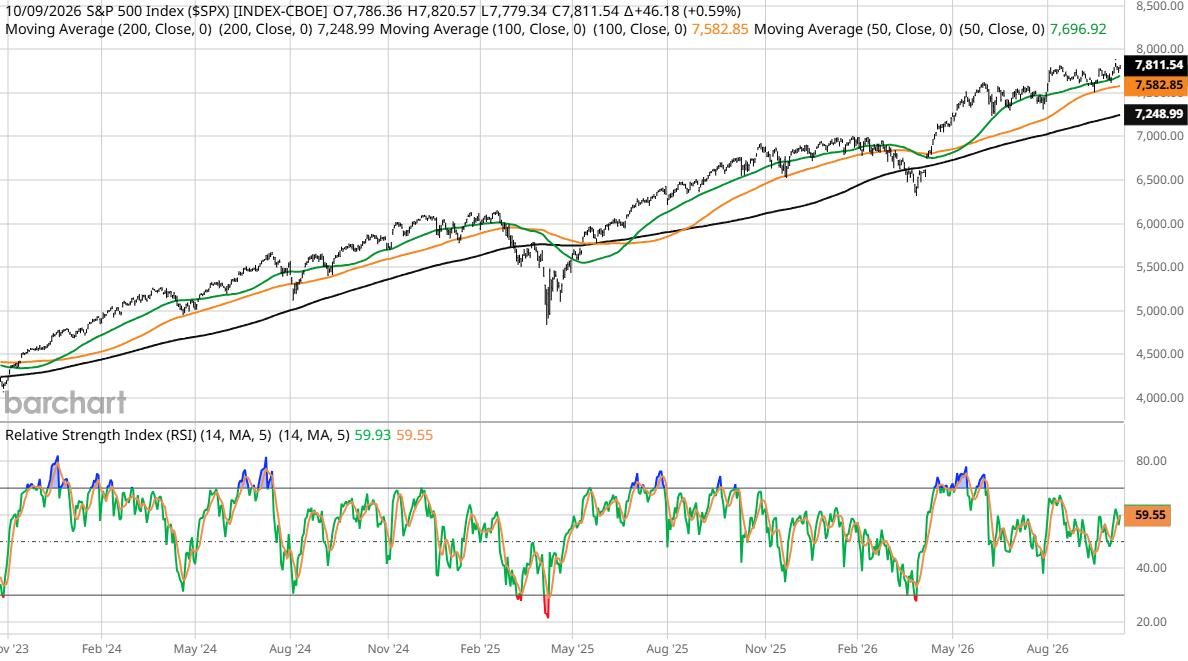
Just looking at the S&P 500 last week, you’d definitely question what investors have to complain about. The index hit another new high and has gone up more than 14 percent this year. Look at a lot of individual brokerage accounts and you can get a very different impression. Small caps have slid, banks have lost ground, homebuilders are struggling, and many perfectly respectable companies are well below their highs. Both things can be true.
That’s the market I think investors need to understand right now because the headline index is answering a different question than what many others are asking. The S&P 500 is a measure of how a basket of the top firms in America are doing. It doesn't tell you how the average stock is doing, and it certainly doesn't tell you how the typical investor's batch of stocks is doing.
It’s a difference that’s impossible to miss. The equal-weight S&P 500, where every company gets equal voice, is down about 4.6% from its highs even as the standard market cap-weighted index reaches new milestones. The Russell 2000 is roughly 9% off of its high. Less than half of S&P 500 companies are trading above their 200-day moving averages currently. The biggest IT businesses still dominate the main index. This is not a matter of statistical curiosity. It explains why so many investors feel far poorer than the evening news says they should.
The Index Is Not Lying. It Is Concentrated.
There is a tendency whenever such an event happens to say the market is somehow fake. I would not go that far. Nvidia, Microsoft, Alphabet, and the other companies benefiting from the AI spending boom are real businesses that produce real profits. If their earnings keep growing and investors are willing to pay the valuations, their stocks deserve to rise. The issue is what happens underneath them.
Market-cap weighting means the winners become increasingly influential as they get larger. That is one of the reasons indexing has worked so well over long periods. The system naturally adds weight to successful businesses and reduces the influence of companies that shrink. But there are periods when that mechanism can disguise what is happening elsewhere. We are in one of them.
Technology and AI stocks now comprise a remarkable share of the U.S. market, and the concentration has attained levels that warrant concern. So the S&P can go higher even if a greater share of its constituents struggle.
If you have nothing but an S&P 500 ETF, you may not care all that much. You likely do if you hold individual stocks, small caps, banks, healthcare businesses, retailers, REITs, or homebuilders.
This is something investors tend to forget during strong markets. We talk about "the market" as though it is one trade. It never is. There are thousands of businesses under that index, with different balance sheets, different customers, and very different exposure to the cost of money. Right now, the cost of money is where I would look.
A 5% Treasury Yield Changes the Math
The 10-year Treasury finished last week around 5.24% after touching its highest level in roughly 24 years. That matters far more to the average stock than another discussion about whether AI spending remains strong.
A company such as Nvidia can absorb high rates much more easily than a smaller company that needs to refinance debt. A cash-rich technology company isn't concerned about borrowing costs in the same way as a homebuilder whose customers suddenly face a more expensive mortgage. A business growing earnings 30% can overcome a higher discount rate far more easily than a mature company growing at 3%. That is why I think the weakness underneath the index makes sense.
Higher yields do two things at once. They increase the financing cost for companies and consumers, and they provide investors a credible alternative to equities. When government bonds offer more than 5%, the hurdle rate changes. A stock offering a 3% dividend and modest growth must now compete with something it did not have to compete with a few years ago.
You can see the pressure in housing. Homebuilder stocks have weakened as mortgage rates have moved higher with Treasury yields. You can see it in small caps, where financing matters more. You can see it in banks, where the KBW Bank Index has fallen about 13% since August despite expectations for decent earnings growth. This scenario is where the headline index can become misleading psychologically.
Investors see the S&P at a record and assume everything expensive has gotten even pricier. Then they look at their positions and see stocks down 15%, 20%, or 30% and start wondering what they have missed. They may not have missed anything. They may simply own the part of the market where the cost of capital is actually being felt.
This Week Could Tell Us Whether That Changes
That is why this coming week matters. On Tuesday, JPMorgan, Goldman Sachs, Citigroup, and Wells Fargo report earnings. Bank of America and Morgan Stanley follow on Wednesday. I am less interested in whether they beat earnings estimates by a few cents than in what they say about deposits, credit, loan demand, delinquencies, and the consumer. Banks sit close to the plumbing of the economy. When the cost of money changes, they usually see the consequences before many other businesses do. Then on Wednesday morning we get September CPI.
That may be the most important data for the broader market this week, as investors have been repricing the prospect that interest rates will stay higher for longer than they did the previous month. The Bureau of Labor Statistics will issue CPI at 8:30 AM. Eastern on October 14, followed by producer prices on Thursday. I would not try to predict the CPI number. I would like to watch how the market reacts to it.
If inflation is lower and the 10-year Treasury yield starts to move meaningfully away from 5%, I would be looking at the parts of the market that have been hit the hardest by the rate hike soon after. Small caps, homebuilders, banks, and other rate-sensitive equities don’t need rates to go back to 2021 levels. They need investors to believe that the market has changed.
Conversely, if inflation remains stubborn, yields hold above 5%, and the equal-weight market continues making no progress while the S&P pushes higher on the back of the same handful of giant technology companies, I would become more cautious rather than more bullish.
A narrow market can stay narrow for longer than people expect. I have seen that enough times over 35 years to keep betting on strong stocks, even if they look strong. But concentration eventually matters because the number of companies capable of carrying the index becomes smaller, and the consequences of one of them disappointing become larger.
There is also a behavioral trap here for individual investors. The stocks that have worked feel safe because they keep going up, while everything that has fallen feels dangerous. That is often exactly the point at which people sell what has already been repriced and move into what has already worked.
The S&P 500 may be at a record high, but that doesn’t imply you should chase the stocks that got it there. Neither does a 20% decrease necessarily make a laggard cheap. The question is, is something changing that can close the gap between price and value?
For the weaker parts of this market, the catalyst I am watching is the cost of capital. If yields roll over, breadth improves and the stocks that have been left behind begin responding, this market could broaden rapidly. If yields stay high and those same stocks keep falling while a few megacaps carry the averages, then the message underneath the index is probably more important than the record high itself.
That is what I will be watching this week. The S&P 500 is not lying. It may simply be telling you how the biggest stocks are doing rather than how your stocks are doing.
On the date of publication, Jim Osman did not have (either directly or indirectly) positions in any of the securities mentioned in this article. All information and data in this article is solely for informational purposes. For more information please view the Barchart Disclosure Policy here.