
- PRICING
- LIVE QUOTES
- LEARN
- HELP


EN
Applied Digital Ends the Quarter With $36 Billion in Contracted Revenue as AI Moat Widens
Ellendale, North Dakota, offers a quick lesson in what a data center can do for a small town. Before Applied Digital (APLD) began working with the community, local tax revenue ran about $400,000 a year. Today it is close to $4 million, CEO Wes Cummins said on the company's Oct. 7 earnings call.
The tax revenue increase can help pay for schools, infrastructure, and emergency services. Cummins added that construction workers on the sites earn six figures on average, and most of that money stays in the local economy.
Notably, Applied Digital ended fiscal Q1 of 2027 with $36 billion in contracted revenue across five campuses, three states, and two different regions of the country. Let’s see whether the AI infrastructure company can translate an enviable backlog into revenue over the next 36 months.
Polaris Forge 1 Became the AI Campus Blueprint
In May 2025, Applied Digital signed its first lease with CoreWeave (CRWV), which covered the first two buildings at Polaris Forge 1 in Ellendale.
By the end of 2025, the first building was fully operational. It can support more than 40,000 liquid-cooled Nvidia (NVDA) GB300s. The second building was announced in summer 2025 and came online a year later.
Both are now fully operational. Together, they hold 10 data halls and 250 megawatts of critical IT load, the power set aside to run the computers. Cummins called it a 150% jump in delivered capacity, with a third building on schedule.
With the Harwood campus expected to start soon, he said North Dakota should reach 300 megawatts by the end of this calendar year.
Applied Digital Earnings: Revenue Soars as Losses linger
In fiscal Q1 2027 (ended in August), Applied Digital reported revenue of $341.9 million, up 322% year-over-year (YoY) from $80.9 million, CFO Saidal Mohmand said. Most of the company’s revenue growth originated from HPC hosting, which brought in $262.6 million.
However, only a small portion of this revenue comes from rent tenants pay to use the space.
- Base rent totaled $65.8 million, helping the firm generate recurring revenue.
- Tenant fit-out services grew to $183.5 million. Notably, the company spent $176.1 million to deliver these services.
- Tenant recoveries added $13.3 million. Customers paid this back to cover costs Applied Digital had already spent on their behalf, so it nets out to roughly zero.
- The Bitcoin (BTCUSD) hosting segment earned $37.8 million in sales and $13.3 million in operating profit.
- Operating profit more than doubled to $13.3 million from $6 million last year, driven by favorable power pricing.
- ChronoScale, the GPU compute business in which Applied Digital owns about 96%, added $41.5 million. About $23 million came from GPU hardware sales.
Applied Digital reported a net loss of $221 million or $0.76 per share in Q1. However, it booked $67.5 million in non-cash charges tied to Babcock & Wilcox (BW) warrants and stock. It also reported $41.3 million in stock-based compensation from one-time performance stock units.
APLD reported an adjusted net loss of $4.1 million or $0.01 per share and adjusted EBITDA (earnings before interest, tax, depreciation, and amortization) stood at $64.4 million. Net operating income from HPC hosting was $58.8 million, an 89% margin.
How Applied Digital Funds Its AI Factories
In June, the company closed $1.59 billion of 7% senior secured notes due 2031. The money paid off a $300 million bridge loan and funded the third Polaris Forge 1 building.
The company ended the quarter with about $2.9 billion in cash, plus $0.7 billion in restricted cash. Debt stood near $6.4 billion, and more than 80% of that principal is not due until fiscal 2031 or later.
Next up are Polaris Forge 3, Delta Forge 1 and Delta Forge 2. All three are leased to the same Tier 1 investment-grade hyperscaler on 150-year take-or-pay leases. The plan is preferred equity from Macquarie Asset Management, followed by project debt.
Why the AI Data Center Moat is Getting Wider
Cummins closed the call with a bold argument. Local moratoriums, tighter zoning, and longer permitting times are slowing data center projects in some markets, which could act as a tailwind. Cummins explained, “every new restriction elsewhere makes what we already own harder to replicate.”
Applied Digital expects about 250 megawatts of expansion leases by calendar year-end. Cummins said rates could rise by more than 15%, possibly with longer terms.
The company signed a long-term power deal with Base Electron, in which it holds about 10%. It covers a 1,200-megawatt natural gas plant in Center, North Dakota, with deliveries expected to begin in 2030.
The goal is 3.5 to 4 gigawatts by the end of 2030. Cummins said it could deliver about 1 gigawatt a year in 2029 and 2030, after reaching roughly two gigawatts by the end of 2028. Over the next 12 months, he expects to place more than 600 megawatts into service, up from 250 over the past 12.
Cummins also said demand remains extremely strong, and nearly all of 2027 capacity looks contracted. So the test now is simple. Can Applied Digital build as fast as it has promised?
Is APLD Stock Still Undervalued?
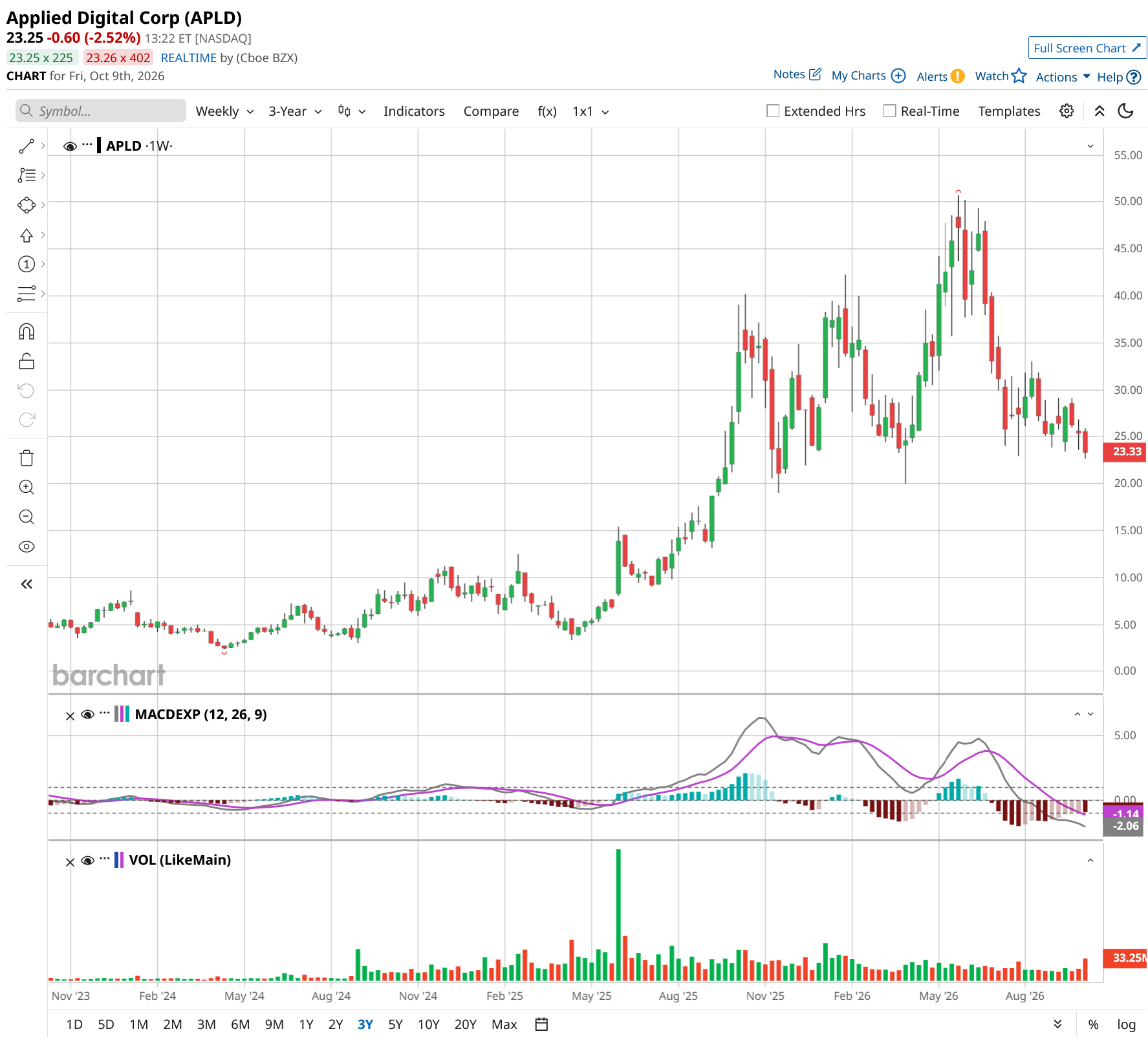
Down 54% from its 52-week high, Applied Digital trades at a market cap of $7 billion. Analysts forecast revenue to increase from $611 million in fiscal 2026 to $5.55 billion in fiscal 2031.
Despite its stellar top-line expansion, it is forecast to report a cumulative free cash outflow of $20 billion through 2031. The company will have to raise capital multiple times to sustain its capital expenditures, making it a high-risk investment, especially if AI demand decelerates.
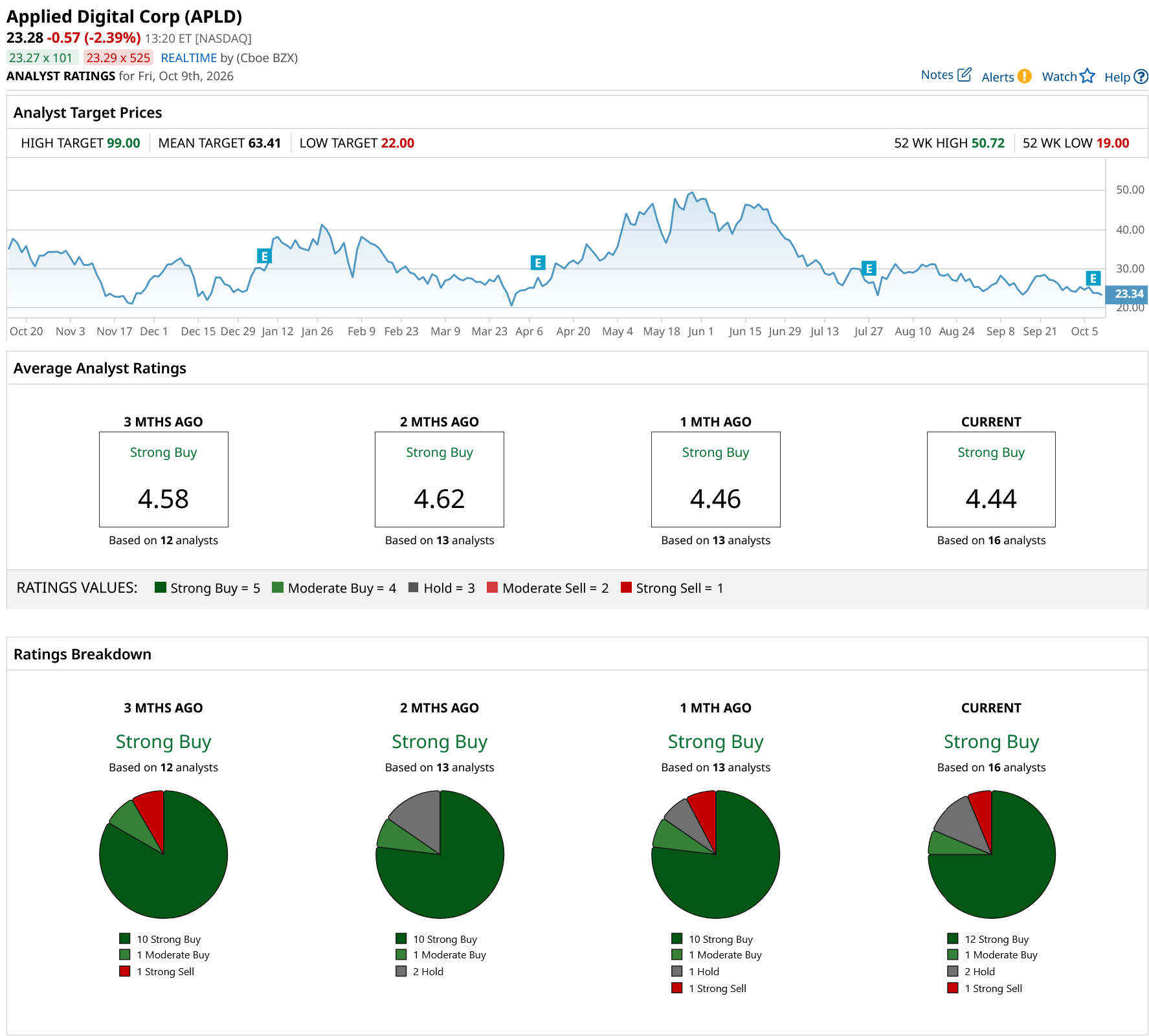
Out of the 16 analysts covering APLD stock, 12 recommend “Strong Buy,” one recommends “Moderate Buy,” two recommend “Hold,” and one recommends “Strong Sell.” The average APLD stock price target is $63.41, above the current price of $23.28.
On the date of publication, Aditya Raghunath did not have (either directly or indirectly) positions in any of the securities mentioned in this article. All information and data in this article is solely for informational purposes. For more information please view the Barchart Disclosure Policy here.