
- PRICING
- LIVE QUOTES
- LEARN
- HELP


EN
Why Michael Burry Just Bought BYD Stock
Michael Burry is once again making waves with a contrarian bet, this time turning his attention to Chinese electric vehicle (EV) giant BYD Company (BYDDY). The investor best known for predicting the 2008 housing-market collapse recently disclosed a sizable position in BYD after a pullback in Chinese equities, adding a notable bullish signal to a stock facing both strong growth opportunities and significant geopolitical risks.
Burry’s move is particularly intriguing because it comes as he remains broadly skeptical of the AI-driven market rally and continues to favor value-oriented opportunities, suggesting the Chinese EV maker could be undervalued after a steep share-price decline. Meanwhile, BYD has emerged as one of China’s leading EV makers, with ambitions to expand its global footprint and challenge the world’s largest automakers. However, slowing domestic sales, trade barriers, and geopolitical tensions remain important risks to the company’s expansion.
About BYD Stock
BYD, headquartered in Shenzhen, China, is a leading company in new energy technology, specializing in EVs, batteries, and renewable energy solutions. Originally a manufacturer of rechargeable batteries, BYD has grown through deep vertical integration, cutting-edge battery innovation, and expanding global operations and now boasts a market cap of $85.9 billion. With a global presence and strong support from governments and institutions, BYD is at the forefront of the global transition to sustainable transportation and clean energy solutions.
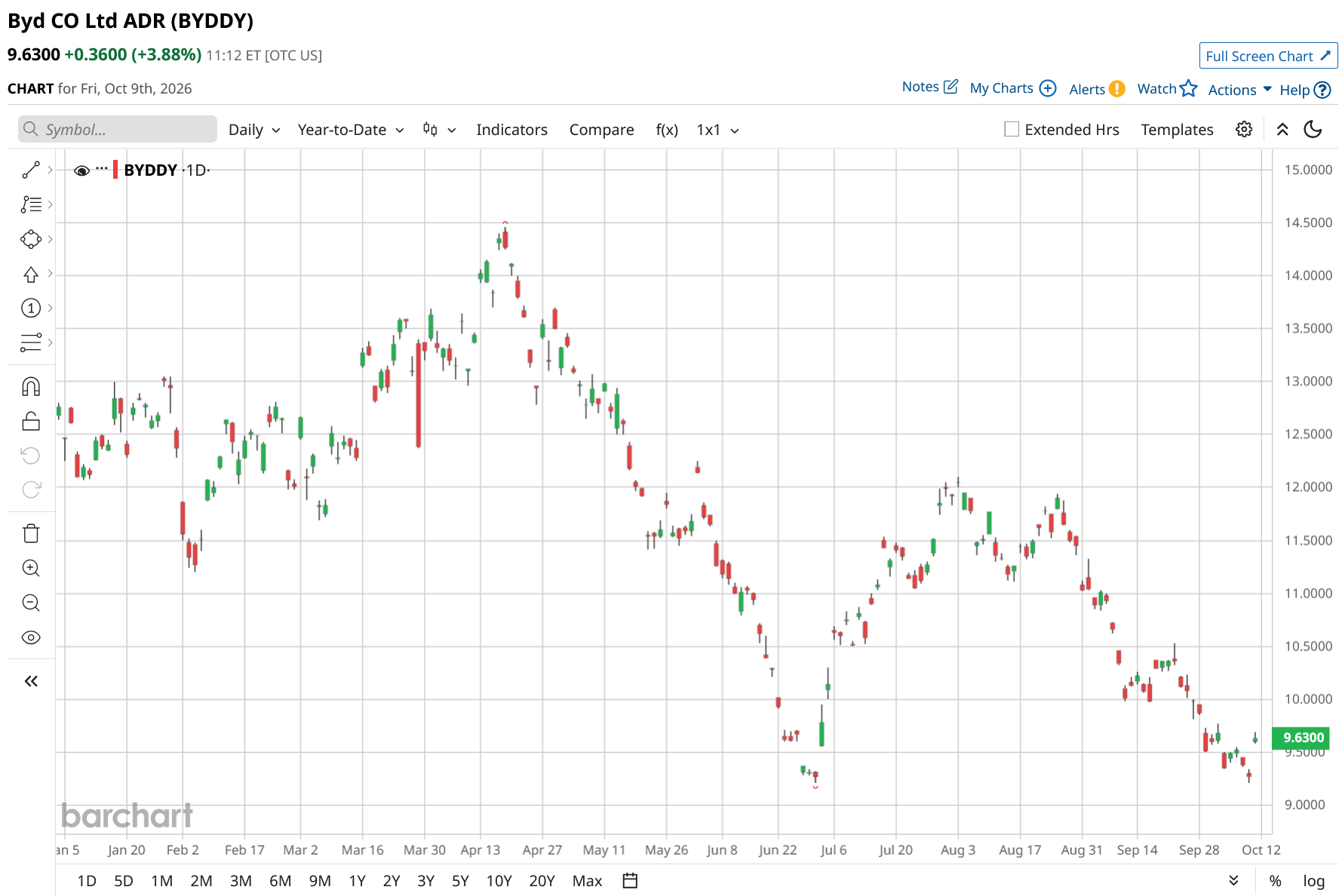
BYDDY has been under considerable pressure, making Michael Burry’s decision to initiate the position particularly notable. The stock has declined 34.4% over the past year and 24.1% so far in 2026, while shares have fallen another 13.7% over the past month. The sustained weakness reflects investor concerns about slowing demand in BYD’s home market, intensifying competition among Chinese EV makers and the potential impact of trade barriers as the company expands overseas.
The latest trading action has also been subdued. BYDDY slipped 1.17% on Oct. 8 and 1.47% on Oct. 7, following a marginal 0.3% gain on Oct. 6.
The recent selloff comes despite BYD posting September global sales of 463,561 vehicles, up 17% year-over-year (YoY). The problem is the composition of that growth: overseas shipments surged 153.9%, while domestic demand remained weak. BYD’s September disclosure showed nine-month vehicle sales down 3.9% YoY, highlighting the challenge of maintaining growth in China.
Moreover, trade and geopolitical risks could make international expansion more difficult, while fierce competition and a saturated Chinese EV market could continue pressuring volumes and profitability.
The stock is trading at a discount compared to industry peers at 0.75 times sales.
Financial Performance Remained Under Pressure
BYD’s financial results for the six months ended June 30 (released on Aug. 28) showcased strong overseas expansion offset by weakness in China. Revenue fell 7.1% YoY to RMB 344.8 billion ($51.4 billion), while net profit attributable to shareholders declined 20.5% to RMB 12.3 billion ($1.8 billion). Furthermore, its EPS fell 21.1% from the first half of 2025 to RMB 1.35.
The decline was primarily driven by the company’s core automotive business. Revenue from automobiles and related products fell 9% YoY to RMB275.3 billion ($41.1 billion). By contrast, revenue from electronics and other products increased almost 1% to RMB 69.4 billion ($10.4 billion).
On the other hand, gross profit declined 2.8% to approximately RMB 65 billion ($9.7 billion), but the gross margin improved to 18.85% from 18.01% a year earlier. The improvement was helped by the rapid expansion of overseas operations, which generally generated higher margins than BYD’s domestic business.
What Do Analysts Expect for BYD Stock?
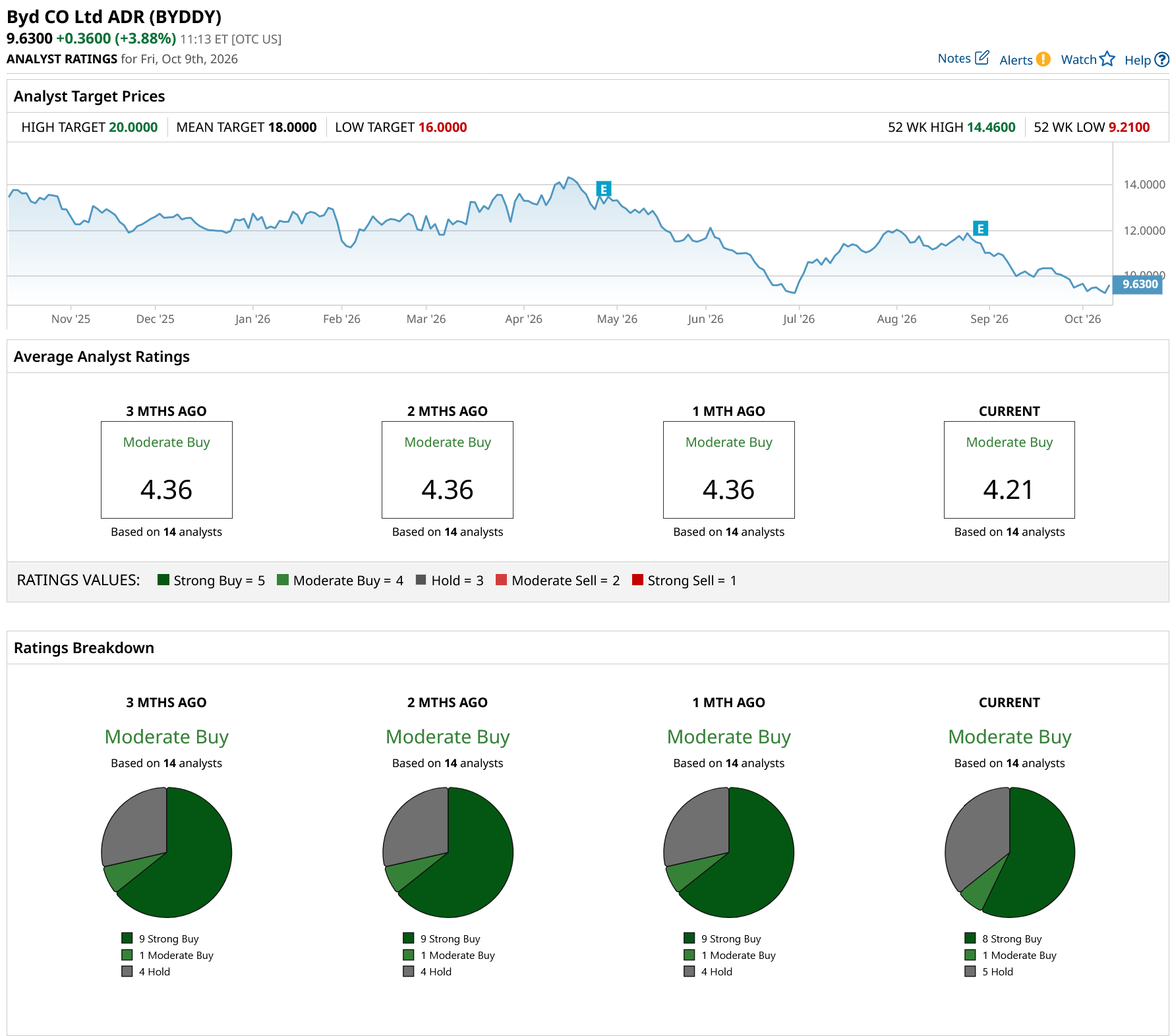
BYDDY has garnered significant attention from Wall Street despite its muted financial performance and stock price weakness, with a consensus rating of “Moderate Buy” from the 14 analysts currently covering the stock. Nine of the 14 give a “Buy” and the remaining five a “Hold.” This, combined with the total lack of any "Sell" ratings, signals continued bullishness about its prospects.
BYDDY’s average price target of $18 indicates a potential upside of 87% from the current price.
On the date of publication, Subhasree Kar did not have (either directly or indirectly) positions in any of the securities mentioned in this article. All information and data in this article is solely for informational purposes. For more information please view the Barchart Disclosure Policy here.