
- PRICING
- LIVE QUOTES
- LEARN
- HELP


EN
How Strong Quarterly Results At Shopify (SHOP) Have Changed Its Investment Story
- Shopify reported strong quarterly fundamentals, with revenue of US$3.6b, net income per share of US$1.16, and platform GMV of about US$116b, while tightening controls on autonomous AI agents in checkout and expanding same day delivery options in Canada.
- The mix of higher transaction volumes, tighter AI traffic governance, and broader fulfillment access signals Shopify pushing deeper into being full stack commerce infrastructure rather than just store software.
- We will now explore how Shopify's robust quarterly results, particularly its 32% GMV expansion, could reshape the broader investment narrative.
Scan beyond Shopify and compare this quarter's momentum against a curated list of other commerce and AI infrastructure players in our 39 profitable AI stocks that aren't just burning cash.
Shopify Investment Narrative Recap
To be comfortable owning Shopify, you need to believe it can keep turning its merchant base, payments rails, and logistics tools into a single commerce operating system. The current quarter points to that idea still being intact, with 32% GMV growth and US$3.6b in revenue supporting that story. In the near term, the key swing factor is whether this level of merchant and transaction activity persists without pushing costs or incentives higher.
The biggest watchpoint is execution risk as the platform absorbs more AI driven traffic, complex payments flows, and international volume. Tighter controls on autonomous agents and constraints on AI crawlers look material to near term risk management but not to the core demand catalyst. Competitive pressure from larger e commerce platforms, plus softer profit margins at 14.5% versus 23.4% last year, still sit at the center of the bear case.
The most relevant recent development is Shopify blocking autonomous AI agents from completing checkout flows and restricting AI crawlers on cart paths. That decision goes straight to operational reliability. It is about protecting payment integrity, load on infrastructure, and potential chargeback or fraud exposure for merchants who rely on Shopify for day to day sales.
For investors watching catalysts, that AI agent policy interacts directly with the push into agent powered shopping through partners like Muse. The stock narrative now hinges on whether Shopify can let merchants tap new AI driven demand while keeping liability, data access, and system strain in check. If the balance tilts too far toward friction for agents, some of the upside from AI enabled commerce could simply arrive more slowly.
What The Current Forecasts Assume For Shopify
Shopify's narrative projects US$26.3b revenue and US$3.9b earnings by 2029. This profile is built on analyst assumptions of 25.6% yearly revenue growth and an earnings increase of about US$2.0b from US$1.9b today.
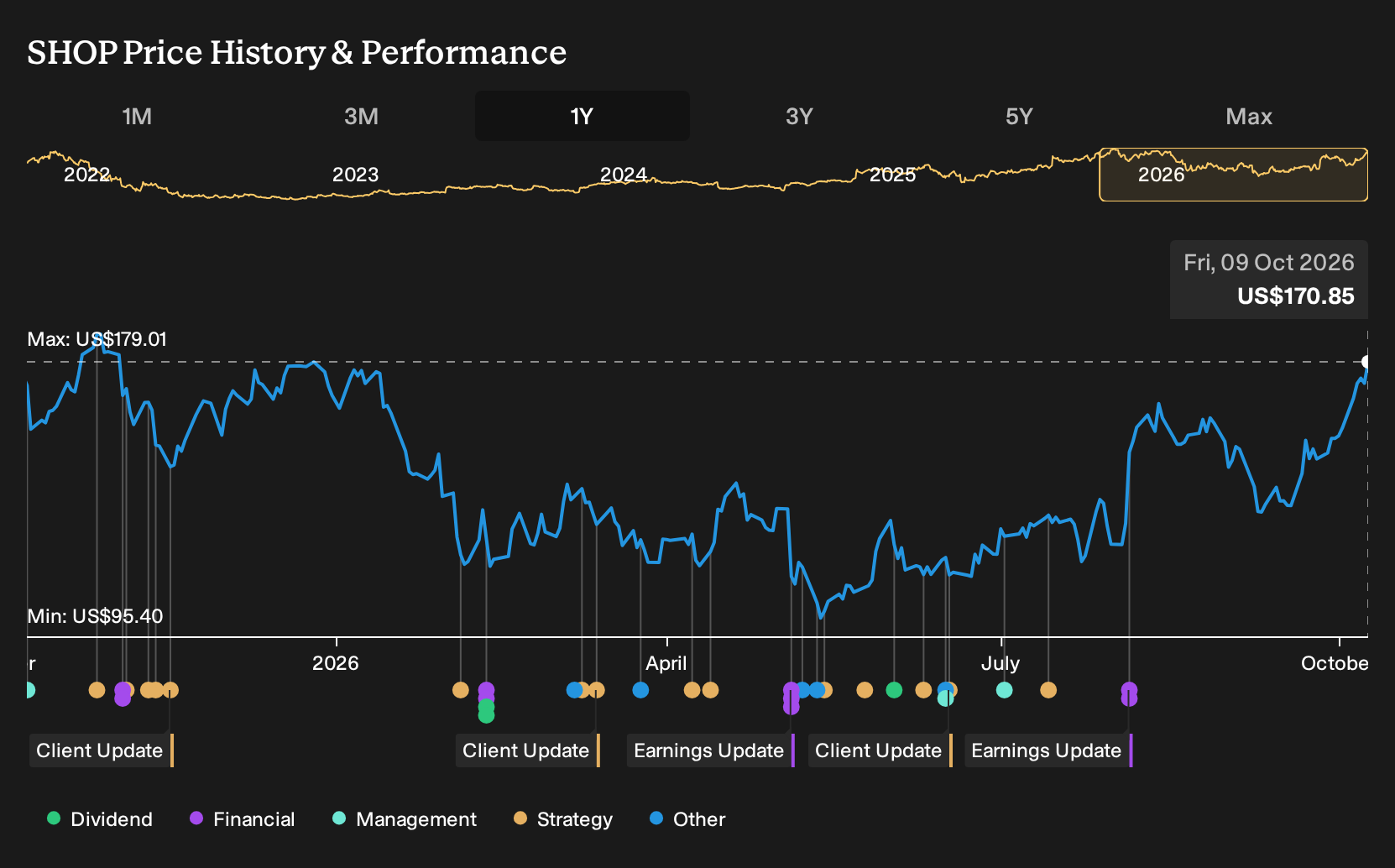
Discover why Shopify's fair value appears to be roughly aligned with its current price.
Exploring Other Perspectives
You can read Shopify's new AI checkout limits in very different ways. The most cautious analysts focus on rising complexity and higher costs, which helps explain their pre news forecasts of US$25.7b revenue and US$3.3b earnings by 2029. That is materially below consensus and shows how sharply opinions can diverge, so it is worth exploring several viewpoints.
Explore 11 other Shopify fair value estimates, including one that suggests as much as 34% downside from the current price.
Decide For Yourself
Don't just follow the ticker. Dig into the data and build a conviction that is truly your own.
- A great starting point for your Shopify research is our analysis highlighting 1 key reward and 2 important warning signs that could impact your investment decision.
- See our latest analysis for Shopify. The report includes a comprehensive fundamental analysis summarized in a single visual, the Snowflake, making it easy to evaluate Shopify's overall financial health at a glance.
Looking For More Investment Ideas Beyond Shopify?
If Shopify has sharpened your interest in digital commerce and resilient business models, it can be useful to line it up against a broader watchlist built around clear financial traits.
- For investors who care most about stability and balance sheet strength, start with companies screened for resilient finances in our list of solid balance sheet and fundamentals (25 results).
- If your focus is on finding quality at a price that may look appealing, compare Shopify with businesses flagged as potential value opportunities in the 30 high quality undervalued stocks.
- When you want to hunt for under the radar ideas with robust fundamentals, broaden your research using the 20 high quality undiscovered gems.
This article by Simply Wall St is general in nature. We provide commentary based on historical data and analyst forecasts only using an unbiased methodology and our articles are not intended to be financial advice. It does not constitute a recommendation to buy or sell any stock, and does not take account of your objectives, or your financial situation. We aim to bring you long-term focused analysis driven by fundamental data. Note that our analysis may not factor in the latest price-sensitive company announcements or qualitative material. Simply Wall St has no position in any stocks mentioned.
Have feedback on this article? Concerned about the content? Get in touch with us directly. Alternatively, email editorial-team@simplywallst.com