
- PRICING
- LIVE QUOTES
- LEARN
- HELP


EN
Missed Banco de Chile's Run? What Holders Had To Believe
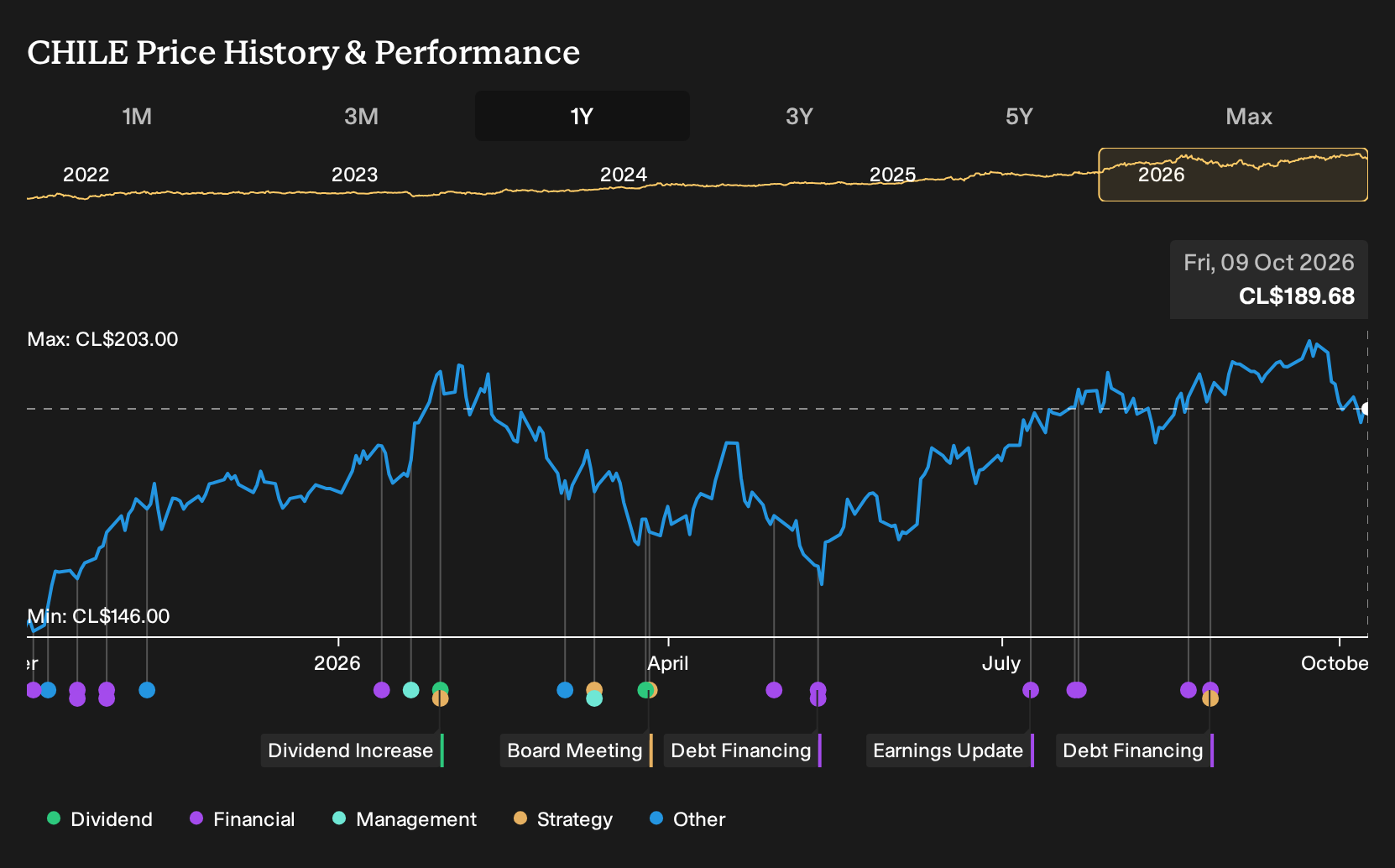
Banco de Chile offered investors a puzzle. Analysts were split between a bullish CLP160 fair value and a bearish CLP98.2, and both sides highlighted real risks around sluggish credit demand and rising fintech pressure. Investors who held Banco de Chile over the past year are up 38.0%, including dividends. If you had put money to work on 9 October 2025, what did the information on record actually suggest you were signing up for?
The useful thing about a Narrative is that the reasoning is checkable: the assumptions sit beside the argument, and together they imply an estimated Fair Value you can disagree with.
Banco de Chile has already moved. See which of 174 high quality undervalued stocks still trade below our estimates.
The Two Banco de Chile Stories Investors Had To Weigh
The shares cost CLP148 and Banco de Chile sat between two very different stories that both sounded plausible at the time.
On the bullish side, the Narrative pointed to a Fair Value of CLP160 and leaned on a view that above trend loan growth and rising middle class affluence could support faster revenue expansion and growing fee income.
The bearish camp argued for a Fair Value of CLP98.2 and focused on the risk that sluggish credit demand, rising fintech competition, and higher regulatory costs might compress margins and limit balance sheet growth.
What The Results Changed For Banco de Chile
The clearest fresh fact was Banco de Chile’s Q2 2026 report. Total revenue was CLP666,248m in Q2 2025 versus CLP756,946m one year later, with net income moving from CLP304,867m to CLP390,567m and net margin rising from 45.8% to 51.6%. That pattern supported the optimistic case more than the cautious one, although only over a single quarter.
The lesson is simple. When narratives clash, anchor on what margins actually do. For any bank you are assessing, track net margin over time to test claims about durable profitability against what the income statement records.
What Today's Banco de Chile Price Already Assumes
Today you would be paying CLP190 for Banco de Chile after a 38.0% gain over the past year. The selected Narrative places its Fair Value below that level and frames the gap around how credit costs, tax effects, and a less supportive rate backdrop might shape future earnings quality.
At this price, you are effectively assuming Banco de Chile can convert strong capital and low funding costs into durable customer income growth even as cost of risk guidance rises. The question is how that assumption holds up against the risk that higher provisions and weaker loan appetite weigh on net interest income and returns.
"Although Banco de Chile enters the next phase of the credit cycle with very strong capital ratios and low funding costs, the recent CLP 50,000,000,000 increase in additional provisions and higher guided cost of risk of 1.2% to 1.3% signal that future loan growth could come with structurally heavier credit charges that pressure net interest income and earnings."
Not everyone reads the same price the same way. → See the lower figure this Narrative lands on, and how it gets there
Looking Beyond Banco de Chile
Once you understand Banco de Chile, another question appears for curious investors. What happens when customers want similar services without any branches at all?
One Latin American player built its whole model around that shift in expectations. Everything sits on a phone, from payments to investing and credit tools.
Without buildings and paper forms, its cost base looks very different. The business leans on software, data and automation instead of tellers and counters.
That approach taps into the same customer frustration Banco de Chile faces from fintech pressure. The open question is how far this branchless model can really stretch.
It is written up in full, assumptions and all. → Explore the Narrative that puts this company 41% above its price
This article by Simply Wall St is general in nature. We provide commentary based on historical data and analyst forecasts only using an unbiased methodology and our articles are not intended to be financial advice. It does not constitute a recommendation to buy or sell any stock, and does not take account of your objectives, or your financial situation. We aim to bring you long-term focused analysis driven by fundamental data. Note that our analysis may not factor in the latest price-sensitive company announcements or qualitative material. Simply Wall St has no position in any stocks mentioned.
Have feedback on this article? Concerned about the content? Get in touch with us directly. Alternatively, email editorial-team@simplywallst.com