
- PRICING
- LIVE QUOTES
- LEARN
- HELP


EN
Vericel (VCEL), Why Is The Stock Back In The Spotlight?
Vericel (VCEL) has drawn fresh attention after recent share price moves, prompting investors to reassess how the biopharmaceutical group’s $2.1b valuation lines up with its current revenue, profitability, and return profile.
The recent move to a US$40.10 share price comes after a mixed stretch, with a 30 day share price return of 2.85% set against a 90 day share price decline of 14.68%. Even with that pullback, Vericel’s 1 year total shareholder return of 25.90% and 3 year total shareholder return of 27.06% indicate momentum has been positive over a longer horizon. However, the weaker 5 year total shareholder return of 21.05% reminds investors the ride has not been smooth.
Scan how Vericel compares with other biopharma names showing stronger momentum and fundamentals in our hand picked 20 high quality undiscovered gems list.
Vericel now trades around US$40, with a mixed recent track record that includes both sharp pullbacks and solid multi year gains. Is this a sensible spot to commit fresh capital, or does patience offer a better entry as valuation comes into focus?
Most Popular Narrative: 34% Undervalued
Vericel’s most followed narrative pegs fair value around $60.57, which sits well above the last close near $40.10 and frames a story built on MACI and burn care expansion rather than a quick trading swing.
Ongoing operational initiatives including the now approved Burlington manufacturing facility, automation and the approximately 30% MACI sales force expansion effective in 2026 are shifting from a transition year of fixed cost absorption toward the company’s goal of around US$500m revenue and high 30% adjusted EBITDA margins by 2029. If achieved, this would improve net margins.
See why 8 investors see Vericel as 34% undervalued.
Result: Fair Value of $60.57 (UNDERVALUED)
Still, the Vericel story can break if MACI adoption slows or if the impact of 2026 fixed cost absorption on margins turns out to be more significant than currently assumed.
Find out about the key risks to this Vericel narrative.
Another View: Vericel Looks Expensive On Earnings
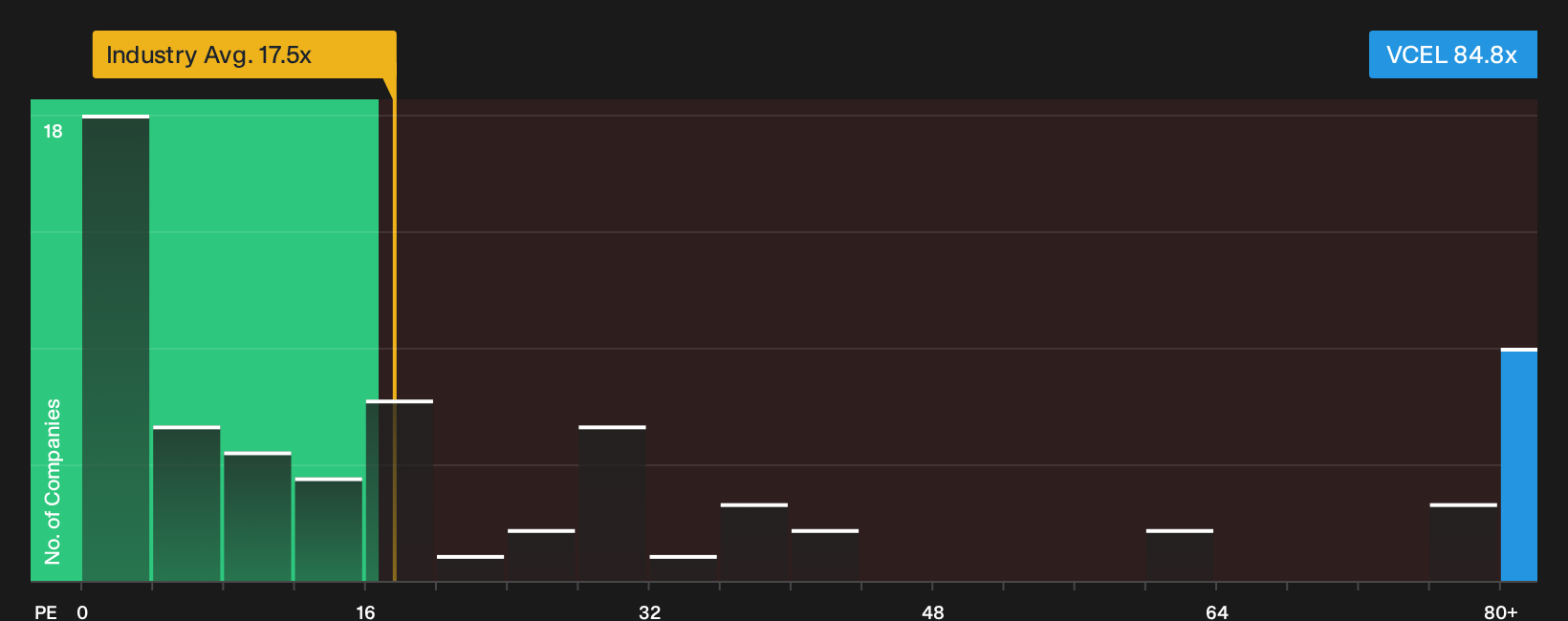
On the flip side of the fair value narrative, Vericel’s current P/E of 84.8x is far above the US Biotechs industry at 17.1x, the peer average at 15.3x, and even the 24x fair ratio. That gap points to meaningful valuation risk if sentiment cools.
For investors who prefer to anchor decisions on earnings multiples rather than long term narratives, the question becomes simple: How much of the Vericel story are you comfortable paying up for at this kind of premium, and what might change your mind if the multiple starts to compress?
See what the numbers say about this price — find out in our valuation breakdown.
Next Steps
Mixed messages across Vericel’s valuation and earnings multiples can feel confusing, so it helps to pressure test the numbers yourself before sentiment swings again. To see what the optimism is built on, review the 3 key rewards.
Looking for more Vericel style investment ideas?
If Vericel has you rethinking where the next opportunity might come from, do not stop with a single stock when a wider field is just a few clicks away.
- Spot potential bargains early by scanning companies that combine quality fundamentals with appealing valuations through the 28 high quality undervalued stocks.
- Prioritise resilience by filtering for businesses with strong finances using the list of solid balance sheet and fundamentals (25 results).
- Tilt your watchlist toward stability and downside protection by reviewing the 31 resilient stocks with low risk scores.
This article by Simply Wall St is general in nature. We provide commentary based on historical data and analyst forecasts only using an unbiased methodology and our articles are not intended to be financial advice. It does not constitute a recommendation to buy or sell any stock, and does not take account of your objectives, or your financial situation. We aim to bring you long-term focused analysis driven by fundamental data. Note that our analysis may not factor in the latest price-sensitive company announcements or qualitative material. Simply Wall St has no position in any stocks mentioned.
Have feedback on this article? Concerned about the content? Get in touch with us directly. Alternatively, email editorial-team@simplywallst.com