
- PRICING
- LIVE QUOTES
- LEARN
- HELP


EN
How Executive Exit At Hugo Boss Has Changed Its Investment Story
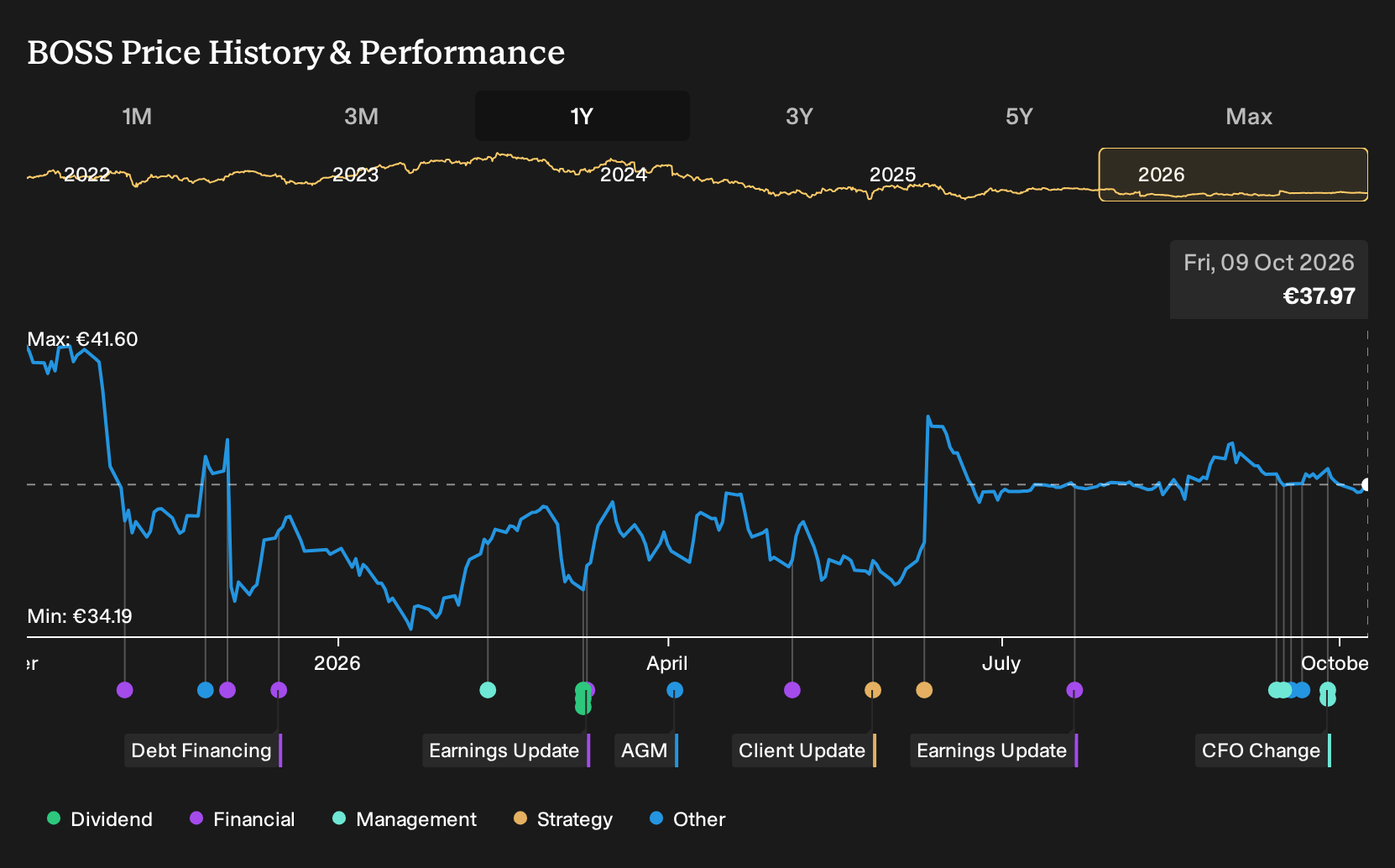
- Hugo Boss reported that long-serving executive Yves Müller stepped down in 2026 from his dual roles as CFO and COO. Internal leader Ivica Maric, who has held senior finance and operations positions since 2005, is joining the Managing Board to oversee both functions from October 1, 2026.
- The decision to hand both finance and operations to Maric concentrates control of cost discipline, supply chain execution, and capital allocation in a single leader. This can reshape how Hugo Boss balances margin focus, store portfolio decisions, and investment in digital and premium product initiatives.
- We will look at how Hugo Boss's investment narrative is affected by consolidating CFO and operations leadership under Ivica Maric after Müller's departure.
Hugo Boss Investment Narrative Recap
To own Hugo Boss, you need to trust that the business can keep tightening operations while dealing with uneven demand in the U.S. and China, softer BOSS Womenswear and HUGO lines, and cautious consumers facing higher prices. Consolidating finance and operations under Ivica Maric does not, on its own, radically change those near term realities.
The key short term swing factor still lies in execution on store productivity, inventory management and direct to consumer growth. The main risk remains that cost cuts, space reductions and price rises hit a ceiling as traffic and sentiment stay weak. That would limit how much further profitability can be supported by internal efficiencies.
The most relevant update is the decision to hand both CFO and COO responsibilities to Maric from October 1, 2026. With a background in Controlling, Accounting and Business Operations, he is now directly responsible for cost discipline, sourcing choices and working capital at Hugo Boss, all areas that connect closely to existing risks and catalysts.
For you, the question is whether this tighter setup helps the group keep inventory under control while it reroutes supply away from China and copes with tariffs in the U.S. The same structure could support store portfolio optimization and digital investment. However, any misstep on price increases or weaker brands like HUGO would quickly show up in margins and cash flow.
What Hugo Boss Consensus Forecasts Assume
Hugo Boss' consensus outlook is fairly muted on the top line. Analysts are effectively calling for flat revenue over the next three years, while expecting a modest lift in profitability as net margin edges from 5.5% today to 5.9% by 2029.
On earnings, the group is modeled to move from €231.5 million today to €245.8 million around 2029, with a wide spread between bullish and bearish views that run from €279.1 million down to €207.2 million. That implies an earnings increase of roughly €14.3 million from current levels, which is incremental rather than transformative and leaves room for disappointment if U.S. or China demand weakens further.
To line up with this picture, you would be underwriting a business that trades on an 11.3x P/E today and is expected to move toward 17.0x on those 2029 earnings. That multiple would sit above the current 15.0x for the GB Luxury peer group and assumes investors are willing to pay more for Hugo Boss' profit stream even as revenue assumptions stay restrained.
Hugo Boss' narrative projects €4.2 billion revenue and €245.8 million earnings by 2029. This rests on essentially flat yearly revenue growth and an earnings increase of about €14.3 million from €231.5 million today.
Uncover how Hugo Boss' fair value indicates an 8% potential upside to its current price that could narrow quickly.
Exploring Other Perspectives
One bullish twist you might explore is the catalyst around Frasers Group’s roughly 48% stake in Hugo Boss and the possibility of tougher capital allocation once the CFO and COO roles move to Ivica Maric. The most optimistic analysts were already pencilling in €4.4b revenue and €287.7m earnings by 2029 before this leadership change; their thesis could either strengthen or soften as the new setup plays out. Investor opinions differ widely, so treat this as a prompt to compare that upbeat script with your own view rather than a final verdict.
Explore 3 other Hugo Boss fair value estimates, including one that suggests potential upside of up to 149% from the current price.
Form Your Own Verdict
Don't just follow the ticker; dig into the data and build a conviction that's truly your own.
- A great starting point for your Hugo Boss research is our analysis highlighting 2 key rewards that could impact your investment decision.
- See our latest analysis for Hugo Boss. The report includes a comprehensive fundamental analysis summarized in a single visual, the Snowflake, making it easy to evaluate Hugo Boss' overall financial health at a glance.
Looking for more Hugo Boss style investment ideas?
If Hugo Boss is already on your radar, it can help to widen the lens and compare it with other businesses that share similar qualities in balance sheet strength, valuation or risk profile. The Simply Wall St Screener lets you filter by the traits you care about most so you can build a shortlist that genuinely fits your plan.
- For investors who care most about financial resilience and clean balance sheets, start with a list of solid balance sheet and fundamentals (204 results) that can serve as a defensive core to your portfolio.
- If you are hunting for mispriced opportunities, use the 174 high quality undervalued stocks to see which stocks combine fundamentals with a valuation that appears undemanding.
- Those who want calmer nights and fewer surprises can turn to a 222 resilient stocks with low risk scores that screens for businesses with more measured risk scores.
This article by Simply Wall St is general in nature. We provide commentary based on historical data and analyst forecasts only using an unbiased methodology and our articles are not intended to be financial advice. It does not constitute a recommendation to buy or sell any stock, and does not take account of your objectives, or your financial situation. We aim to bring you long-term focused analysis driven by fundamental data. Note that our analysis may not factor in the latest price-sensitive company announcements or qualitative material. Simply Wall St has no position in any stocks mentioned.
Have feedback on this article? Concerned about the content? Get in touch with us directly. Alternatively, email editorial-team@simplywallst.com