
- PRICING
- LIVE QUOTES
- LEARN
- HELP


EN
Final Stock Selection for A Dual Stock and Option Selling Strategy
Dual Edge Research publishes two powerful newsletters that work great individually — and even better together. The Bull Strangle Newsletter focuses on stocks and options, combining stock ownership with premium-selling strategies to generate consistent income and market-beating returns. The Smart Spreads Newsletter specializes in seasonal commodity futures spreads, offering a diversified approach with low correlation to equities. Together, they deliver a complete investment perspective — one focused on income, the other on diversification — all under one simple subscription.
Introduction
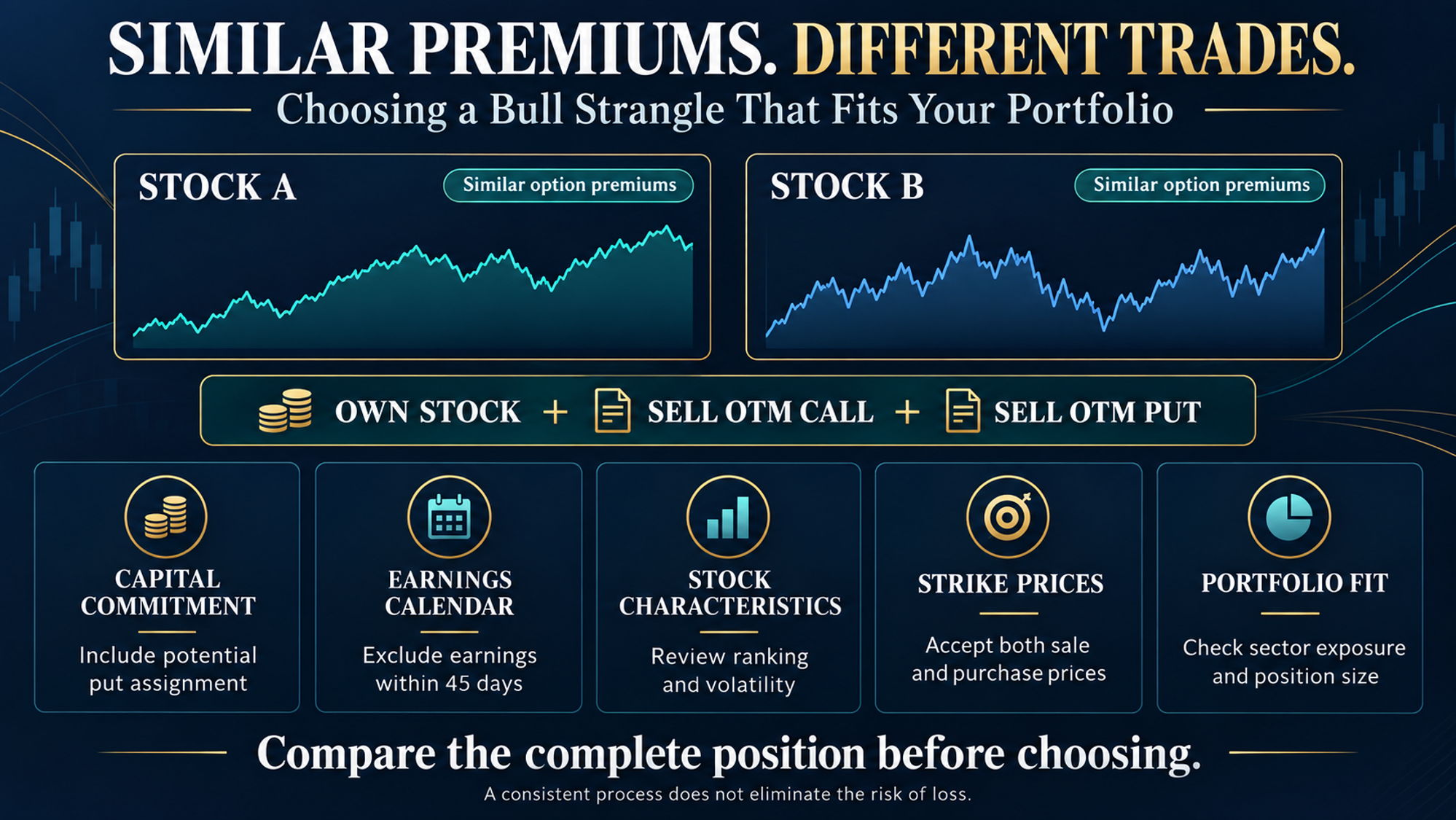
Two stocks offer similar option premiums. Which one belongs in a stock-and-option selling portfolio? The answer requires more than comparing the income collected. Stock characteristics, strike prices, potential assignment, and existing portfolio exposure can make two apparently similar opportunities quite different.
A Bull Strangle combines stock ownership with the sale of an out-of-the-money call and an out-of-the-money put. The call creates an obligation to sell shares at its strike price if assigned. The put creates an obligation to buy additional shares at its strike price if assigned. Evaluating a candidate means considering all three parts together.
Compare the complete capital commitment.
Start by putting the candidates consistently. Use the same option expiration and comparable capital commitments. A trade that collects more premium may involve a larger stock purchase or a larger potential obligation under the short put. For a hypothetical example, suppose Candidate A requires a $10,000 stock purchase and a $9,500 reserve for potential put assignment. Candidate B requires a $15,000 stock purchase and a $14,000 assignment reserve. If each generates $600 in combined call and put premiums, the dollars collected are identical, but the commitments are not.
Using stock cost plus the put assignment reserve as the comparison basis, Candidate A collects approximately 3.1% of its $19,500 commitment. Candidate B collects approximately 2.1% of its $29,000 commitment. These figures are premium percentages before fees, not total returns. Changes in the stock price and the cost of closing the options can materially change the result. This example does not establish which candidate is better. It shows why comparing premium dollars alone leaves out an essential part of the decision. The comparison should also use the same convention for handling premium proceeds in the capital calculation.
Check earnings before comparing premiums.
Our Bull Strangle screening process excludes stocks with earnings scheduled within the next 45 days. We check the calendar early so we don't spend time comparing otherwise attractive candidates. An earnings announcement can produce a sharp move in either direction. A larger option premium may reflect that uncertainty. If one candidate falls inside our earnings exclusion window, it does not qualify under our entry rules, regardless of the premium available. The earnings rule reduces exposure to a specific scheduled event. It does not eliminate unexpected company news or broader market risk.
Review the stock and the strikes.
After the earnings check, we review the stock ranking, volatility, and strike distances. The ranking combines our screening factors into a consistent evaluation framework. It helps organize the comparison, but a qualifying ranking does not guarantee a profitable trade. Volatility helps explain both the option premium and the potential size of price movements. Similar premiums can arise from different combinations of volatility and strike distance. A premium figure becomes more useful when we understand the commitments required to collect it.
Review the call strike relative to the current stock price. If the shares are sold at that strike, would the outcome be acceptable? The short call limits upside participation in the covered shares, so willingness to sell matters before entering the position. Then review the put strike. If assigned, would we be comfortable purchasing additional shares at that price? An attractive premium is insufficient if the resulting stock purchase would exceed our available capital or create an oversized position.
Consider the portfolio after assignment.
A candidate can meet the individual trade requirements and still be a poor fit for the portfolio. If we already have substantial exposure to its sector, adding another position may increase concentration. A different candidate may provide a better balance, even when the quoted premiums are similar.
Position sizing should include shares already owned and shares being purchased for the new trade. In our process, we sell excess shares acquired through put assignment rather than retain them, so they don't become a lasting increase in the planned position. We still need sufficient capital to support assignment, and selling those shares may realize a loss. The key question is whether the intended stock position fits our sizing rules and sector exposure. Similar premiums can lead to different portfolio concentrations, so the choice depends partly on what we already hold.
Let the process determine the choice.
Before entering either trade, bring the comparison back to a short checklist. Has the earnings calendar been checked? Does the stock meet the screening requirements? Are both strikes acceptable? Can the account support potential assignment? Does the resulting position fit the portfolio’s sector exposure and sizing rules? If one candidate meets those requirements and the other does not, the process clarifies the decision. If both qualify, the complete capital commitment and portfolio fit help distinguish them. If neither qualifies, waiting is a valid decision.
Similar premiums start the comparison. The stock purchase, option obligations, and effect on the existing portfolio determine whether the trade fits the Bull Strangle process. Premium income can offset some losses, but the stock can decline substantially, and put assignment can increase exposure to that decline. A consistent process does not eliminate the risk of loss.
Want to build a more complete trading toolkit?
The Bull Strangle Newsletter focuses on stocks and options, combining stock ownership with disciplined option-selling techniques designed to generate consistent income while managing risk.
The Smart Spreads Newsletter focuses on seasonal commodity spreads, a historically proven approach that seeks opportunities across agricultural, energy, metal, and financial futures markets.
Each strategy is designed to stand on its own, but together they provide a diversified approach that can perform across a wide range of market environments. For traders looking to deepen their education, The Bull Strangle Strategy and Trading Commodity Spreads are both available on Amazon.
Visit BullStrangle.com to subscribe for just $1 for the first month.
For a video overview of the Bull Strangle Newsletter
For a video overview of the Smart Spreads Newsletter
Darren Carlat
Dual Edge Research
(214) 636-3133
DualEdgeResearch@gmail.com
Disclaimer
This information is for informational purposes only and should not be considered investment advice. Past performance is not indicative of future results, and all investments carry inherent risk. Consult with a financial advisor before making any investment decisions.