
- PRICING
- LIVE QUOTES
- LEARN
- HELP


EN
Valuation Questions Put Horton Stock In Focus
- D.R. Horton, a major U.S. homebuilder, has come under pressure as investors reassess its valuation and weigh demand risks in housing.
- The pullback arrives while Berkshire Hathaway increases its exposure to housing related stocks, highlighting a split between cautious sentiment and large institutional interest.
- Next, the focus shifts to how D.R. Horton’s investment narrative holds up as valuation concerns intersect with sector demand uncertainty.
D.R. Horton Investment Narrative Recap
For a shareholder in D.R. Horton, the key belief is that its focus on affordable homes, broad U.S. footprint and capital light lot control can keep volumes and earnings resilient even when demand feels patchy. The recent pullback tied to valuation concerns does not change that core setup. The more immediate swing factor is how effectively management balances sales incentives and pricing with protecting homebuilding margins.
The biggest risk right now sits in that same incentive bucket. Sales support around 10% of home revenue and heavy use of mortgage rate buydowns can keep pressure on profitability, especially as lot and land costs trend higher. Legal and regulatory issues around mold claims and mortgage escrow practices add another layer of expense and execution risk that investors need to keep in mind.
Recent commentary around D.R. Horton has highlighted its capital light land approach and large controlled lot position of about 570,000 lots, with only 22% owned. That structure matters directly for this pullback because it can reduce balance sheet strain and give the business more flexibility if conditions soften or if demand shifts across regions. Investors watching Berkshire Hathaway’s housing exposure often track this kind of model closely.
There is also ongoing work to shorten build cycles and trim construction costs per square foot. Recent data points to a 5% year over year reduction in stick and brick costs in Q3 FY26. Faster build times and lower direct costs can help offset elevated incentives and rising lot expenses, which turns operational execution into a key factor for margins and cash generation over the next few quarters.
D.R. Horton Analyst Set Up
Analysts framing the D.R. Horton story are building their case around steady top line expansion and a gradual lift in profitability rather than a sharp cyclical swing. That lens matters for you because it anchors expectations on consistent execution in land, build times and incentives instead of on a big call about where housing demand goes next.
Revenue in the models is set to compound at 8.2% a year over the next three years, while profit margins are assumed to move from 9.2% today to 10.5% by 2029. The earnings line in those projections climbs from US$3.1b today to US$4.4b by the 2029 financial year, an increase of about US$1.3b. Analysts are effectively betting that D.R. Horton squeezes more profit out of each dollar of sales even as it keeps leaning into affordability and heavy sales incentives.
Under those same assumptions, the analyst group expects the share count to shrink by about 4.23% a year over the coming three years. Fewer shares mean the earnings pie is spread across a smaller base, which lifts earnings per share if net income meets those US$4.4b forecasts. That math is part of why the models point to earnings per share of US$18.57 by 2029.
The valuation overlay sits on top of these operating assumptions. To make the prevailing price targets stack up, the stock is modeled to trade on a P/E of 11.3x against those 2029 earnings, compared with 12.5x today and 13.3x for the broader U.S. consumer durables peer group. That framework effectively asks you to weigh a modestly lower multiple against higher forecast earnings and firmer margins.
D.R. Horton's narrative projects US$42.2b revenue and US$4.4b earnings by 2029. This relies on 8.2% yearly revenue growth and an earnings increase of about US$1.3b from US$3.1b today.
Uncover why D.R. Horton's fair value indicates an 18% potential upside to its current price that could narrow quickly as sentiment catches up.
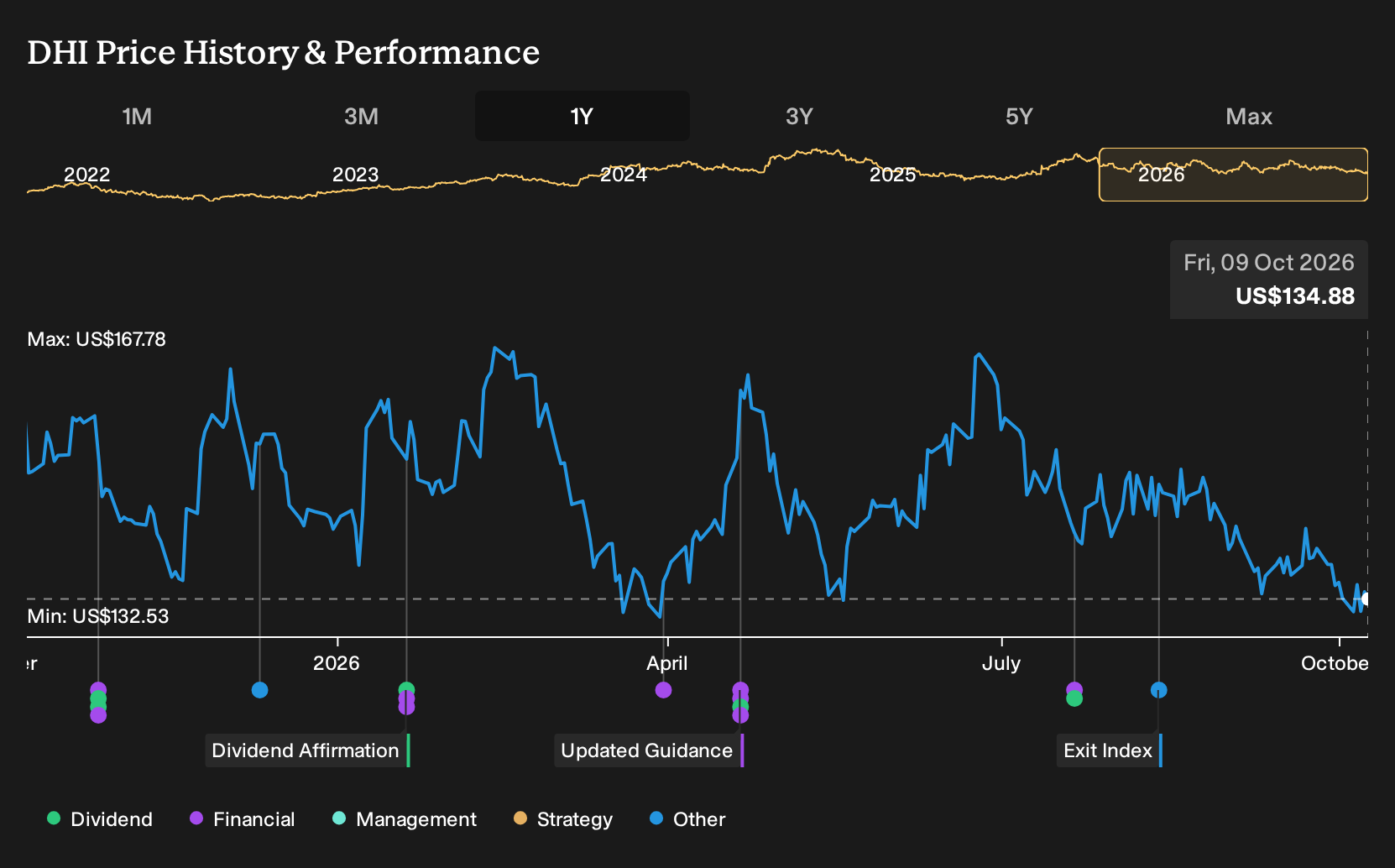
Exploring Other Perspectives
One flashpoint where views really split on D.R. Horton is the multiple. The lowest analysts still plug in roughly US$43.9b of revenue and US$4.7b of earnings by 2029, yet they only award an 8.3x P/E. That is a sharply more cautious story than consensus, and the latest pullback could easily shift both narratives. It may be helpful to explore a few of these angles before deciding where you land.
Explore 3 other D.R. Horton fair value estimates, including one that suggests as much as 7% downside from the current price.
The Verdict Is Yours
Don't just follow the ticker. Dig into the data and build a conviction that's truly your own.
- A great starting point for your D.R. Horton research is our analysis highlighting 2 key rewards that could impact your investment decision.
- See our latest analysis for D.R. Horton. The report includes a comprehensive fundamental analysis summarized in a single visual, the Snowflake, making it easy to evaluate D.R. Horton's overall financial health at a glance.
Looking for more investment ideas beyond D.R. Horton?
Once you have formed a view on D.R. Horton, it can help to line that thesis up against other potential opportunities so you can see where the risk and reward trade off feels most attractive for you.
- If you care most about quality at a reasonable entry point, scan through our 20 high quality undiscovered gems that pair solid fundamentals with relatively low market attention.
- For a focus on balance sheet strength and financial resilience, compare D.R. Horton with a list of solid balance sheet and fundamentals (25 results) that can handle tougher conditions without heavy strain.
- If capital preservation sits high on your priority list, build a watchlist from our 31 resilient stocks with low risk scores and see which businesses align best with your comfort level.
This article by Simply Wall St is general in nature. We provide commentary based on historical data and analyst forecasts only using an unbiased methodology and our articles are not intended to be financial advice. It does not constitute a recommendation to buy or sell any stock, and does not take account of your objectives, or your financial situation. We aim to bring you long-term focused analysis driven by fundamental data. Note that our analysis may not factor in the latest price-sensitive company announcements or qualitative material. Simply Wall St has no position in any stocks mentioned.
Have feedback on this article? Concerned about the content? Get in touch with us directly. Alternatively, email editorial-team@simplywallst.com