
- PRICING
- LIVE QUOTES
- LEARN
- HELP


EN
These 3 Stocks Pay Up to 10.8% (And Pay Us Every Single Month)
If you own dividend stocks and pay careful attention to your investment account (or if you're just an avid reader of equity-income articles), you're probably aware that most if not all of your dividend stocks pay you on a quarterly basis.
In other words, each stock pays its dividend in one of these three patterns:
- January, April, July, and October
- February, May, August, and November
- March, June, September, and December.
But what if that wasn't frequent enough for your liking? What if you wanted to get paid more often?
If we were feeling less generous, we'd tell you to buck up and thank your lucky stars you're not in Europe. There, companies not only tend to pay on a semiannual or annual basis, but they also frequently pay uneven dividends that vary based on their profits (as opposed to American companies, which generally pay stable, predictable dividends).
However, it's the weekend, and we're feeling good. So, we'll spend some time talking to you about how you in fact can collect your dividends more often (each and every month, to be exact), and give you a few examples of companies that deliver these more frequent income checks.
Disclaimer: This article does not constitute individualized investment advice. Individual securities, funds, and/or other investments appear for your consideration and not as personalized investment recommendations. Act at your own discretion.
The importance of dividends
Before we dig into the virtues of monthly dividend payers, here's a quick primer on dividends (and their importance) for the rookie investors reading today:
A dividend is a cash payment that a company makes to its shareholders. It's an excellent additional source of investment return that complements price gains—and it means different things for different investors.
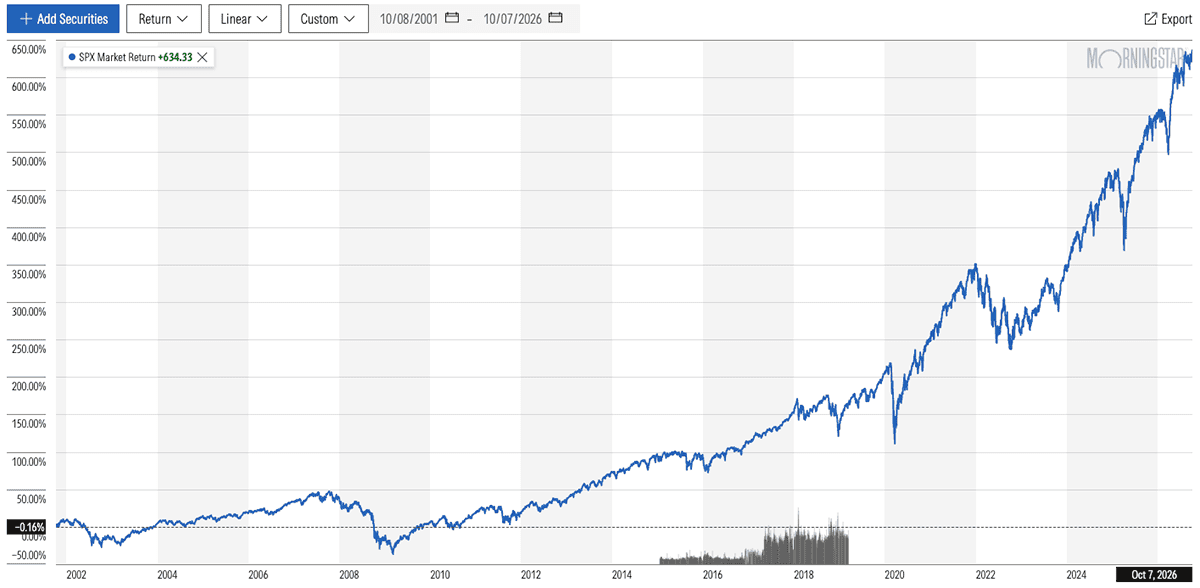
For anyone who isn't yet retired, cash from dividend stocks is just more fuel to reinvest so you can keep growing your portfolio. Here's a look at the return someone could expect if they received just the price returns from the S&P 500 over the past 25 years:
Now look at the chart below to see how much better the return is when you factor in dividends, assuming you reinvested those dividends back into the S&P 500 (returns illustrated by an S&P 500-tracking ETF; note that expenses are included in performance).
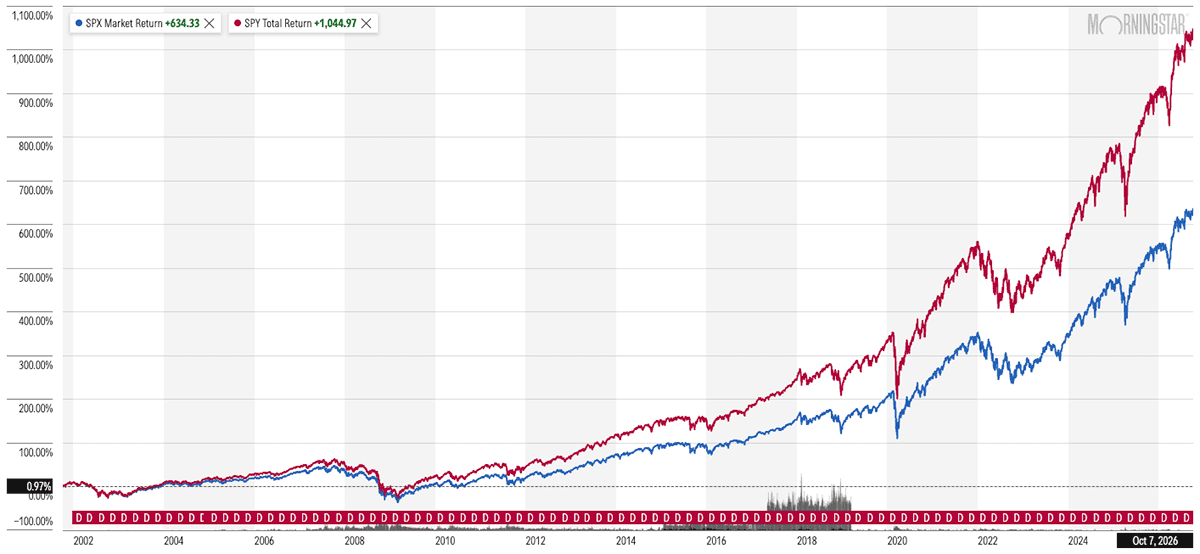
The price return is around 635%. The total return (price plus dividends) is almost 1,045%!
But dividends can mean something else entirely when you've reached retirement. Specifically, they can become a source of passive income.
When you retire, you no longer receive a regular paycheck from an employer. Instead, you have to rely on Social Security checks and whatever you've saved up for retirement. Investors typically withdraw money from their nest egg to pay the bills in retirement, but a steady stream of stock-dividend and bond-interest income can reduce how much of your investment accounts you have to draw down—keeping your nest egg better intact for longer.
Young and the Invested Tip: If you want a more diversified dividend approach than picking individual stocks, consider these dividend ETFs instead.
So … why monthly dividends?
We're glad you asked!
The schedule
Monthly dividends, from a pure payout-schedule perspective, appeal primarily to retirees. However, stocks making more frequent payouts can benefit every kind of investor in some way.
Remember what we said before: U.S.-based stocks typically pay quarterly, and they have different schedules—so, some write checks in Jan/Apr/Jul/Oct, some pay in Feb/May/Aug/Nov, and the rest shell out dividends in Mar/Jun/Sep/Dec. So, depending on your portfolio's makeup, you could be receiving income in uneven clumps, making budgeting more difficult.
But with monthly dividend stocks, you're typically getting the same exact payout every month (and sometimes an occasional payout hike, too). That's outstanding news to retirees. After all, they're not working anymore—but they still have bills to pay, and bills still come monthly.
Faster compounding
There's also a tangible (albeit slight) benefit to investors of any age: quicker compounding.
When a company pays a dividend, you can choose to have it go straight to your account for use as you'd like … or you can immediately reinvest those dividends, which many people do when they're not already retired.
Let's say you buy $10,000 worth of shares in a stock with a 5% yield and hold it for 30 years. It never gains a dime, the yield holds at 5% the entire time, and you reinvest every dividend.
- If that stock paid you quarterly, you'd end up with a balance of $44,402.13.
- If that stock paid you monthly, you'd end up with a balance of $44,677.44.
Sure, $275 isn't world-changing, but more is still more. If nothing else, it's a case for including a few of these income investments as part of a diversified portfolio.
Higher yields
Most of the dividend stocks you hold are likely plain-vanilla C corporations, like Apple (AAPL) or Coca-Cola (KO), that have no unusual rules or designations.
But for whatever reason, most monthly dividends are paid by companies with specialized structures, such as real estate investment trusts (REITs), business development companies (BDCs), and royalty trusts. These businesses all have one thing in common: They're mandated to pay out large percentages of their taxable income or cash flow back to shareholders in the form of dividends.
And in general, these special classes tend to deliver much higher yields than your average stock.
Young and the Invested Tip: You can get your dividend fix through mutual funds, too.
Do they have any downsides?
If you're wondering what the catch is, good—a healthy dose of skepticism will keep you alive longer.
There are no real dangers that are specific to the monthly dividend schedule. But there are some things you should keep in mind, just given the types of companies and high levels of yield involved.
- Growth: This isn't a hard-and-fast rule, but very generally, you should rein in your expectations for stock growth when it comes to high yielders. These companies generously reward shareholders—but every dollar they're paying you is a dollar that isn't being reinvested to grow the business. In many cases, a monthly dividend will account for a majority (and occasionally all) of a company's total return, which is what you get when you combine both the stock's price performance and the dividends paid.
- Interest-rate risk: Let's say a bond pays 2% and a dividend stock pays 4%. Sure, stocks carry much more risk than bonds, but in this case, we're getting more reward for that risk—not just another 2 points of dividends, but any price appreciation, too. However, if that same bond were to pay 4%, the risk/reward proposition for the stock would look quite a bit worse. The opposite applies, too: Lower bond yields typically make high-yield stocks look better by comparison. Interest rates also affect things like the cost of corporate borrowing and the rates at which some of these companies can lend to other businesses, so on the whole, monthly dividend stocks tend to be sensitive to interest rates.
- Danger signal: There is zero consensus as to what a "high" yield is. It differs largely based on personal preference, as well as other factors such as the current rate environment. But if a company has a high yield relative to its historical yield, that could be a sign of trouble. After all, there are two ways for a dividend yield to grow: an increase in the payment, or a decrease in price. If a stock jumps from a 4% yield to an 8% yield in a month, and it hasn't increased its dividend, watch out—because that stock has dropped by 50% in a month, which could reflect a deteriorating business.
But risks are risks—every investment has them. As long as you know what you're getting into, monthly dividend stocks may be a great addition to your portfolio.
To give you an idea of what kinds of companies pay monthly dividends, check out these three names from my larger article about the market's best monthly dividend stocks.
Janus Living
- Industry: Senior housing
- Market capitalization: $6.6 billion
- Dividend yield: 2.0%
Janus Living (JAN) is a real estate investment trust that exclusively invests in senior housing communities, setting it apart from other senior-housing REITs that also invest in skilled nursing, assisted living, medical, and other properties.
JAN's portfolio is currently made up of 11,420 units across 41 senior housing communities in 13 states. It operates entirely under the RIDEA (REIT Investment Diversification and Empowerment Act) structure, which allows senior housing and healthcare REITs to go beyond acting as passive landlords, and instead participate directly in their properties' operating income.
Invest With CIBC
CIBC Investor's Edge lets you trade U.S. and Canadian stocks and ETFs, options, mutual funds, and bonds through registered accounts like FHSAs, TFSAs, RRSPs, and RESPs, as well as non-registered accounts.
Sign up with CIBC Investor's Edge today and you can make all of your fractional trades commission-free through Oct. 31, 2027.
Janus is a baby-fresh REIT, spun off in March 2026 by fellow monthly payer Healthpeak Properties (DOC). Healthpeak retains a 73.6% majority stake in the company, and it externally manages Janus through one of its subsidiaries.
"We have a constructive growth outlook for the company," say JPMorgan analysts. "We see the stock as being well positioned to deliver outsized internal and external growth compared to what we expect for our overall REIT coverage universe. We expect near-term internal growth to be in the low-double digits, roughly 3-4x what we are forecasting for the overall REIT group, as the senior housing (operating) segment continues to enjoy significant tailwinds."
They also point out that the company is sitting on no debt and "significant amounts of cash" following both its IPO and a June secondary offering.
JAN kicked off its dividend in June with a prorated quarterly payout, but it switched to a 4.75¢-per-share monthly starting with its July distribution. The yield isn't anything to scream about—it's certainly modest compared to other monthly dividend stocks. But the dividend represents only about 60% of Wall Street's estimates for Janus's 2026 funds from operations (FFO, a profitability metric for REITs), so there's plenty of room for this REIT to raise.
Capital Southwest Corp.
- Industry: BDC
- Market capitalization: $1.5 billion
- Dividend yield: 10.8%
Business development companies (BDCs) are specialized firms that provide capital for small- and midsized businesses. It's a small niche in the public markets—only a few dozen trade on U.S. exchanges—but it's also one of the highest-yield corners of Wall Street. That's because, like REITs, they must distribute at least 90% of their income in the form of dividends in exchange for exemption from corporate income tax.
Capital Southwest Corp. (CSWC) is a BDC that focuses on lower-middle-market companies with $3 million to $25 million of EBITDA (earnings before interest, taxes, depreciation, and amortization). It primarily deals in first lien debt, which makes up 90% of the portfolio at fair value. Equity makes up 9%, and the remaining sliver is split between second-lien and subordinated debt.
This 130-company portfolio is spread across a couple dozen industries, though most prominent at the moment are healthcare services, consumer services, media & marketing, and consumer products, all of which enjoy low double-digit weights.
In August, Capital Southwest reported decent results for the first quarter of its fiscal 2027. Net investment income (NII) was in line with Wall Street estimates. Non-accruals (loans in which the borrower has stopped making payments, and the lender has stopped recording interest income) held at 1.1% after a decline from 1.5% between Q3 and Q4 of fiscal 2026. And almost 90% of its debt investments enjoyed the top "1" or "2" rating (out of 5) on Capital Southwest's internal rating scale.
"We continue to expect [net asset value, or NAV] outperformance versus the group in future quarters due to CSWC's internally managed model, moderate leverage, and top-quartile return on equity," says B. Riley Securities analyst Sean-Paul Adams (Buy).
Capital Southwest uses a regular-and-supplemental dividend strategy. The company has been paying a 19.34¢ monthly dividend since it converted away from its quarterly schedule in 2025. But it also paid out 6¢ per share in supplemental distributions in each of the past six quarters. On its own, the regular dividend equates to a 9.8% yield. Add in the supplemental, and that percentage nears 11%.
Young and the Invested Tip: Closed-end funds (CEFs) can also offer extremely high yields, but you want to read up: They're not like mutual funds and ETFs.
Ellington Financial
- Industry: Mortgage real estate
- Market capitalization: $1.5 billion
- Dividend yield: 13.4%
Ellington Financial (EFC) is a mortgage real estate investment trust (mortgage REIT or mREIT, for short). It invests in residential and commercial mortgage loans, residential and commercial mortgage-backed securities (MBSes), consumer loans, asset-backed securities backed by consumer loans, and a number of other mortgage- and loan-related investments.
Whereas your typical equity REIT owns and possibly operates physical real estate, an mREIT deals in "paper" real estate like the instruments we just mentioned. An mREIT will take out debt to purchase mortgages and related products, and their profit is the spread between what they're paying on debt and what they're earning in interest income from their mortgages—known as net interest margin.
It's a difficult business—one that can be rocked by any number of things, including high and/or rising interest rates. September's hike did a number on EFC, which is off by 6% year-to-date even when accounting for its massive dividend. However, Wall Street remains more hopeful about Ellington than most of its industrymates.
"While [the third quarter] was likely challenging for most companies in the sector, we would expect the best book value performance from EFC and [Rithm Capital]," write Keefe, Bruyette & Woods analysts Bose George and Frankie Labetti (Outperform). "EFC provides monthly book values, and its August book value of $13.62 was relatively flat from Q2 book value of $13.61. While book value is likely down in September (we estimate down 2.8%), this still suggests the shares are trading below 90% of book."
In 2024, Ellington Financial reduced its monthly dividend from 15¢ per share to 13¢ as it absorbed the recent acquisition of another mREIT, Arlington Asset Investment Corp., and as Longbridge, a 2022 acquisition, worked on returning to profitability. Good news on the latter front: Longbridge has indeed returned to the black and actually looks attractive as some Baby Boomers choose to remain in their existing homes during retirement.
The dividend has stabilized, and EFC still boasts one of the largest yields among the best monthly dividend stocks covered here today. George and Labetti add that they believe the dividend remains "well covered."
Still, the 2024 dividend cut is an important reminder that double-digit yields are hardly risk-free.
What If I Need Help Picking Stocks?
Motley Fool Stock Advisor is a stock picking service that espouses my favorite, plain-vanilla trading style: buy-and-hold. Fool analysts provide recommendations for both "Steady Eddies" and potential high-flying stocks with sound fundamentals—exactly the combination of holdings you want to generate strong performance without risking extremely high volatility.
Importantly, Stock Advisor doesn't just give you a list of tickers and call it a day. It also provides investment rationales and research for each pick to help educate you before you buy.
Stock Advisor has returned more than 950% since its founding in February 2002, more than quadrupling the S&P 500 over that time (as of 10/9/26). You can join this service at a discounted rate for the first year, and get a 30-day membership-fee-back period, if you sign up for Stock Advisor today.