
- PRICING
- LIVE QUOTES
- LEARN
- HELP


EN
How AML Penalties Will Impact Amex Stock Investors
- Regulators have issued a cease and desist order and a US$350 million civil penalty to American Express after identifying enterprise wide anti money laundering failures that left roughly US$13 billion in suspected illicit transactions undetected and unreported over about a decade.
- The enforcement orders require American Express to overhaul its compliance framework, which brings added cost, management focus, and operational pressure at the same time the business is investing in global acceptance, AI driven products, and small business services.
- We will now look at how American Express's investment narrative is tested by the large anti money laundering penalty and remediation demands.
Stress test your thesis on American Express by comparing it with a curated group of payment and finance players that currently screen as 31 resilient stocks with low risk scores.
American Express Investment Narrative Recap
To own American Express, you need to believe that its premium cardholder base, growing international footprint, and expanding small business ecosystem can keep supporting fee income and billings, even as it spends heavily on rewards and technology. The big near term swing factor remains whether revenue momentum can stay ahead of rich customer engagement costs that sit around 44% to 45% of sales.
The fresh US$350 million anti money laundering penalty adds execution risk, but the absence of growth caps or asset limits points to a manageable hit to the operating story. The sharper risk near term is that any distraction around remediation coincides with revenue disappointments or the co brand portfolio drag into late 2026.
The launch of the next generation Amex Corporate platform sits right next to this regulatory story. Management is trying to turn American Express into more of a workflow partner for finance teams, combining corporate cards with expense software, AI supported mobile tools, and planned accounts payable features inside one environment.
If the platform gains traction, it can deepen commercial relationships, support billed business, and open extra fee and software like revenue streams at the same time co brand loan transfers weigh on growth. The catch is execution. Integrating AI agents, software, and payments while overhauling compliance increases complexity, so investors will likely watch delivery milestones and client adoption closely.
What The Current American Express Forecasts Assume
American Express forecasts in the current analyst playbook point to revenues of about US$97.6b and earnings of roughly US$15.0b by 2029. That profile reflects an implied 11.3% yearly revenue growth rate and an earnings increase of around US$3.7b from US$11.3b today.
Uncover how American Express' fair value indicates a 23% potential upside to its current price before the market closes the gap.
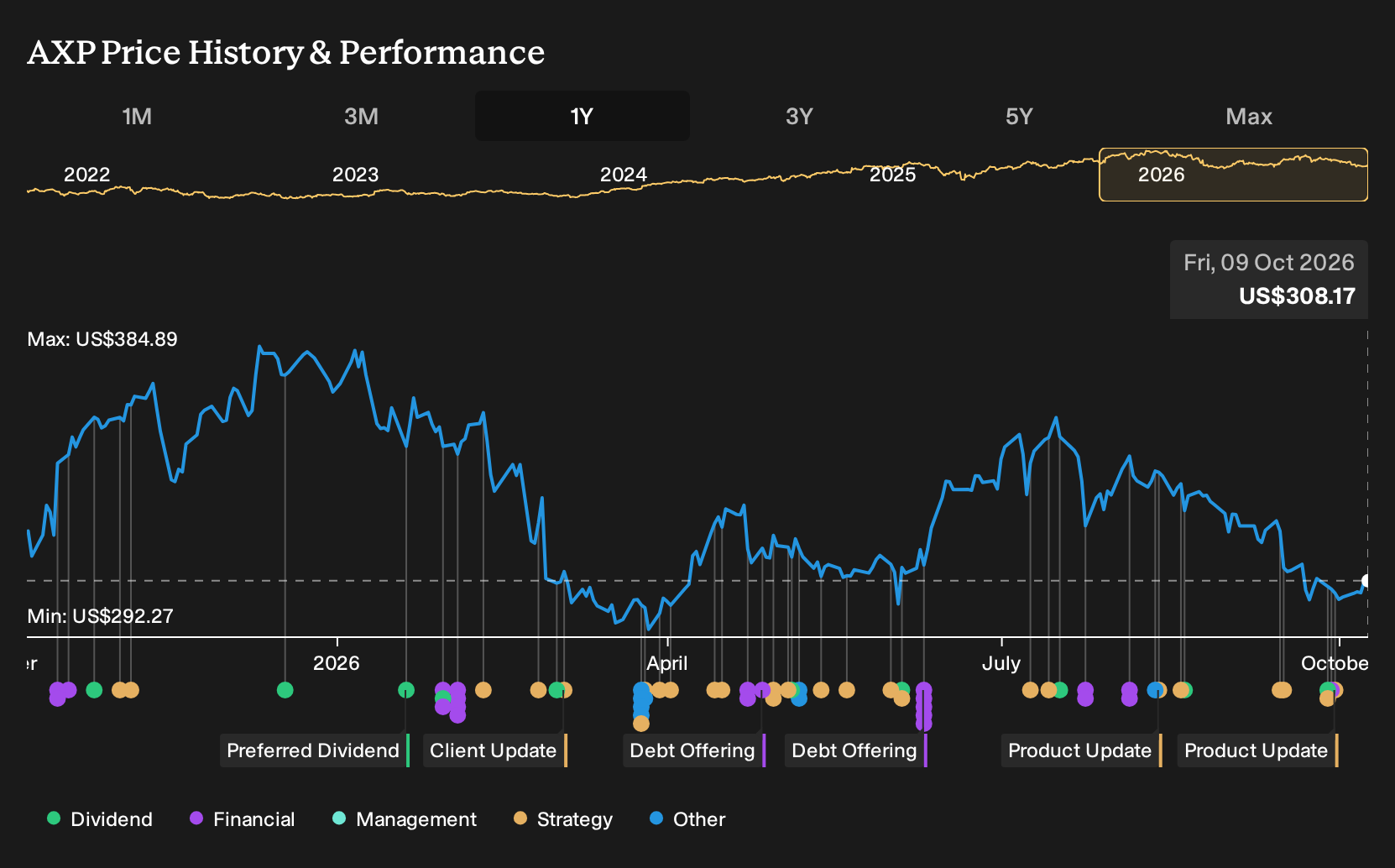
Exploring Other Perspectives
For American Express, the bearish analysts focus on regulatory risk rather than rewards costs. They were already working off lower expectations, with revenue assumptions of about US$96.4b and earnings of roughly US$14.5b by 2029, and they see that profile as fully priced. This new enforcement action could reinforce those cautious narratives even further. Consider using it as a prompt to compare several viewpoints before deciding how you interpret the situation.
Explore 7 other American Express fair value estimates, including one that suggests it could be worth just $315.00.
The Verdict Is Yours
Disagree with existing narratives? Extraordinary investment returns rarely come from following the herd, so consider conducting your own research.
- A great starting point for your American Express research is our analysis highlighting 4 key rewards and 1 important warning sign that could impact your investment decision.
- See our latest analysis for American Express. The report includes a comprehensive fundamental analysis summarized in a single visual, the Snowflake, making it easy to evaluate American Express' overall financial health at a glance.
Looking For More Ideas Beyond American Express?
If this American Express story has you rethinking risk, reward, and regulation, it can help to widen the lens and compare it with other businesses that fit different profiles on quality, value, and balance sheet strength.
- For readers hunting for potential mispriced quality, scan a curated set of companies that currently register as 28 high quality undervalued stocks.
- If resilience matters most to you, filter for businesses that appear on the list of solid balance sheet and fundamentals (25 results) and compare how their financial footing stacks up against American Express.
- Income focused investors can weigh American Express against a shortlist of high yield opportunities by reviewing the 8 dividend fortresses.
This article by Simply Wall St is general in nature. We provide commentary based on historical data and analyst forecasts only using an unbiased methodology and our articles are not intended to be financial advice. It does not constitute a recommendation to buy or sell any stock, and does not take account of your objectives, or your financial situation. We aim to bring you long-term focused analysis driven by fundamental data. Note that our analysis may not factor in the latest price-sensitive company announcements or qualitative material. Simply Wall St has no position in any stocks mentioned.
Have feedback on this article? Concerned about the content? Get in touch with us directly. Alternatively, email editorial-team@simplywallst.com