
- PRICING
- LIVE QUOTES
- LEARN
- HELP


EN
3 Consumer Staples Stocks Built For Inflation And Weaker Spending
Consumer sentiment has slumped to levels that now rival some of the bleakest moments in modern history, while high inflation, steeper borrowing costs and stubborn gas prices quietly reshape everyday spending. That mix can punish some businesses and leave others relatively insulated. This article walks through three consumer staples stocks exposed to these crosscurrents and explains how each might respond so you can decide which deserve a closer look on your watchlist.
The three stocks below are simply a sample set. The full screen on Simply Wall St surfaced 18 more consumer staples companies with equally compelling stories that are not covered here. If you want to identify which essentials-focused businesses best fit your own risk tolerance and income goals, head straight to the Consumer Staples (Essential Goods) Stocks screener to analyze, filter, and zero in on your highest-conviction ideas.
Spectrum Brands Holdings (SPB)
Spectrum Brands Holdings sits squarely in the Consumer Staples screener, with a portfolio that touches everyday home care, grooming and pet essentials across major retailers, which makes it a useful case study when consumers pull back on discretionary items but keep core habits intact.
Spectrum Brands Holdings runs a global branded consumer products group spanning home appliances, personal care and pet and garden essentials, generating about US$1.1b from Global Pet Care, US$1.1b from Home & Personal Care and US$608 million from Home and Garden, with a market value near US$1.8b.
"The separation of the Home & Personal Care segment through the US$127 million Oaktree investment, structured as preferred equity and a term loan that are non recourse to Spectrum Brands Holdings, creates a clearer path toward a focused Global Pet Care and Home & Garden profile that could shift how investors value future revenue and earnings."
What happens if a single pressure point on future profitability moves even slightly in Spectrum Brands Holdings' favor could matter a lot for patient holders.
When that kind of pressure point matters, the full narrative for Spectrum Brands Holdings shows how Spectrum Brands Holdings could accelerate, where the restructuring helps and where hidden risks might still bite.

Lamb Weston Holdings (LW)
Lamb Weston Holdings plugs straight into the essential goods theme through frozen potato products that feed both home freezers and quick service menus, which makes its recent execution in a tougher spending backdrop worth a closer look.
"The call now places the cause on supply. Mike Smith calls the European crop “a tale of two years,” argues that raw potato quality and yield “is likely going to be the limiter,” and says “not all open industry capacity will be used.”
What happens if a single unseen cost and volume trade off starts to shift could matter a lot for Lamb Weston’s future earnings power.
Lamb Weston Holdings produces frozen potato products and appetizers that plug into everyday eating habits, from grocery freezers to fast food fryers. The company generates about US$4.5b from North America and about US$2.2b from International operations, with a market value near US$6.8b.
That pivot point is exactly where the full narrative for Lamb Weston Holdings shows how Lamb Weston Holdings could turn supply friction into pricing power, mix shifts and fresh capacity upside.

Sysco (SYY)
Sysco ties into this essential goods screen as a wholesale backbone for eating out and institutional meals, supplying food staples and restaurant supplies rather than selling groceries directly to households.
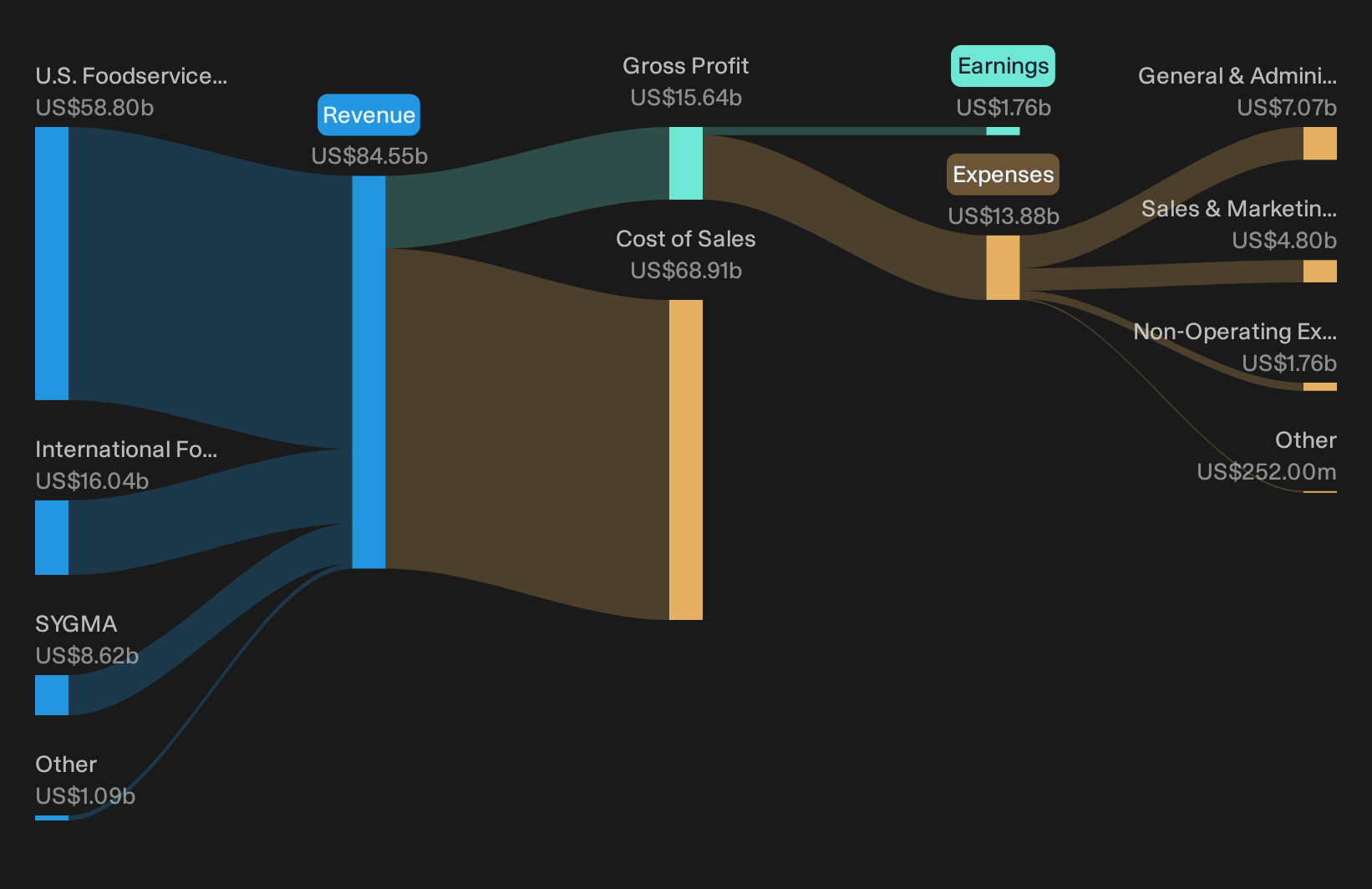
Sysco runs a global foodservice distribution network, with U.S. Foodservice Operations bringing in about US$58.8b, International Foodservice Operations around US$16b, SYGMA roughly US$8.6b and Other about US$1.1b, and the business carries a market value of roughly US$38.5b.
"Sysco is rolling out more than 30 AI and technology projects across sales, supply chain, merchandising and back office. The company has about US$100 million of in-year savings built into fiscal 2027 guidance and a targeted US$500 million profit improvement by fiscal 2029 that is aimed at higher operating margins and earnings."
What happens if a single efficiency push in Sysco’s vast distribution network shifts how much of each food dollar drops through to profit margins?
That margin swing is exactly where the full narrative for Sysco explains how Sysco’s AI projects could affect operating leverage, pricing power and competitive position in addition to the headline cost savings.
Seeking Fresh Alternatives Before They Fly
Some of the most interesting stories start moving quietly. By the time headlines catch up, the ideal entry can be gone. Scan fresh breakouts and under the radar ideas while it matters and consider getting in early.
- Spot potential inflection points in strong income payers by checking which companies in the 8 dividend fortresses could support a more dependable cash flow stream for your portfolio.
- Track early momentum in emerging computing trends and see which businesses in the 25 quantum computing stocks might benefit if quantum hardware and software adoption builds from here.
- Target resilient balance sheets before the crowd by reviewing the list of solid balance sheet and fundamentals (25 results) and focus only on companies that pair financial strength with grounded fundamentals.
This article by Simply Wall St is general in nature. We provide commentary based on historical data and analyst forecasts only using an unbiased methodology and our articles are not intended to be financial advice. It does not constitute a recommendation to buy or sell any stock, and does not take account of your objectives, or your financial situation. We aim to bring you long-term focused analysis driven by fundamental data. Note that our analysis may not factor in the latest price-sensitive company announcements or qualitative material. Simply Wall St has no position in any stocks mentioned.
Have feedback on this article? Concerned about the content? Get in touch with us directly. Alternatively, email editorial-team@simplywallst.com