
- PRICING
- LIVE QUOTES
- LEARN
- HELP


EN
Utility Pricing Power Might Change The Case For Investing In Valmont Industries (VMI)
- Valmont Industries recently reported firmer pricing in its North America utility business as solid demand intersects with higher steel and zinc costs, with management focused on passing more of these expenses through to customers.
- The key development is not just stronger pricing power, but also the ability of Valmont Industries to offset rising input costs without evident demand pushback in its core utility markets.
- We will examine how Valmont Industries’ investment narrative is affected by stronger North America utility pricing power amid rising material costs.
Scan other grid and infrastructure players that show firm pricing power in similar conditions by reviewing our curated 43 power grid technology and infrastructure stocks
Valmont Industries Investment Narrative Recap
To own Valmont Industries, you need to believe the utility grid buildout and agriculture technology opportunity stay intact while cost inflation remains manageable. The short term swing factor is still how quickly higher steel, zinc and freight costs are absorbed into new contracts. Recent signs of firmer North America utility pricing suggest some progress, but cost pressure has not disappeared.
The key risk remains a squeeze between material inflation and the two quarter pricing lag, especially if telecom weakness persists and mixes against Infrastructure margins. Stronger pricing power in utility helps offset that risk, although any slowdown in project awards or execution issues on capacity expansions would quickly refocus attention on that margin gap.
The latest commentary around firmer North America utility pricing ties directly into Valmont Industries’ plan to capture a US$6.7b regional opportunity pipeline and add about US$1b of utility revenue by 2029. Passing through more of the higher steel and zinc costs gives that growth plan a better chance of landing at the margin levels management is targeting.
This matters for the broader capture, strengthen, enable framework, which points to US$5.4b of sales, a 17% operating margin and about 21% ROIC by 2029. The ability to price through inflation in real time is central to that story. Without it, the risk of Infrastructure margin slippage grows, even with healthy grid demand and utility focused capex in the plan.
Valmont Industries’ analyst narrative points to about US$5.1b of revenue and US$550.5m of earnings by 2029, based on an assumed 6.8% yearly revenue growth rate and an earnings increase of roughly US$44.8m from about US$505.7m today.
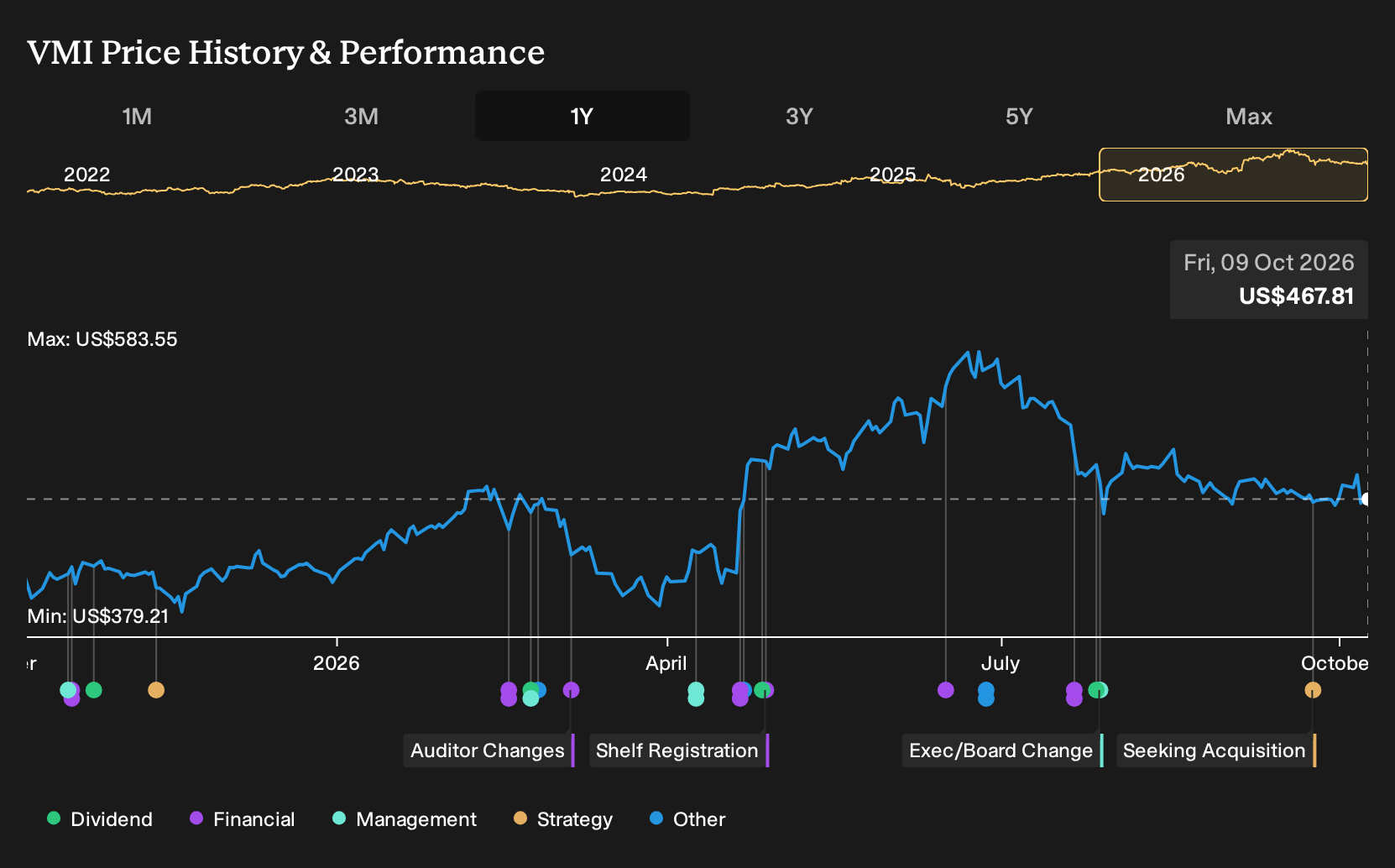
Uncover why Valmont Industries' fair value indicates a 33% potential upside to its current price, which could narrow quickly.
Exploring Other Perspectives
Three fair value views from the Simply Wall St Community put Valmont Industries anywhere between US$335 and US$624.5 per share, which is a wide band for the same stock. These private investors clearly disagree. When you add rising steel, zinc and diesel costs, plus telecom softness, you get a set of risks and catalysts that readers should test against several alternative viewpoints.
Explore 2 other Valmont Industries fair value estimates, including one that suggests up to 33% potential upside from the current price.
Decide For Yourself
Disagree with existing narratives? Extraordinary investment returns rarely come from following the herd, so go with your instincts.
- A great starting point for your Valmont Industries research is our analysis highlighting 5 key rewards that could impact your investment decision.
- See our latest analysis for Valmont Industries. The report includes a comprehensive fundamental analysis summarized in a single visual, the Snowflake, making it easy to evaluate Valmont Industries' overall financial health at a glance.
Looking For More Investment Ideas Beyond Valmont Industries?
If the Valmont Industries story has you thinking about where else pricing power, resilient demand or balance sheet strength might show up, it makes sense to widen the lens. The Simply Wall St Screener helps you filter the market quickly so you can focus on a shortlist that genuinely fits your risk appetite and return goals.
- For investors hunting for small companies with meaningful upside potential, scan our 14 elite penny stocks with strong financials that already show stronger financial underpinnings than the typical micro-cap.
- If valuation discipline is your priority, filter for sturdier fundamentals and reasonable pricing with a curated 28 high quality undervalued stocks that combine quality metrics with discounted multiples.
- For those who care most about resilience through the cycle, start with a 31 resilient stocks with low risk scores that screen well on balance sheet strength and business risk scores.
This article by Simply Wall St is general in nature. We provide commentary based on historical data and analyst forecasts only using an unbiased methodology and our articles are not intended to be financial advice. It does not constitute a recommendation to buy or sell any stock, and does not take account of your objectives, or your financial situation. We aim to bring you long-term focused analysis driven by fundamental data. Note that our analysis may not factor in the latest price-sensitive company announcements or qualitative material. Simply Wall St has no position in any stocks mentioned.
Have feedback on this article? Concerned about the content? Get in touch with us directly. Alternatively, email editorial-team@simplywallst.com