
- PRICING
- LIVE QUOTES
- LEARN
- HELP


EN
Damo is optimistic about the AI semiconductor market: TSMC has strong certainty, and the target price of Shengmei Semiconductor and Huirong Technology has room to rise by more than 50%
The Zhitong Finance App learned that in Morgan Stanley's latest report covering the semiconductor sector in Greater China, it gave an “attractive” industry rating for the AI semiconductor industry chain. Among the targets that can be invested in US stocks, Taiwan Semiconductor (TSM.US) is regarded by Dama as the most definitive beneficiary, and together with Shengmei Semiconductor (ACMR.US) and Huirong Technology (SIMO.US), form the core beneficiary group of AI computing power expansion.
TSM.US (TSM.US) has the strongest certainty
As the “seller” of AI computing power, TSMC has almost monopolized the two key aspects of advanced manufacturing processes and advanced packaging in the world. Damo gave TSMC an “increase in holdings” rating. The target price was NT$3088, which implied an upward margin of about 21% compared to the current NT$2,550, corresponding to about 22 times the expected price-earnings ratio in 2026.
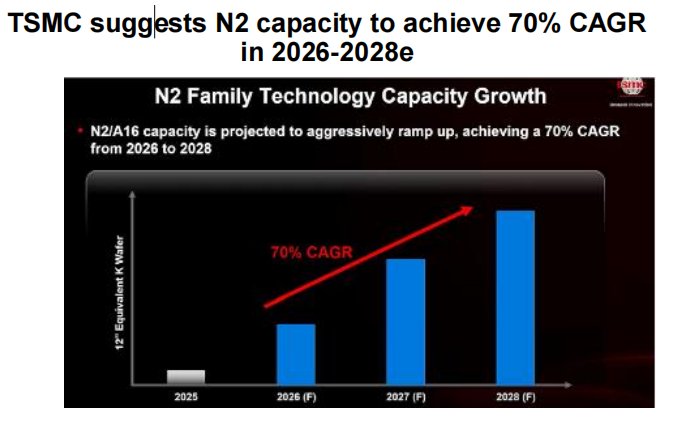
The report predicts that TSMC is expected to raise the price of advanced process wafers by 5% to 10% in 2027 — in a context where AI chips are in short supply, this shows its irreplaceable pricing power. The demand side is also solid: Damo estimates that its AI semiconductor revenue share will exceed 30% in 2026, and 2nm (N2) production capacity will expand at a compound annual growth rate of about 70%. With revenue growth diluting capital expenses, a gross profit margin of 60% is viewed as a “floor” rather than a “ceiling.”
In the field of advanced CoWOS packaging, Damo expects global demand to increase from 689,000 wafers in 2025 to about 2.5 million wafers in 2027, and TSMC's CoWOS production capacity may expand to 260,000 wafers per month in 2028. Damo estimates that in 2025, TSMC has produced about 5.1 million AI chips, and the annual GB200 NVL72 rack shipment volume is expected to reach 30,000 sets. Both GPUs and self-developed ASICs eventually converged into TSMC's foundry and packaging production capacity, making it the “greatest common denominator” of AI computing power expansion.
Shengmei Semiconductor (ACMR.US): Cleaning equipment faucet, target price of $115
In the semiconductor equipment sector, Damo gave Shengmei Semiconductor an “gain” rating. The target price is 115 US dollars. Compared with the current price of 70.8 US dollars, there is a significant upward space of about 62%, corresponding to about 25 times the expected price-earnings ratio in 2026. As a leading domestic manufacturer of cleaning equipment, Shengmei Semiconductor benefits from the dual logic of expanding production in local Chinese fabs and localization of advanced process equipment. EPS growth is expected to reach 104% in 2026.
Huirong Technology (SIMO.US): Memory control chip leader, target price $400
In the storage industry chain, Damo gave Silicon Motion (Silicon Motion) an “gain” rating, with a target price of 400 US dollars, implying about 53% upward space compared to the current $261.9, corresponding to about 22.8 times the expected price-earnings ratio in 2026. As a global leader in NAND storage control chips, Huirong Technology directly benefits from the NAND shortage and price increase cycle caused by AI storage. The EPS growth rate is expected to reach 263% in 2026.
Wonder Optoelectronics (HIMX.US): Display driver chip, neutral rating
In contrast, Damo maintains the “same as the general market” rating for Wonder Optoelectronics, with a target price of $17.4, implying about 31% upside compared to the current $13.3. As a display driver chip manufacturer, Wonder Optoelectronics's AI attributes are relatively weak. Although the EPS growth rate of 65% in 2026 is impressive, the valuation flexibility is not as flexible as the AI core target described above.
The “certainty” ranking of US semiconductors is clear
Based on Damo's rating system, the definitive ranking of AI semiconductor targets in the US stock market is very clear: TSMC is in the first tier with the “advanced process+CoWOS package” dual monopoly position; Shengmei Semiconductor and Huirong Technology have two high boom segments, respectively, to attract growth capital with the highest target price upward space; and Qijing Optoelectronics is rated neutral due to limited AI exposure.
However, Damo also raised concerns: the growth rate of AI semiconductors is expected to slow in 2027, and the capital expenditure growth rate of major cloud vendors may drop to around 12% in 2028. However, at the current juncture, no matter how the technology route evolves, TSMC, as the “greatest common denominator” of AI computing power, is still the most definitive US stock allocation direction among Daima Gan.