
- PRICING
- LIVE QUOTES
- LEARN
- HELP


EN
How Investors Are Reacting To Vistra (VST) $4.2b Nuclear Loan Commitment
- Vistra has received a conditional US$4.2b loan commitment from the U.S. Department of Energy to upgrade nuclear plants in Pennsylvania and Ohio, aiming to extend operating lives and increase nuclear output.
- The planned nuclear uprates support Vistra’s push toward long term contracted power for data centers and other large users, while potentially lowering financing costs through government backed rates.
- This article examines how Vistra’s investment narrative is shaped by the US$4.2b nuclear loan commitment and longer nuclear lifespans.
Vistra Investment Narrative Recap
To own Vistra, you need to believe that long term electricity demand from AI data centers and large customers will keep filling its fleet with contracted volumes across nuclear, gas, solar and storage. The conditional US$4.2b nuclear loan fits that view, since it ties more of Vistra’s output to regulated style funding and multi decade power contracts.
In the near term, the key swing factor is how quickly those long duration data center deals offset softer wholesale pricing and earnings volatility from hedging. The biggest risk is policy friction around large loads and capacity markets. Vistra’s pushback on PJM’s IRAS proposal shows how exposed its plan is to market rule changes.
The most relevant recent development for this story is Vistra’s filing at FERC that attacks PJM’s Interim Resource Adequacy Service. Management argues IRAS unfairly targets new large loads, including data centers, and distorts capacity price signals that generation projects rely on. For a company leaning into AI driven demand, that is not a side issue.
If IRAS or similar rules advance, the timing and profitability of new nuclear uprates and large scale contracts could be harder to predict. If regulators reject or reshape the proposal, Vistra’s long term agreements, such as the 20 year nuclear PPAs with Meta, sit on a more stable market design. That regulatory outcome sits right beside the nuclear loan as a core catalyst to watch.
Vistra’s Analyst Case Tied To Nuclear And AI Demand
Analysts are effectively treating Vistra as a high-demand grid platform that links long-term AI data center load to uprated nuclear assets, gas peakers, renewables and storage. The nuclear loan commitment feeds into that story because it lines up with projections that both revenue and margins could be higher by the late 2020s if more output ends up under contract instead of exposed to merchant swings.
In the current consensus view, the business today generates about US$2.0b of earnings with profit margins of 10.6%. Forecasters expect those margins to reach 15.6% over the next three years as more contracted data center volumes, nuclear life extensions and a broader mix across ERCOT and PJM support steadier cash flows. That margin shift matters at least as much as headline AI demand growth because it affects how much of every incremental dollar of power sales drops through to the bottom line.
Vistra's narrative projects US$26.0b of revenue and US$4.1b of earnings by 2029. This implies 10.7% yearly revenue growth and an earnings increase of about US$2.1b from US$2.0b today.
Consensus earnings of US$4.1b by around October 2029, with some analysts as high as US$4.9b, frame how much nuclear and data center driven demand is built into the AI power story. The step up from US$2.0b today points to a business model that leans heavily on larger, longer contracts and a higher share of output tied to assets such as nuclear plants that can run for decades if policy and economics line up. For investors, the question is less about whether AI adds load and more about how much of that load ends up in structures that resemble long-term infrastructure cash flows instead of short-cycle merchant exposure.
To translate those operating assumptions into a valuation, analysts suggest Vistra would be trading on a P/E of 21.5x those 2029 earnings. That multiple would be slightly below the 22.9x currently cited for the US Renewable Energy industry and down from Vistra's own 22.9x today, so the story in the consensus numbers is not one of a higher rating. It is one where earnings power tied to nuclear uprates, data center contracts and share count shrinking does more of the work than a richer multiple.
The model also incorporates a modest decline in shares outstanding of about 0.94% per year over the next three years, which lines up with Vistra's history of buybacks and capital returns. Fewer shares, combined with the expected rise in net income, mean that per share earnings grow faster than total profits in these projections. For a stock tied to long lead time nuclear and grid investments, that per share lens matters because it frames how much of the cash from AI-related projects flows to each investor rather than just into more capex.
On price targets, the analyst group clusters around a consensus of US$212.79 per share, based on those 2029 revenue and earnings figures and an assumed 8.0% discount rate. Within that, the spread is wide, from US$106.0 at the low end to US$305.0 at the top. That range reflects genuine disagreement over how quickly data center demand turns into signed contracts, how PJM and ERCOT rules evolve and how reliably nuclear uprates and DOE-backed funding translate into realized returns.
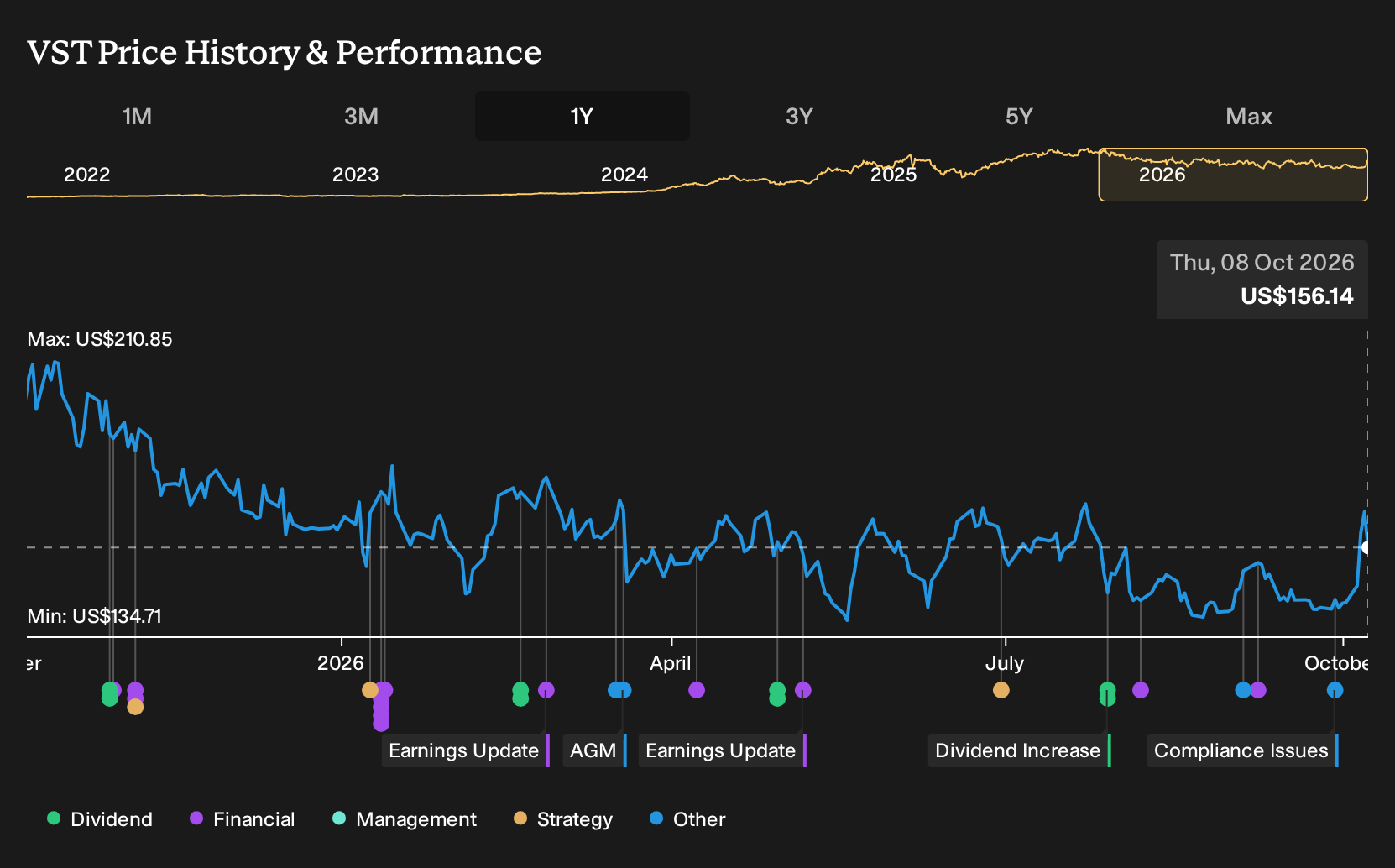
With the stock at US$138.35 as of the latest report, the average target implies a 35.0% higher price than today. The calculations behind that target rest on three key legs that all tie back to Vistra's nuclear and AI angle. First, that revenue can compound at 10.7% a year. Second, that earnings can reach US$4.1b by 2029 with margins improving by about 5 percentage points. Third, that investors are willing to value those earnings at around 21.5x, which sits a little below the renewable peer figure quoted in the report.
For readers weighing Vistra against other grid and data center linked stocks, those inputs offer a checklist rather than a verdict. If AI power demand, nuclear life extensions, capacity market rules and credit conditions all track close to the assumptions in the analyst models, then the current consensus narrative holds together. If any one of those pieces shifts meaningfully, the story around revenue growth, earnings power and the appropriate P/E for a company this tied to the US power system could look very different.
Uncover why Vistra's fair value indicates a 36% potential upside to its current price that could narrow quickly.
Exploring Other Perspectives
One alternate view focuses less on Vistra’s FERC push against IRAS and more on the risk that data center demand fizzles if efficiency and distributed energy grow faster than expected. The most cautious analysts were penciling in roughly flat revenue near US$19.6b by 2029 and a low US$106.0 target, which shows how sharply opinions can differ. Those estimates and the new nuclear loan news were set on different days, so investors may see both bullish and bearish narratives evolve as fresh information becomes available and may wish to consider several angles rather than rely on a single forecast.
Explore 10 other Vistra fair value estimates, including one that suggests it could be worth just $170.91.
Reach Your Own Conclusion
Don't just follow the ticker; dig into the data and build a conviction that's truly your own.
- A great starting point for your Vistra research is our analysis highlighting 2 key rewards and 2 important warning signs that could impact your investment decision.
- See our latest analysis for Vistra. The report includes a comprehensive fundamental analysis summarized in a single visual, the Snowflake, making it easy to evaluate Vistra's overall financial health at a glance.
Looking for more Vistra style investment ideas?
If the Vistra story has you thinking about how to position around power demand, cash flows and balance sheet strength, it can help to line it up against other businesses with different profiles before making any decisions.
- For readers who want potential mispricing paired with quality fundamentals, use the hand picked 27 high quality undervalued stocks and see which businesses the data flags as out of sync with their underlying strength.
- If income is your focus and you care about stability of payouts, scan the curated 8 dividend fortresses to spot stocks where stronger yields are backed by more resilient financial profiles.
- When capital preservation sits high on your list, start with the lower volatility end of the market by reviewing the targeted 31 resilient stocks with low risk scores and compare how these companies stack up on risk scores next to Vistra.
This article by Simply Wall St is general in nature. We provide commentary based on historical data and analyst forecasts only using an unbiased methodology and our articles are not intended to be financial advice. It does not constitute a recommendation to buy or sell any stock, and does not take account of your objectives, or your financial situation. We aim to bring you long-term focused analysis driven by fundamental data. Note that our analysis may not factor in the latest price-sensitive company announcements or qualitative material. Simply Wall St has no position in any stocks mentioned.
Have feedback on this article? Concerned about the content? Get in touch with us directly. Alternatively, email editorial-team@simplywallst.com