
- PRICING
- LIVE QUOTES
- LEARN
- HELP


EN
Starlink Sword points to the US mobile communications market, SpaceX (SPCX.US) opens up new room for growth: Wall Street focuses on reshaping the telecom industry pattern
The Zhitong Finance App learned that SpaceX (SPCX.US), the “AI+ Space Exploration” leader founded by Musk and with a market value of more than 2 trillion US dollars, plans to make a major acquisition of the US national 800 MHz spectrum portfolio held by Grain Management, involving up to 14 MHz of paired spectrum, which is a key step towards becoming a complete mobile communication operator. This important deal initiated by SpaceX is still awaiting approval from the US Federal Communications Commission (FCC). Some media reported that the transaction amount was about 8 billion US dollars, citing information revealed by people familiar with the matter. The market immediately re-assessed the competitive barriers of traditional telecom operators. The three traditional US operators — AT&T, Verizon, and T-Mobile — fell rapidly in post-market trading in the US stock market on Thursday. In particular, AT&T's stock price, which clearly refused to cooperate with SpaceX, fell by about 6% in recent years.
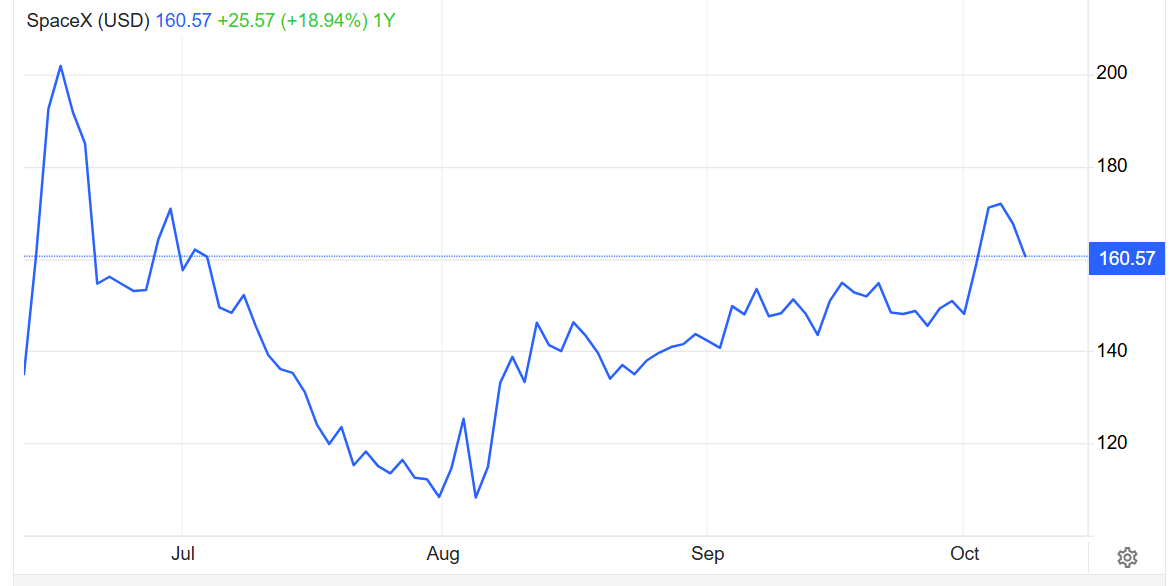
The news of this major acquisition comes at a time when SpaceX's stock price has rebounded sharply under a series of strong catalysts related to space AI data center construction plans and ground-based AI computing power infrastructure orders — since the beginning of August, SpaceX's stock price has rebounded sharply to nearly 50% from the bottom area after listing. Although SpaceX's regular trading closed down 4.19% to $160.57 on Thursday, it still had a cumulative rebound of about 48.3% from the closing low of $108.27 on August 5; after the announcement of the spectrum trading plan, the stock price quickly rebounded after the market. As of 16:30 Beijing time on October 9, US stocks reported a pre-market report of $166.47, and the stock price rebounded strongly close to 4% during the pre-market trading period.
The technical value of the latest acquisition plan is to promote the formation of a more complete Starlink network coverage system between the “Starlink” (Starlink) satellite Internet and terrestrial networks. Starlink's satellite network is good at covering remote areas and ground communication blind spots. The addition of low frequency spectrum helps improve penetrating connections, signal penetration capabilities and indoor coverage within buildings and complex shielded environments through ground system deployment. That is, satellite networks provide wide-area coverage and supplement blind spots on the ground, and low-frequency terrestrial networks improve connectivity within buildings and complex shielding environments, which complement each other.
Combining existing satellite capacity, SpaceX is completing the capabilities needed to upgrade from an “occasional emergency connection” to a “mobile service for everyday use.” Grain's official announcement clearly targets the deal to integrate terrestrial and space connections; at the same time, the FCC has approved SpaceX to deploy a new 15,000 satellite constellation of direct-connected terminals, opening up space for mobile business expansion. Judging from the investment logic, the expansion of the coverage scenario is expected to enable Starlink to further compete with primary card users, home broadband, and enterprise communication budgets from auxiliary service providers. Goldman Sachs, J.P. Morgan, Citi, and TD Cowen are bullish on the long-term bullish market of SpaceX's stock price — near/short-term revenue jumps driven by terrestrial AI computing power leasing, and long-term growth space is being expanded by Starlink satellite connections, high-frequency launch capabilities, and space AI data centers and AI application businesses.
Satellite internet interprets “The Rise of a New King”. Is SpaceX's Starlink about to change the rules of the global telecom industry game?
Market commentator The Kobeissi Letter wrote on the X platform that SpaceX's acquisition of the telecom asset portfolio will bring “one of the biggest disruptions in history” to the telecommunications and communications industry.
On Thursday, Elon Musk's SpaceX (SPCX.US) said the company is moving towards competition with major US mobile operators and announced that it has agreed to acquire up to 14 MHz of paired spectrum in the 800MHz band. The telecom industry was shocked by the news.
After the news was announced, shares of AT&T (T.US), T-Mobile US (TMUS.US), Verizon (VZ.US), and Comcast (CMCSA.US), another cable broadband internet service giant, all fell sharply, and their stock prices were still on a downward trajectory before Friday's market.
Telecom industry experts and Wall Street strategists generally believe that Starlink's formal entry into the telecommunications sector will completely disrupt the industry's long-standing pattern of market share consolidation.
Investor and social media opinion leader Sawyer Merritt wrote on the X platform: “The Starlink Mobile network is about to change the rules of the game.” Starlink is acquiring spectrum licenses, getting closer to becoming a supertelecom operator with more and more complete business coverage in the US.
The Kobeissi Letter stated in an article on the X platform that this development will bring “one of the largest disruptions in the history of the telecommunications and internet services industry.”
The Kobeissi Letter notes that for decades, the industry has had problems with insufficient competition, slow innovation, limited coverage, and increasingly mediocre service levels. The agency said, “SpaceX, the AI and commercial space giant with the stock code SPCX, is about to change all this. This is a clear reminder to the industry's current giants: either evolve or be left behind. ”
A team of analysts from William Blair, a well-known investment research institution on Wall Street, pointed out that existing wireless and telecom broadband operators have been publicly questioning whether the SpaceX network can achieve the service quality of their own networks. Analysts said, “We expect SpaceX to launch an attractive Starlink Broadband and StarLink Mobile package. The company may also add a subscription to the Grok B-side or C-side AI application into the package.”
Space and Tesla CEO Elon Musk said on social media X that the move fills “the last critical piece of the spectrum puzzle SpaceX needs to provide full smartphone communication coverage in the US.”
Currently, SpaceX provides mobile connectivity through the Starlink Direct to Cell smartphone direct satellite service, and cooperates with mobile operators such as T-Mobile in the US to allow existing 4G LTE or higher phones to directly connect to satellites in regions not covered by terrestrial cellular networks.
According to reports, among the three major telecom operators in the US, T-Mobile chose to be deeply tied to Starlink (Starlink), while AT&T chose Starlink's core competitor. T-Mobile and SpaceX have reached an exclusive agreement to use T-Mobile's frequency band (such as PCS band) with Starlink's Direct-to-Cell satellite to build a “space-based base station.” AT&T did not choose Starlink, but instead established a long-term exclusive commercial partnership with AST SpaceMobile, another famous satellite communications company, and made a direct strategic investment in it.
According to SpaceX's 2025 progress report, the service has enabled more than 12 million people to connect at least once; in remote or deep natural areas without traditional mobile network coverage, an average of more than 6 million people actively use the service every month.
Billionaire investor Chamas Parihapitia said on the X platform that the asset portfolio acquisition “is of great significance.”
In another post, Musk said, “This would sound crazy, but I saw a path where SpaceX could be worth several orders of magnitude higher than the current size of the Earth's economy.”
Mach33 founder and CEO Aaron Burnett wrote on the X platform that phones launched in 2027 and 2028 will be equipped with chipsets capable of natively supporting Starlink Mobile's other higher throughput spectrums. He said, “This is another part of the spectrum puzzle that has already been solved, but related discussions took place before SpaceX went public, so it hasn't received much attention.” Musk confirmed it by replying “yes” on the X platform.
Gene Munster, a senior fund manager from top asset management agency Deepwater Asset Management, explores the possibility that Starlink will soon launch its own mobile device.
He wrote on the X platform: “Elon said he doesn't want to make a phone. But I still think SpaceX will eventually do this.” Munster said that a phone vertically integrated with the Starlink Mobile network can provide features that other telecom operators cannot match, and communication services will be much cheaper.
He said, “This will be a bigger problem for Samsung than for Apple. Apple's tight connection between devices and services is even harder to break.”
Earlier this year, Musk said it was “not impossible” to launch a Starlink phone. He said on the X platform that the phone launched by the company will be “very different” from existing phones and will be specially optimized to run neural networks at maximum performance per watt.
However, Musk confirmed in February that SpaceX was not developing mobile devices at the time, quelling related rumors.
Following the release of the latest SpaceX news, these telecom operators have received attention on the investment platform Stocktwits retail interaction platform. At press time, retail investor sentiment surrounding SPCX (SpaceX) shares was “bullish,” while discussions continued to be at a “high” level. The stock is also one of the hottest stock symbols on the platform.
One user said, “SpaceX -- SpaceX, owned by Elon Musk, has just taken a major step to challenge the traditional US communications industry. Stocks such as AT&T, T-Mobile, and Verizon are suffering a severe setback.”
However, another user said, “VZ, T—don't worry about Starlink. Both companies will stay strong for a long, long time.”
Meanwhile, retail sentiment surrounding AT&T shares remains “bullish” despite AT&T share price declines
From “signal blindness correction” to “user competition”: Starlink is rewriting the competitive boundaries of the telecommunications industry
The construction of its own spectrum and autonomous network will enhance SpaceX's control over product pricing, customer relationships, and package combinations. William Blair's team of stock analysts anticipates that SpaceX may launch an attractive “Starlink Broadband+Starlink Mobile” combination, or even join the Grok service. The investment implication of this concept is to expand individual customer revenue contributions and reduce customer acquisition costs through cross-selling of household, mobile, and AI services.
The stock prices of the three traditional US telecom operators, including AT&T, are under pressure, reflecting that the market is beginning to recapture the possibility of future loss of users, negative price competition, and increased operating expenses for customer retention; Starlink is very likely to obtain a larger market that the telecom industry can serve.
Wall Street's overall prospects for SpaceX's stock price and fundamental growth are clearly too high: out of 38 Wall Street analysts compiled by S&P Global, 30 gave “buys” or “strong purchases,” with an average target price of $225.61. Focusing on SpaceX's core bullish investment logic, analysts are forming a mutual combination of “leasing and selling AI computing power resources to expand recent revenue, Starlink mobile services expand the long-term user market, and launch capacity to support network expansion.” This spectrum acquisition further enhances the commercial integrity of satellite internet, communication, and connectivity services, and also gives the market reason to evaluate the company from a broader perspective of infrastructure platforms.
Anthropic has announced that it will use the full computing power of SpaceX's Colossus 1, involving more than 300 MW of capacity and more than 220,000 Nvidia GPUs, directly supporting Claude to increase service limits. A computing power lease contract announced by Google with SpaceX involves about 110,000 Nvidia GPUs and supporting components, and it is agreed to pay 920 million US dollars monthly from October 2026 to June 2029; after the end of 2026, the two parties can terminate it 90 days in advance. These deals revealed another commercialization path for SpaceX: rapid deployment of computing power, which not only serves large iterations of its own models, but also meets the needs of other model developers.
After the news of the spectrum acquisition came out, Wall Street financial giant J.P. Morgan Chase maintained the “accumulation” bottleneck of SpaceX in the latest research report, stressing that Starlink is advancing towards a complete “satellite+ground” mobile network, long-term commercialization is more credible, and the market space extends to the Internet of Things, autonomous driving, and robotics.
J.P. Morgan said that the proposed purchase of Grain's 800MHz and maximum 14MHz spectrum enhances indoor coverage, complementing the coverage and capacity with the 65MHz medium frequency spectrum of the proposed EchoStar; if there is no MVNO agreement to rent an existing US operator network, SpaceX will likely need to build a terrestrial macro base station network to provide an experience comparable to traditional operators. Low-frequency reserves are still far less than AT&T's 90MHz, so J.P. Morgan expects subsequent acquisitions and believes that Anterix's 900 MHz spectrum, valued at around $2.6 billion, is particularly suited to demand.
Spectrum competition will also extend to auctions: SpaceX is likely to participate more actively in the 2027 Upper C-Band and pre-2028 1.6, 2.7, 4.4, and 7 GHz band auctions. J.P. Morgan believes that there is room for improvement in the previous total auction expenditure benchmark of about 40 billion US dollars. The optimistic scenario is about 53 billion US dollars, corresponding to 0.75 and 1 US dollar per covered population per MHz; the FCC target of more than 100 billion US dollars in auction revenue by 2028 is also more likely to be achieved. The three major operators are under pressure to add new competitors and rising spectrum procurement costs, but construction of terrestrial networks is time-consuming and expensive, and the recent fundamental impact has been limited.
J.P. Morgan believes that tower leasing is another major beneficiary. Based on the assumption of 60,000 to 70,000 macro stations and monthly rent of $1,800-2,000 per station, J.P. Morgan estimates that the annual tower rent after full deployment is about 1.6 billion to 1.8 billion US dollars, corresponding to incremental leasing opportunities for AMT, CCI, and SBAC of about 10% to 12%. The core market exposure is greatest with CCI, followed by AMT and SBAC; site selection depends on building coverage requirements, and capacity still needs to be supplemented by additional spectrum or more intensive co-location deployments. The three major operators can further boost tower rents in the medium term, while long-term competition may reduce industry investment.
The Citigroup analyst team believes that the deal favors SpaceX and Tower and continues to disrupt the valuations of telecom and cable operators. The core change is that Starlink establishes a national mobile network through “satellite+macro base station+small base station” to directly manage user relationships.
The proposed purchase of the 800 MHz spectrum is about 7 MHz each, which complements Echo Star's 65 MHz intermediate frequency; currently, Starlink still uses the 10 MHz spectrum leased from T-Mobile. The FCC approved 15,000 new 2GHz satellites and the v3 return band, but if the low frequency goes directly to the star, the satellite design may need to be adjusted. As a result, Citi anticipates that terrestrial networks will assume important coverage and capacity, and that satellites will supplement rural and other markets, and that spectrum will still need to be expanded in the future.
Citi emphasized that capacity decisions can compete for the market. According to satellite model estimates, the EchoStar transaction, the addition of the Grain transaction, and the purchase of an additional 40 MHz Upper C-band supports about 17 million, 19 million, and 28 million users respectively; the geospatial fusion model corresponds to the latter two scenarios of about 19 million and 31 million, which is equivalent to 7% and 11% of the post-paid mobile phone market, bringing about 45.2 billion and 76 billion US dollars in scenario valuation gains to SpaceX, accounting for about 2% and 3% of the market value. The high scenario corresponds to the market capitalization risk of about 13% of the three major operators, Charter about 17%, and Comcast about 3%.
Operators have retreated an average of about 17% from their high point during the year. Citi believes that the risk is partially measured, and it is expected that it will not substantially impact the performance of the three major operators until at least 2029. Over the next 6 to 18 months, extended switching cycles and low churn rates can improve profits; splitting tariffs, mobile and broadband bundling, and network investment will form a response. Concerns that smart devices will reduce package revenue and increase spectrum investment are still suppressing valuations, and operators are not expected to provide competitive MVNO cooperation conditions in the short to medium term.