
- PRICING
- LIVE QUOTES
- LEARN
- HELP


EN
Did Storm Response Activation Just Shift DaVita (DVA) Stock Investment Narrative?
- DaVita has already activated its emergency response plan after recent severe weather, coordinating with care centers and agencies so dialysis patients can keep accessing treatment, medicines and emergency supplies despite flooding, storm surge and power risks.
- The response highlights how extreme weather can strain DaVita's operating model, with potential effects on staffing, facility uptime, logistics costs and care continuity in regions exposed to storms.
- The next area of focus will be how DaVita's emergency dialysis response and operational resilience could influence the broader investment narrative.
DaVita Investment Narrative Recap
To be a shareholder in DaVita, you need to believe this dialysis operator can keep core treatment volumes steady while using integrated kidney care and clinical tools to offset tight reimbursement and a high debt load. The emergency response activation underlines how essential its services are, but the financial impact from one storm looks limited relative to the broader earnings drivers.
The bigger short term swing factor still sits with U.S. dialysis economics, payer mix and whether operating expenses tied to technology and support functions stay in check. Flooding, storm surge and outages can add temporary costs and disruption. They do not change the key risk around reimbursement updates that may lag underlying cost trends.
The most relevant datapoint alongside this severe weather response is the focus on DaVita’s Integrated Kidney Care business, which analysts expect to add about US$20 million of adjusted operating income in 2026 and roughly 1 percentage point of ongoing contribution. That arm depends on tight coordination, data and care continuity, all of which get stress tested in storms.
For you as an investor, the link is execution. If DaVita can keep treatment access stable through events like this while still scaling integrated care, it reinforces the idea that non facility revenue streams can help offset reimbursement and payer mix pressure. If storm related costs creep higher or outages drag on, it could sharpen attention on how much cushion those programs really provide against margin strain.
What The DaVita Forecasts Assume
Forecasts around DaVita lean heavily on a clear set of numbers rather than broad stories. The sell side is working off a view that revenue rises by 4.6% per year over the coming three years, while profit margins move from 5.9% today to 6.9% on roughly the same timetable. Those inputs shape how much room the business might have to absorb weather related disruption, higher labor costs or technology spending without eroding overall profitability.
On earnings, analysts are anchoring on current profit of US$822.5 million and a consensus target of US$1.1b by 2029. That implies an increase of about US$277.5 million in annual earnings over the forecast period, with the group using earnings per share of US$22.51 as a key reference point. For portfolio construction, it matters that the share count is expected to fall about 7% a year for the next three years, because it means part of that earnings bridge reflects fewer shares rather than only higher operating profit.
Valuation work around DaVita then ties those operating assumptions back to what investors are currently paying. The consensus P/E implied by the 2029 earnings estimate sits at 13.0x, compared with 14.1x today and an industry level quoted at 24.0x for US healthcare. That leaves investors weighing whether a lower future P/E multiple on higher earnings is an efficient way to get exposure to kidney care resilience, or whether the current multiple already captures most of that story given the reimbursement and cost risks still on the table.
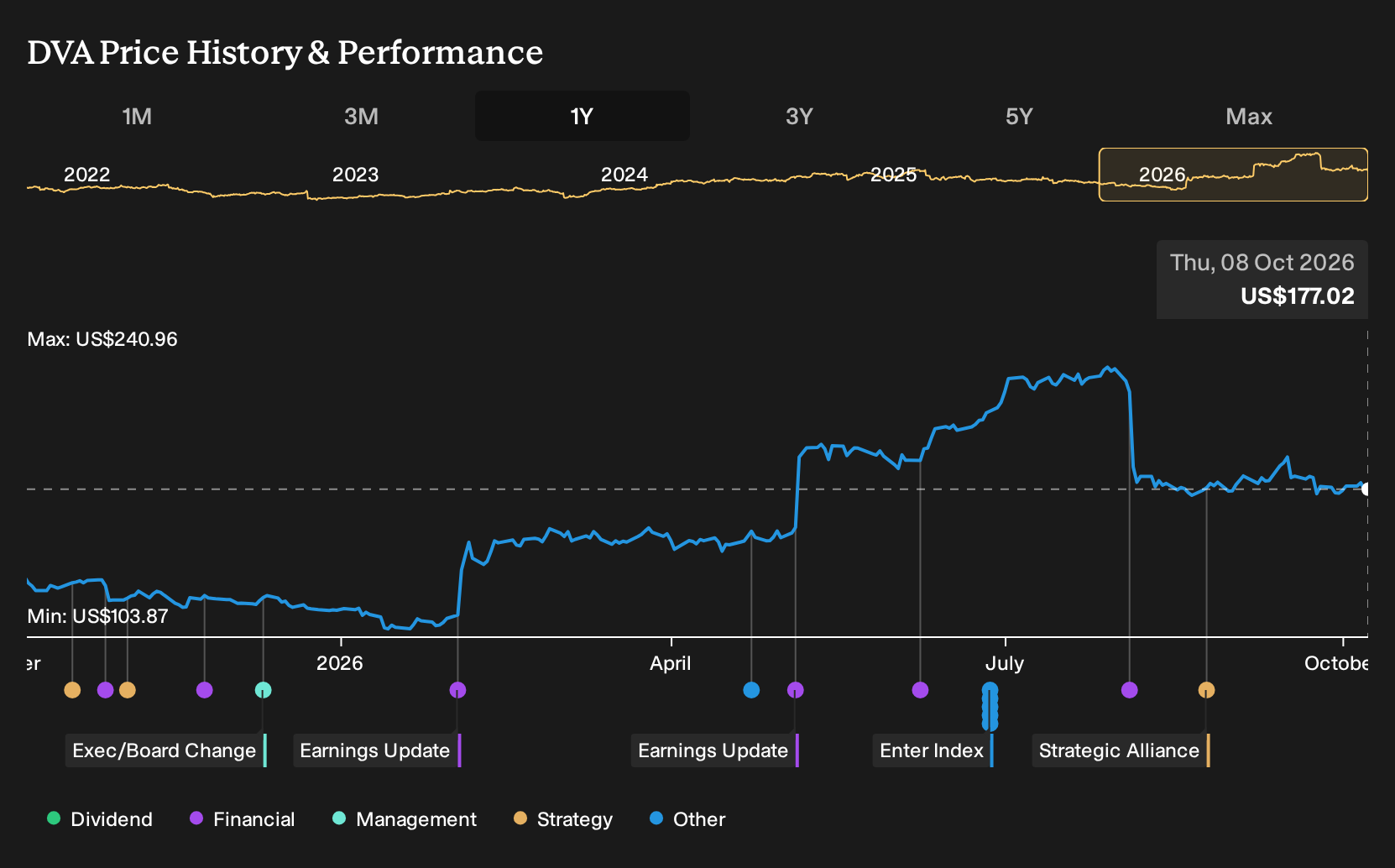
Analysts fold these metrics into a price target of US$219.86, which is 17.1% above the recent share price of US$182.34, while the most optimistic and most cautious targets sit at US$270.0 and US$165.0 respectively. The forecast package that underpins those numbers includes projected 2029 revenue of US$16.1b and earnings of US$1.1b, discounted at about 8.4% to reflect risk. For you as an investor, the question is not whether those inputs are precise, but whether they feel reasonable given what you have already seen from DaVita around integrated kidney care, capital allocation and severe weather response.
DaVita's outlook ties these elements together by pointing to forecast revenue of US$16.1b and earnings of US$1.1b by 2029, built on 4.6% yearly revenue growth and an earnings increase of about US$277.5 million from US$822.5 million today.
Uncover why DaVita's fair value indicates a 24% potential upside to its current price before other investors close the gap.
Exploring Other Perspectives
One alternate view zooms in on volume risk from severe events like this storm. Bullish DaVita analysts were previously modeling about US$16.5b of revenue and US$1.1b of earnings by 2029, versus the consensus US$16.1b and US$1.1b. If storms keep disrupting treatments, those more optimistic assumptions might shift. It may be useful to explore both sets of expectations before deciding what feels realistic.
Explore 2 other DaVita fair value estimates, including one that suggests as much as 158% upside from the current price!
The Verdict Is Yours
Disagree with existing narratives? Extraordinary investment returns rarely come from following the herd, so consider developing your own view based on thorough research.
- A great starting point for your DaVita research is our analysis highlighting 3 key rewards and 1 important warning sign that could impact your investment decision.
- See our latest analysis for DaVita. The report includes a comprehensive fundamental analysis summarized in a single visual, the Snowflake, making it easier to review DaVita's overall financial profile at a glance.
Looking For More Ideas Beyond DaVita?
If the DaVita story has you thinking about how resilient healthcare exposure fits into your portfolio, it can help to scan a wider set of opportunities that line up with your risk tolerance, income needs and balance sheet preferences.
- For investors who want potential mispricings with quality fundamentals, start by reviewing a curated set of 27 high quality undervalued stocks that may offer more earnings power than their valuations suggest.
- If capital preservation and steadier profiles matter most to you, focus on a 31 resilient stocks with low risk scores that screens for businesses with more resilient operating and financial characteristics.
- For those who care about durability as much as upside, consider a list of solid balance sheet and fundamentals (25 results) that can help you filter for companies with stronger finances supporting their long term plans.
This article by Simply Wall St is general in nature. We provide commentary based on historical data and analyst forecasts only using an unbiased methodology and our articles are not intended to be financial advice. It does not constitute a recommendation to buy or sell any stock, and does not take account of your objectives, or your financial situation. We aim to bring you long-term focused analysis driven by fundamental data. Note that our analysis may not factor in the latest price-sensitive company announcements or qualitative material. Simply Wall St has no position in any stocks mentioned.
Have feedback on this article? Concerned about the content? Get in touch with us directly. Alternatively, email editorial-team@simplywallst.com