
- PRICING
- LIVE QUOTES
- LEARN
- HELP


EN
What Verizon Communications Stock Means For Shareholders After SpaceX Spectrum Deal
- SpaceX agreed to acquire a nationwide 800 MHz spectrum portfolio to build a hybrid Starlink Mobile network that can compete directly with Verizon Communications in mobility and broadband services.
- The move introduces a new kind of rival that blends satellite and terrestrial coverage. This could pressure Verizon Communications, where its long term thesis leans most on connectivity scale and network quality.
- The next focus will be how Verizon Communications long term investment narrative absorbs a Starlink Mobile competitor built on newly acquired spectrum.
Verizon Communications Investment Narrative Recap
To own Verizon Communications you need to be comfortable with a slow growth, capital heavy story where the thesis leans on 5G, broadband and cost discipline rather than rapid expansion. The key near term swing factor is whether combined mobility and broadband revenue keeps tracking guidance as competition intensifies and wireless service revenue pressure lingers.
SpaceX’s spectrum deal raises a fresh long term threat but does not change Verizon Communications near term execution focus. The bigger immediate risk is still elevated competitive intensity in postpaid and fixed wireless, which could squeeze pricing and margins if customer churn ticks higher or promotions stay aggressive.
The new joint venture with AT&T and T Mobile to extend coverage in underserved areas looks most relevant against the Starlink Mobile headlines. Verizon Communications is aligning with peers to improve reach, support direct to device satellite links and provide more resilient emergency connectivity, which all feed directly into the connectivity scale story.
For investors, that joint venture sits alongside fixed wireless and fiber build out as a practical execution lever, not just a headline partnership. Success would support the idea that Verizon Communications can keep filling coverage gaps and defend network quality, while the operational risk is that coordination, capital needs and regulatory oversight dilute the benefits.
Verizon Communications Forecasts and Valuation Check
Verizon Communications is being modeled against a fairly tight set of analyst expectations, which gives you a clear reference point for what the market is already pricing in. Consensus work suggests a slow and steady revenue path, higher profitability over time and a share price that many analysts see as roughly aligned with those assumptions.
On the top line, analysts are building their models on revenue growth of 2.1% a year over the next three years. That is a modest pace for a large telecom group and it fits the idea that Verizon Communications is more of a cash generating, infrastructure heavy operator than a high growth story.
Earnings assumptions do more of the heavy lifting. The analyst group expects profit to move from US$16.2b today to US$23.0b by 2029, with some estimates running as high as US$25.9b. That implies an earnings increase of about US$6.8b from current levels to the US$23.0b consensus figure.
Verizon Communications' narrative projects US$147.7b revenue and US$23.0b earnings by 2029. This requires 2.1% yearly revenue growth and an earnings increase of about US$6.8b from US$16.2b today.
Analysts also assume profit margins rise from 11.6% today to 15.6% over the next three years. That margin lift, combined with limited share count reduction of roughly 1.46% per year, helps explain how moderate revenue growth still feeds into a much larger earnings pool.
On valuation, the consensus view pulls these pieces together into a 2029 picture where revenues reach US$147.7b and earnings sit at US$23.0b. For those numbers to line up with current analyst models, Verizon Communications would trade on a P/E of 11.2x in that year, compared with 12.4x today and a current GB telecom sector P/E of 21.2x.
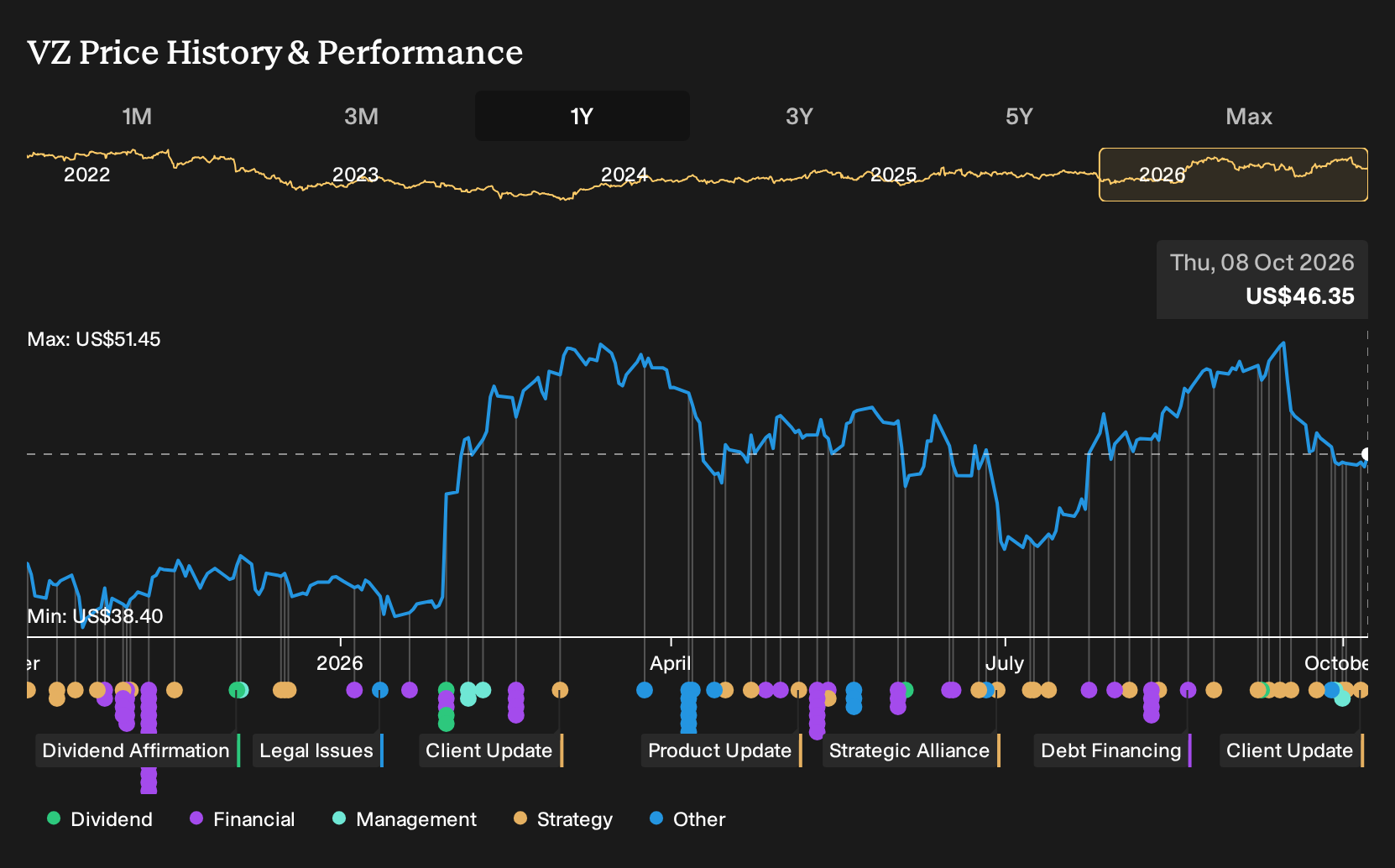
At a current share price of US$48.09 and an average analyst target of US$51.58, the implied upside sits at 6.8%. That relatively small gap signals that many analysts see Verizon Communications as roughly fairly valued against their forecasts rather than mispriced in either direction.
The wide spread between the most bullish US$71.00 target and the lowest US$44.00 target underlines how much opinion still differs on execution, competition and capital allocation. For an individual investor, that range is a prompt to stress test whether the 2.1% revenue growth rate, the jump in profit margins and the US$23.0b earnings line in 2029 feel realistic given personal views on wireless competition and the impact of new entrants like Starlink Mobile.
Uncover why Verizon Communications' fair value indicates an 11% potential upside to its current price that could narrow quickly.
Exploring Other Perspectives
One alternate view leans hard into fixed wireless as the catalyst. Before the Starlink Mobile spectrum news, the most optimistic Verizon Communications analysts were already penciling in US$151.3b of revenue and US$26.0b in earnings by 2029. You can now ask whether those bullish broadband and 5G expectations still hold or need a reset as satellite competition and new reseller deals like SKYBOXE enter the picture.
Explore 6 other Verizon Communications fair value estimates, including one that suggests as much as 292% upside from the current price!
The Verdict Is Yours
Don't just follow the ticker. Dig into the data and build a conviction that's truly your own.
- A great starting point for your Verizon Communications research is our analysis highlighting 3 key rewards and 1 important warning sign that could impact your investment decision.
- See our latest analysis for Verizon Communications. The report includes a comprehensive fundamental analysis summarized in a single visual, the Snowflake, making it easy to evaluate Verizon Communications' overall financial health at a glance.
Looking for more investment ideas beyond Verizon Communications?
Once you have a handle on Verizon Communications, it can help to widen the lens and compare it with other businesses that fit different risk and income profiles using the Simply Wall St Screener.
- For potential value opportunities backed by stronger fundamentals, review a curated 27 high quality undervalued stocks that may suit investors who want quality on sale.
- If capital preservation and steadier profiles matter most to you, filter the market using a 31 resilient stocks with low risk scores that screens for resilience first.
- For those hunting for companies with healthier finances and robust fundamentals, sort through a list of solid balance sheet and fundamentals (25 results) to see which businesses clear a higher quality bar.
This article by Simply Wall St is general in nature. We provide commentary based on historical data and analyst forecasts only using an unbiased methodology and our articles are not intended to be financial advice. It does not constitute a recommendation to buy or sell any stock, and does not take account of your objectives, or your financial situation. We aim to bring you long-term focused analysis driven by fundamental data. Note that our analysis may not factor in the latest price-sensitive company announcements or qualitative material. Simply Wall St has no position in any stocks mentioned.
Have feedback on this article? Concerned about the content? Get in touch with us directly. Alternatively, email editorial-team@simplywallst.com