
- PRICING
- LIVE QUOTES
- LEARN
- HELP


EN
Is Blue Owl Capital (OWL) Undervalued After Its Insurance And AI Real Assets Push?
Blue Owl Capital (OWL) is drawing fresh attention after management outlined a push to manage more insurance capital and deepen ties with insurers, while expanding into real assets such as data centre infrastructure linked to AI demand.
Recent trading has been choppy for Blue Owl Capital, with the share price falling 17.4% over the past 30 days and the year-to-date share price return down 39.5%, even though the 1-year total shareholder return of a 38.4% decline already reflects dividends. Short-term gains of 1.8% over one day and 3.6% across seven days hint that some investors are revisiting the story as management leans into insurance capital and AI-linked real assets. However, the 3-year total shareholder return decline of 20.1% and 5-year total shareholder return decline of 25.8% show that sentiment has been weak for a while.
Compare Blue Owl Capital's recent volatility with hand-picked alternatives by scanning the 27 high quality undervalued stocks, which pair balance sheet strength with cash flow support for their valuations.
So with Blue Owl Capital reshaping itself around insurance capital and AI linked real assets after a sharp pullback, does this risk reward profile still tilt toward patient buyers or suggest caution on valuation?
Most Popular Narrative: 27% Undervalued
Blue Owl Capital's most followed narrative pegs fair value at about $12.74 using an 8.33% discount rate, versus a last close of $9.27. This frames the recent pullback as a sizable gap between price and that fair value view.
Significant ongoing growth in permanent capital vehicles, particularly through expansion in private credit, real assets, and evergreen/interval fund strategies, is providing stable and recurring management fee revenue and positioning Blue Owl for higher future earnings and durable margin expansion.
See why 60 investors see Blue Owl Capital as 27% undervalued.
Result: Fair Value of $12.74 (UNDERVALUED)
Still, the Blue Owl Capital story can be knocked off course if acquisition integration drags on profitability or if fundraising slows and fee earning assets lag expectations.
Find out about the key risks to this Blue Owl Capital narrative.
Another View: What Blue Owl Capital’s P/E Is Telling You
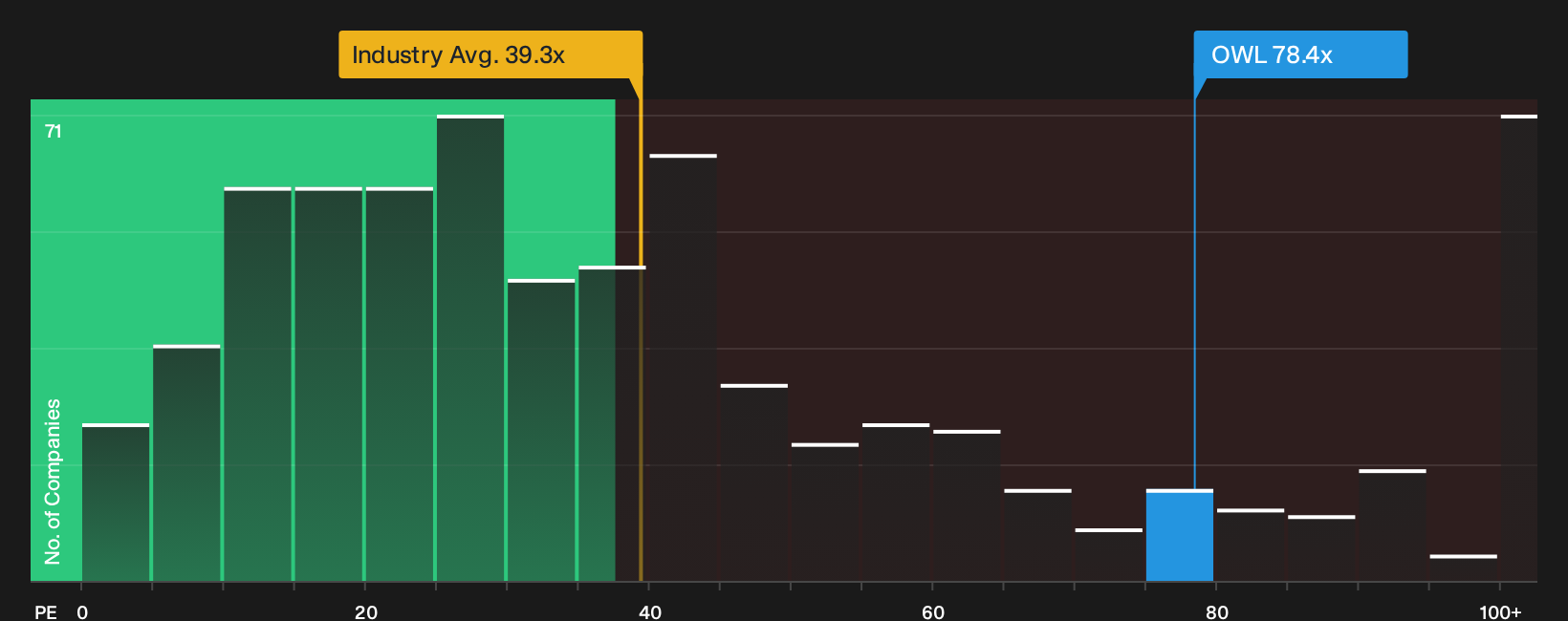
The fair value narrative around $12.74 presents Blue Owl Capital as 27% undervalued. The P/E perspective suggests a different interpretation. At about 78.4x earnings versus a US Capital Markets average of 39.3x and a fair ratio of 18.3x, the stock trades on a relatively high multiple that reflects a substantial amount of anticipated execution success.
That kind of gap can work in either direction. If earnings and fundraising align with the bullish projections, the current valuation may remain consistent with those expectations. If they do not, there is room for the market multiple to move closer to that fair ratio, which would put pressure on the share price. Which outcome do you think the current P/E is effectively pricing in?
See what the numbers say about this price, See what the numbers say about this price — find out in our valuation breakdown.
Next Steps
If this mix of pressure and optimism around Blue Owl Capital leaves you undecided, move quickly to review the latest data and carefully weigh both the 2 key rewards and 3 important warning signs.
Looking for more ideas beyond Blue Owl Capital?
If Blue Owl Capital feels finely balanced for now, you may want to broaden your opportunity set with fresh ideas that match your risk tolerance and income goals.
- Target resilient balance sheets and steady fundamentals by scanning the list of solid balance sheet and fundamentals (25 results) before the next bout of volatility catches you unprepared.
- Hunt for underappreciated potential by reviewing the 20 high quality undiscovered gems so you are not only focused on the most widely followed tickers.
- Prioritise staying power with controlled downside by checking the 31 resilient stocks with low risk scores while markets are still giving you time to reposition.
This article by Simply Wall St is general in nature. We provide commentary based on historical data and analyst forecasts only using an unbiased methodology and our articles are not intended to be financial advice. It does not constitute a recommendation to buy or sell any stock, and does not take account of your objectives, or your financial situation. We aim to bring you long-term focused analysis driven by fundamental data. Note that our analysis may not factor in the latest price-sensitive company announcements or qualitative material. Simply Wall St has no position in any stocks mentioned.
Have feedback on this article? Concerned about the content? Get in touch with us directly. Alternatively, email editorial-team@simplywallst.com