
- PRICING
- LIVE QUOTES
- LEARN
- HELP


EN
Lucid Stock Might Have Bottomed, But Only Speculators Should Bet on LCID Here
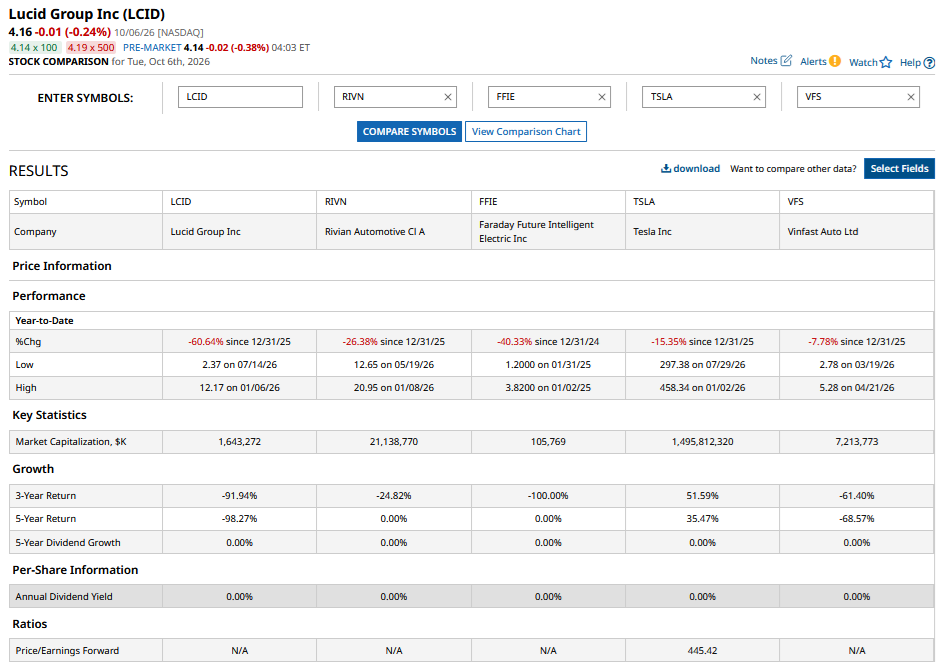
Things have been tough for electric vehicle (EV) stocks this year, even though the rise in gas prices should have theoretically been a positive for the sector. Looking at U.S. companies, Tesla (TSLA) and Rivian (RIVN) are down 17% and 27% year-to-date (YTD), respectively.
Lucid Group (LCID) is among the worst performers, losing 64% so far this year. Once hailed as the “next Tesla," the company has failed to live up to expectations, and while the EV industry meltdown is surely to blame, the company’s execution has also not been up to the mark.
Amid burgeoning cash burn and mounting unsold inventories, which resulted from persistent overproduction in a weak demand environment, Lucid announced an “operational reset” on the second-quarter 2026 earnings call. Among others, CEO Silvio Napoli laid out plans to improve cash flow by $1.4 billion by the end of the year. The company expects to meet the target through workforce reductions, lower capital expenditures and working capital, and operational efficiencies.
Lucid’s Q3 Deliveries Fell Short of Expectations
The plan is in action, and Lucid has lowered production rates to align with demand. In Q3, the company produced 2,954 vehicles while delivering 3,806 units. The delivery numbers, however, fell short of expectations. Meanwhile, Tesla and Rivian beat expectations, with the latter’s deliveries rising to a record high. Notably, while Lucid and Rivian went public in the same year and have gone through a similar EV boom-and-bust cycle, Rivian has fared a lot better in terms of execution.
Coming back to Lucid, I noted in early September that the stock was not a “buy” yet despite falling into the penny stock category. LCID stock has fallen from those levels, continuing its downtrend. With that in mind, let's explore what it would take for a sustained recovery in Lucid stock.
What Works in Lucid’s Favor?
Let's first look at some of the factors working in Lucid's favor. With several startup EV players bankrupt and the Detroit “Big Three” pulling back from their once-ambitious electrification plans, we now have a handful of companies remaining. Given Elon Musk’s politics, many buyers have become wary of Tesla, leaving room for names like Rivian and Lucid. On a similar note, since Tesla has its own robotaxi business — supposedly a key driver of its mammoth $1.5 trillion valuation — ride-hailing companies have been partnering with other EV players.
Last month, Bolt and Lucid announced a partnership, with the former planning to deploy at least 25,000 Lucid vehicles as it works toward its goal of reaching 100,000 robotaxis by 2035. Last year, Uber (UBER) also partnered with Lucid for robotaxis, investing in the company as part of the agreement. In April 2026, the two companies then expanded their partnership to at least 35,000 vehicles.
Meanwhile, Saudi Arabia plans to buy up to 100,000 Lucid EVs. The Saudi government is incidentally Lucid’s biggest shareholder through affiliates of its sovereign wealth fund, and its support has helped keep the company from going bankrupt.
While Lucid might have faltered on execution, it still boasts a quality portfolio of vehicles that have received rave reviews from credible third parties. Luxury carmaker Aston Martin (ARGGY) has also partnered with Lucid to buy electric motors and batteries, which helps validate Lucid’s claim that it offers a world-class product.
To sum it up, a formidable product, continued Saudi cash infusion, and robotaxi partnerships are three key reasons making Lucid investment-worthy.
Lucid Has Shown Strong Support Near $4
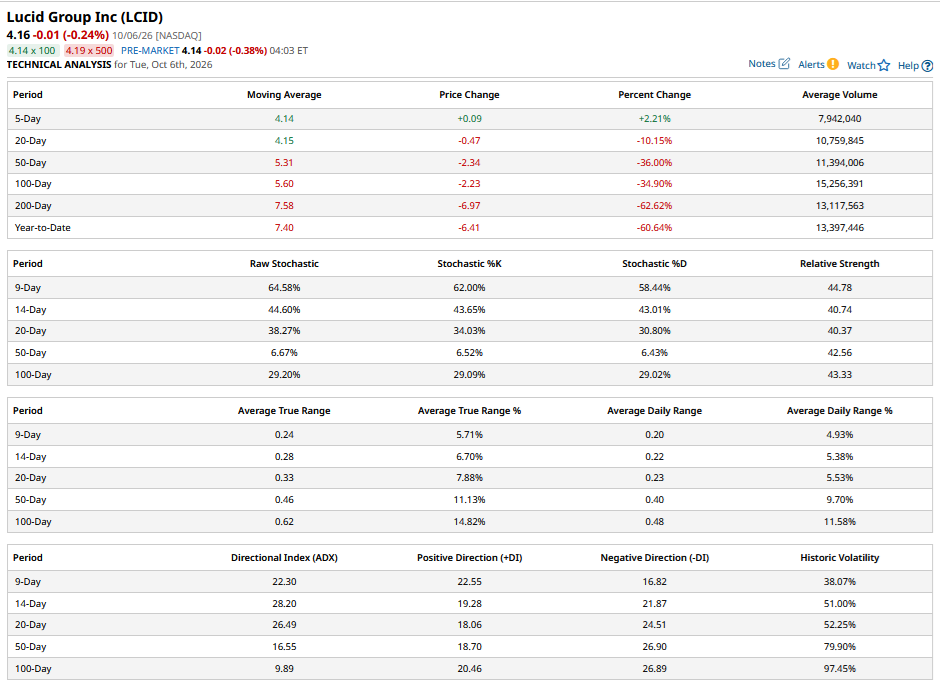
Lucid stock fell to its all-time low on July 14 amid bankruptcy rumors, which the company denied. LCID stock rebounded sharply but subsequently pared back those gains. However, the stock has shown strong support near the $4 level overall. Currently, Lucid trades at $3.82 per share.
In terms of valuation, the stock trades at a forward enterprise value-to-sales (EV/S) multiple of 3.7 times, which is somewhat higher than where it was the last time I covered the stock. While LCID stock has fallen over that period, analysts have also lowered their revenue estimates, modeling fewer deliveries.
All told, I believe Lucid’s risk-reward is a lot more balanced near the $4 level. However, a sustained recovery would depend on how the company progresses in the turnaround by growing its deliveries significantly and becoming a sustainable business that does not need external funding every few months. That's easier said than done, though, and a lot will rely on the upcoming midsize platform, which is expected to be priced below $50,000.
On the date of publication, Mohit Oberoi had a position in: RIVN , TSLA . All information and data in this article is solely for informational purposes. For more information please view the Barchart Disclosure Policy here.