
- PRICING
- LIVE QUOTES
- LEARN
- HELP


EN
How High Can Heating Oil and Distillate Prices Rise?
I asked if heating oil and distillate prices are heading for higher highs in an August 7, 2026, Barchart article, and I concluded with the following:
The path of least resistance for Brent crude oil will determine price action in heating oil futures and other medium-distillate products. In August 2026, the landscape favors higher prices as the hostilities continue to escalate. Expect significant volatility in oil and oil product prices over the coming days, weeks, and months, with Brent crude oil and heating oil futures showing the highest volatility.
Nearby NYMEX heating oil futures traded at $3.9017 per gallon wholesale on August 7. After rising to over $5 per gallon in September 2026, the distillate proxy could eventually challenge the 2022 record high of $5.8595 per gallon.
Heating oil futures soar
While prices have declined from the most recent high, heating oil futures remain bullish in 2026.
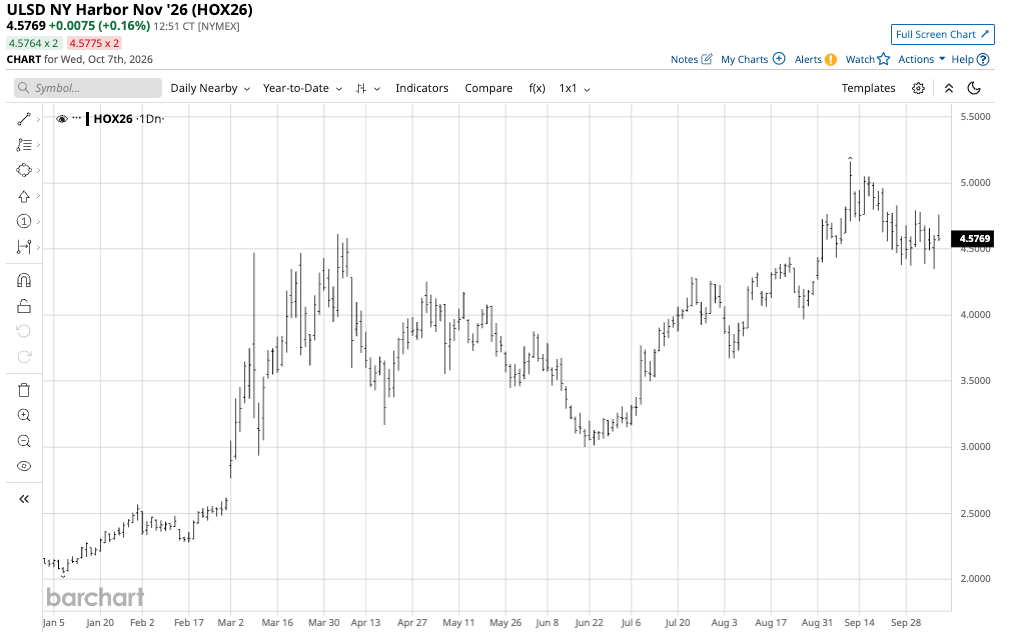
The continuous daily year-to-date chart shows that NYMEX heating oil futures, the proxy for distillates, rose 143.3% from $2.1215 at the end of 2025 to the most recent high of $5.1619 per gallon wholesale on September 10. At over $4.55 per gallon, heating oil futures have corrected, but remain in a bullish trend, with the first technical support at the August 26 low of $3.9677 and resistance at the September 10 high.
Brent crude oil prices are critical for distillate prices
Brent and West Texas Intermediate crude oil are the benchmark prices. Brent futures trade on the Intercontinental Exchange, while WTI trades on the Chicago Mercantile Exchange’s NYMEX division. While many other crude oil grades exist, pricing typically trades at a premium or discount to the two benchmarks.
Brent is the benchmark for around 2/3 of the world’s crude oil. European, Russian, African, and Middle Eastern crude oil tend to price off Brent. WTI benchmarks around 1/3 of the world’s crude oil. North American oil production trades based on the WTI price.
Brent and WTI are light, sweet crude oils with low sulfur content. WTI’s slightly lower sulfur content makes it ideal for processing into gasoline. Brent’s slightly higher sulfur content makes it ideal for processing into distillate fuels.
The conflict in the Middle East escalates and expands
From July through mid-September, crude oil and oil product prices rose as the attempt to reach an MOU to end the conflict between the U.S. and Iran fell apart. Iran continued to stall the process, adding new demands throughout negotiations. Iran has been stalling the U.S. on most issues since the 1979 Revolution, and its tactics have not changed, as they have worked over the years. The U.S. under the Trump administration has been the first administration since 1979 to take military action against Iran, insisting it abandon its nuclear ambitions.
The conflict has blocked the Strait of Hormuz, a critical seaway passage separating the Persian Gulf from the Gulf of Oman, through which 20% of the world’s seaborn crude oil travels each day. The Iranians have attacked neighboring countries’ crude oil production, refining, pipelines, shipping, and infrastructure for hosting U.S. military assets. Most recently, Houthis in Yemen have attacked Saudi Arabia, the leading Middle Eastern oil producer and refiner. The Houthis have also made travel through the Bab al-Mandeb Strait dangerous. Around 7% of the world’s seaborn crude oil travels through the Strait in the Red Sea.
Distillates are not seasonal products
Gasoline is a seasonal oil product. Its price peaks in spring and summer as drivers put more mileage on cars during vacation and pleasure drives. Gasoline prices fall and tend to reach seasonal lows in fall and winter, when weather conditions do not support driving. However, 2026 is not a typical year, as the Middle East conflict has increased gasoline prices going into the off-demand season.
Heating oil may sound like a seasonal fuel, but its role as a proxy for distillates makes it a year-round oil product. Jets fly, and trucks take goods to market year-round. Therefore, heating oil futures show little to no seasonality. However, if there is any, winter months are the time when heating oil demand peaks.
Rising distillate prices could ignite inflation
The leading inflation data excludes food and energy. However, energy is an ingredient in nearly all goods and services, as products must travel from producers and manufacturers to consumers by diesel-powered trucks. Planes transport people worldwide and consume jet fuel. Inflation data may not directly include diesel fuel prices, but they have a significant indirect effect on the economic condition.
Inflation impacts interest rates. At the September FOMC meeting, the U.S. central bank raised its short-term Fed Funds Rate for the first time in 2026 to a midpoint of 3.875%, citing stubbornly higher inflation. The U.S. 30-year Treasury Bond futures declined below a critical technical support level at the October 2023 low, reaching the lowest level (and highest long-term interest rates) since 2007. Higher distillate prices could push inflation higher, and the long-term chart shows that the current trend has already risen to a record high.
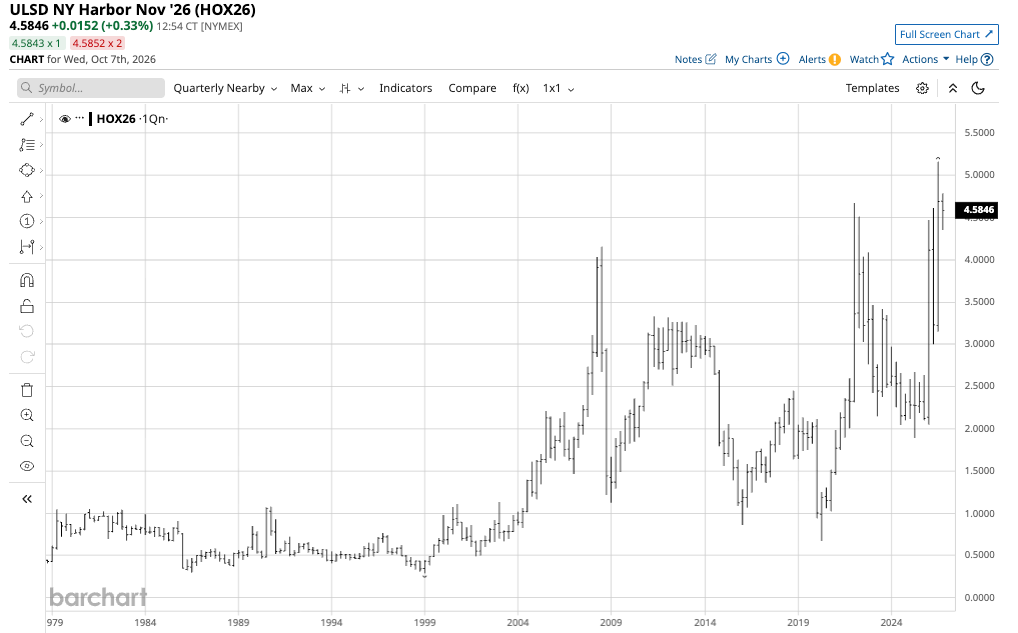
The quarterly continuous NYMEX heating oil futures chart shows that the price eclipsed the 2022 high of $4.6709 in 2026, rising to $5.1619 per gallon wholesale in September 2026. Heating oil futures are in uncharted territory, with prices remaining above the 2022 high. Geopolitical events drove heating oil prices higher in 2022 when Russia, a leading oil producer, invaded Ukraine. In 2026, the conflict between the U.S. and Iran, which escalated and spread throughout the Middle East, has pushed oil products even higher.
Oil prices have become a barometer of the day-to-day events in the Middle East. Attacks drive prices higher, while negotiations and hopes for a resolution drive them lower. It is impossible to pick tops or bottoms in any commodity market, as bullish or bearish trends can cause prices to explode or implode to levels that defy fundamental and technical analysis. Geopolitical issues facing energy commodities and distillate products tied to Brent pricing make analysis even more challenging. In October 2026, the optimal strategy is to go with the flow and follow short-term trends. The direct route for a risk position in distillate fuel prices is through the NYMEX heating oil futures contract. Each NYMEX contract contains 42,000 gallons. At $4.60, the contract value is $193,200. The NYMEX original margin requirement is currently $15,188 per contract. A market participant can control $193,200 worth of heating oil/distillate futures on the long or short side for a 7.86% down payment. When the equity on a risk position falls below $13,808, the exchange requires maintenance margin payments. Meanwhile, when volatility increases in the heating oil futures market, the exchange will raise margin requirements.
The path of least resistance of heating oil futures prices depends on the Middle East. A resolution will push prices much lower, while continued escalations could cause a parabolic rally. Expect volatility and go with the flow with a risk-reward plan. Disciplined trading is likely to yield the optimal results.
On the date of publication, Andrew Hecht did not have (either directly or indirectly) positions in any of the securities mentioned in this article. All information and data in this article is solely for informational purposes. For more information please view the Barchart Disclosure Policy here.