
- PRICING
- LIVE QUOTES
- LEARN
- HELP


EN
What Rockwell Automation Holders Got Right
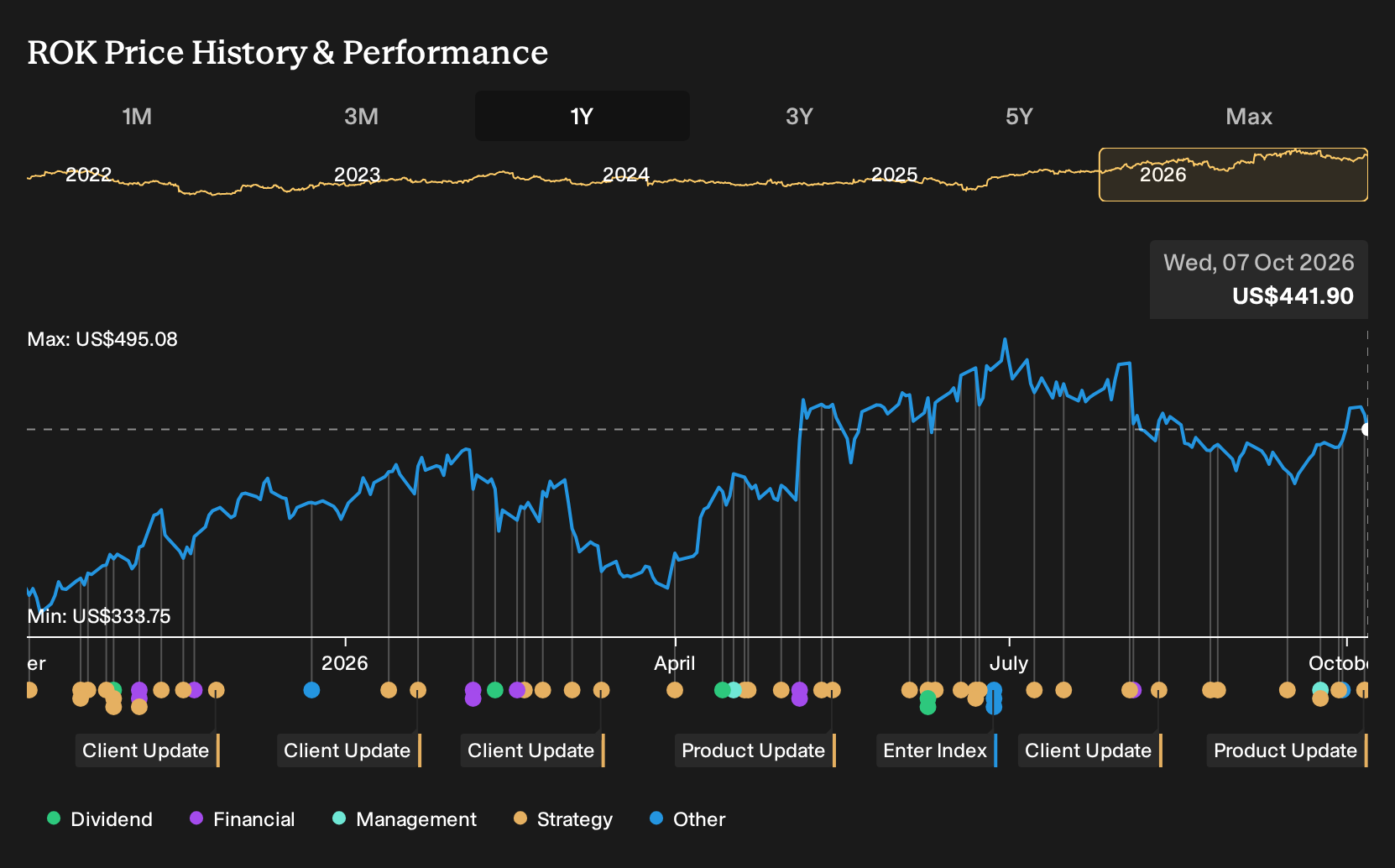
If you only read the headlines on Rockwell Automation in 2026, with double digit revenue and earnings growth turning up in quarter after quarter, the share price outcome might look almost inevitable. For Rockwell Automation shareholders, the return over the past year was 28.6%, including dividends. If you had been weighing the bullish reshoring story against the bearish cyber and geopolitical worries back in October 2025, what would you have focused on to justify taking that risk?
Rockwell Automation has already moved. Pinpoint other ways to investigate the theme among 88 robotics and automation stocks.
The Two Rockwell Automation Stories Investors Had To Choose Between
The shares cost US$344 at the start of the period, and anyone looking at Rockwell Automation then had to pick between two very different expectations for what came next.
The bullish story argued that Industry 4.0, digitalization, and reshoring would justify a Fair Value of US$410. This was effectively a price implied by assumptions about strong recurring software income and a move toward a 23.5% segment margin backed by a US$2b investment plan.
The bearish view pointed to a Fair Value of US$229. This was based on worries about open-source automation undercutting proprietary systems, plus cyber and geopolitical risks that could pressure gross margins and limit international sales.
What The Rockwell Automation Results Put To The Test
Rockwell Automation’s Q3 2026 report showed revenue of US$2,313m and net income of US$407m, with net margin at 17.6% versus 13.7% in Q3 2025. That outcome leaned toward the bullish case that focused on higher profitability. The cautious story was not removed, because cyber and geopolitical risks highlighted in 2025 remain part of the backdrop.
The key lesson is that margin assumptions do a lot of the work in a thesis like this. When judging another automation stock, track whether net margin actually shifts toward the level used in the original forecast.
What Rockwell Automation’s Price Already Assumes
Rockwell Automation now trades at US$442, with this Narrative’s Fair Value set below that level. The gap reflects concern that mix, capex and cost pressures may matter more for long term returns than headline growth.
Anyone paying today’s price is effectively assuming high margin software, AI and logistics scale smoothly. How does slower Lifecycle Services ARR and heavier investment affect that assumption?
"The numbers imply that Rockwell Automation’s current share price already reflects strong execution on margin expansion, software growth, and capital returns, so there is limited room for disappointment before the valuation appears stretched."
Not everyone reads the same price the same way. → See the lower figure this Narrative lands on, and how it gets there
Looking Past Rockwell Automation
Rockwell Automation shows one vision of industrial progress, anchored in factory floors and production lines.
Another path leans on rockets and satellites, turning orbit into core infrastructure.
Instead of boosting output on assembly lines, this company obsesses over reliable, low cost launch.
It not only carries payloads into space but also provides onboard systems that keep them working.
Together, those pieces aim at the basic plumbing of a wider space economy, where dependable access and in orbit hardware could quietly decide which future services can exist.
The case is on the record, with the assumptions it rests on. → See the Narrative that values this company 36% above its price
This article by Simply Wall St is general in nature. We provide commentary based on historical data and analyst forecasts only using an unbiased methodology and our articles are not intended to be financial advice. It does not constitute a recommendation to buy or sell any stock, and does not take account of your objectives, or your financial situation. We aim to bring you long-term focused analysis driven by fundamental data. Note that our analysis may not factor in the latest price-sensitive company announcements or qualitative material. Simply Wall St has no position in any stocks mentioned.
Have feedback on this article? Concerned about the content? Get in touch with us directly. Alternatively, email editorial-team@simplywallst.com