
- PRICING
- LIVE QUOTES
- LEARN
- HELP


EN
Did Earnings Beat Just Shift AAR's (AIR) Investment Narrative?
- AAR Corp. reported first quarter results for the period ended August 31, 2026, with sales of US$918 million and net income of US$40.1 million, alongside basic earnings per share from continuing operations of US$1.01.
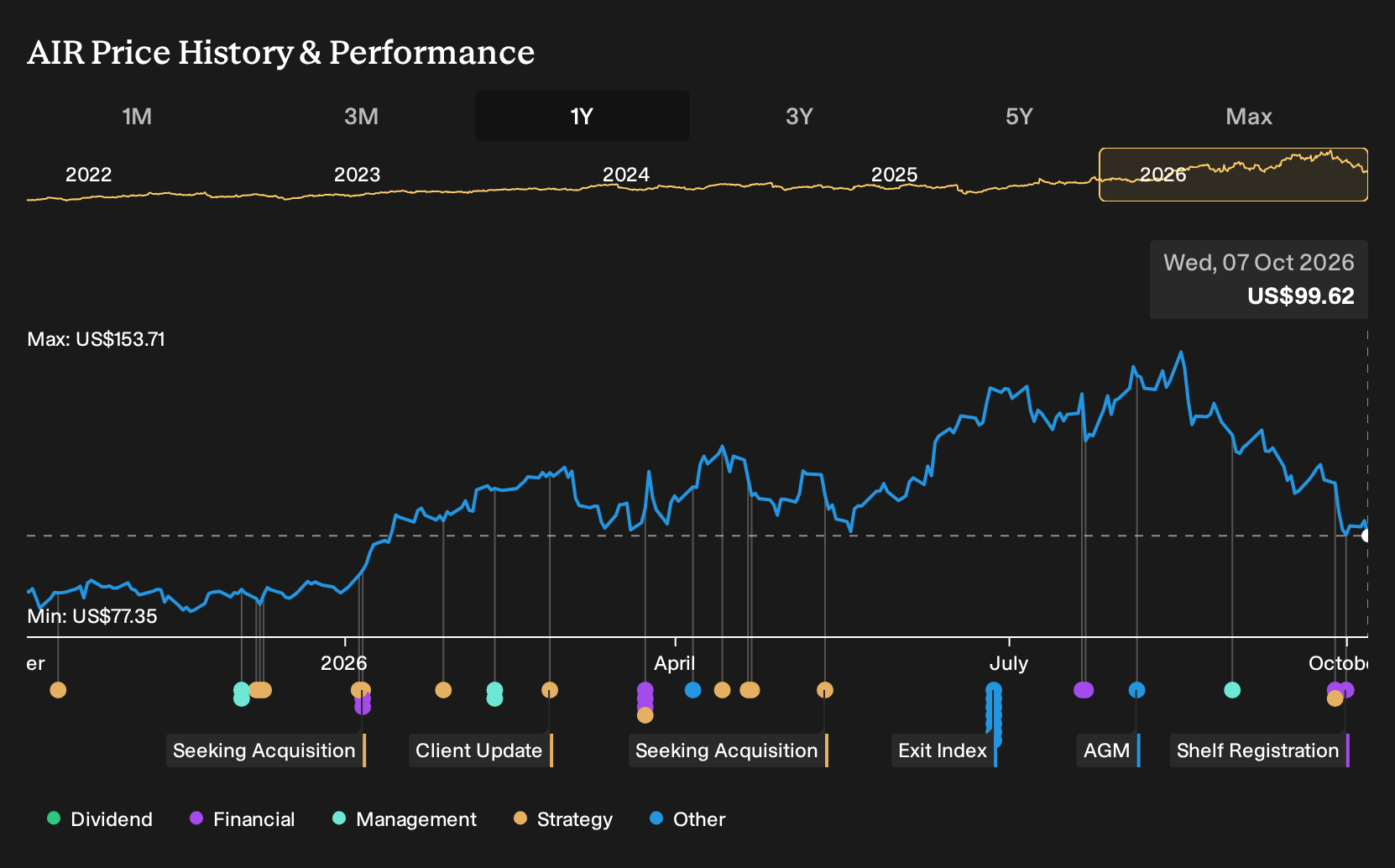
- The company also filed a US$298.6 million shelf registration for 2,943,000 common shares related to an ESOP offering, which follows the completion of a buyback of 2,429,700 shares under a prior repurchase program.
- This article examines how AAR Corp.'s first quarter earnings performance may influence the existing investment narrative around its key business drivers.
Scan how AAR's latest earnings and capital moves compare with peers by lining up similar businesses from our curated list of list of solid balance sheet and fundamentals (25 results).
AAR Investment Narrative Recap
To own AAR, you need to be comfortable with a commercial aviation focused business that is leaning on MRO, parts distribution, and software to drive earnings. The first quarter delivered US$918 million in sales and US$40.1 million in net income, so the operating backdrop entering fiscal 2027 is one of active demand rather than repair mode.
The key short term swing factor remains how resilient commercial and government customers stay if flying activity or budgets soften, especially given AAR's exposure to airline spending. Competitive pressure from OEMs and the need to execute on digital tools such as Trax are still the biggest operational risks, and this latest update does not materially change that risk balance.
The ESOP related shelf registration for up to 2,943,000 common shares sits alongside a completed buyback of 2,429,700 shares and is the announcement to watch here. On a practical level, it tells you AAR is comfortable putting more equity into circulation after already returning US$107.54 million through repurchases.
For catalysts, the interplay between share issuance and per share metrics becomes important. Investors will likely pay close attention to how any ESOP related issuance interacts with earnings per share, especially with analysts already expecting both earnings growth and some increase in the share count. Execution on MRO expansion, distribution, and Trax adoption will need to keep pace with any dilution for the thesis to feel intact.
AAR Earnings Outlook and Analyst Assumptions
AAR's analyst narrative points to US$4.3b in revenue and US$292.7 million in earnings by 2029, based on an assumed 7.1% yearly revenue growth rate. That profile implies an earnings increase of about US$99.3 million from current earnings of US$193.4 million.
Uncover why AAR's fair value indicates a 55% potential upside to its current price, which could narrow quickly.
Exploring Other Perspectives
Three fair value estimates from the Simply Wall St Community span roughly US$76 to US$155, so some retail investors see AAR as close to fully priced while others model far more upside. Weigh that against MRO competition, digital execution risk, and government contract exposure, then decide which scenarios feel most credible to you.
Explore 2 other AAR fair value estimates, including one that suggests potential upside of up to 55% from the current price.
Reach Your Own Conclusion
Don't just follow the ticker; dig into the data and build a conviction that's truly your own.
- A great starting point for your AAR research is our analysis highlighting 5 key rewards and 1 important warning sign that could impact your investment decision.
- See our latest analysis for AAR. The report includes a comprehensive fundamental analysis summarized in a single visual, the Snowflake, making it easy to evaluate AAR's overall financial health at a glance.
Looking for more investment ideas beyond AAR?
Once you have a view on AAR, it can help to cross check that thesis against other opportunities that fit different portfolio roles, from potential growth stories to income candidates and lower risk holdings.
- If you want potential higher upside with tighter position sizes, scan through 12 elite penny stocks with strong financials that meet stricter financial quality filters instead of relying on stories alone.
- For investors hunting for a better balance between quality and price, work through the 29 high quality undervalued stocks and see which businesses align with your return and risk expectations.
- Income focused portfolios can benefit from steady payers, so review the 8 dividend fortresses to see which stocks may complement or contrast with how AAR fits into your holdings.
This article by Simply Wall St is general in nature. We provide commentary based on historical data and analyst forecasts only using an unbiased methodology and our articles are not intended to be financial advice. It does not constitute a recommendation to buy or sell any stock, and does not take account of your objectives, or your financial situation. We aim to bring you long-term focused analysis driven by fundamental data. Note that our analysis may not factor in the latest price-sensitive company announcements or qualitative material. Simply Wall St has no position in any stocks mentioned.
Have feedback on this article? Concerned about the content? Get in touch with us directly. Alternatively, email editorial-team@simplywallst.com