
- PRICING
- LIVE QUOTES
- LEARN
- HELP


EN
How Investors Are Reacting To Neurocrine Biosciences (NBIX) New VYKAT XR Data
- Neurocrine Biosciences reported that multiple new clinical and real world data sets on VYKAT XR in Prader Willi syndrome will be presented at the FPWR 2026 conference, including safety, caregiver burden, adverse events and long term treatment outcomes.
- The breadth of VYKAT XR evidence, from observational studies like PWS VISTA and BRAVE PWS to mortality and healthcare utilization analyses, reflects Neurocrine Biosciences' efforts to build a durable, data rich PWS franchise beyond initial FDA approval.
- Attention now turns to how Neurocrine Biosciences' expanding VYKAT XR evidence base around real world use could influence the broader investment narrative.
Neurocrine Biosciences Investment Narrative Recap
To own Neurocrine Biosciences, an investor needs to believe the company can extend the INGREZZA and CRENESSITY franchises while building a broader rare disease and CNS portfolio. The VYKAT XR data push in Prader Willi syndrome supports that narrative but does not change the near term focus on prescription trends, payer behavior and gross to net pressure on existing brands.
The biggest near term swing factor still sits with pricing and access. Aggressive contracting on INGREZZA, rising payer scrutiny and higher SG&A are the issues to watch. The FPWR data sets matter more for long term durability of the PWS franchise than for near term financial risk.
The most relevant update tied to this event is the planned wave of VYKAT XR clinical and real world evidence at FPWR 2026. Fresh data on safety, caregiver burden and long term outcomes can help support positioning with physicians and payers, which matters for how meaningful PWS becomes in Neurocrine Biosciences revenue mix over time.
The recent decision to bring back Eiry W. Roberts as Chief Medical Officer also matters in this context. A Chief Medical Officer with prior experience leading INGREZZA indication expansion and the CRENESSITY program may help execution across VYKAT XR, late stage CNS assets and future filings, which feeds directly into the next set of pipeline and label expansion catalysts.
Neurocrine Biosciences Consensus Forecasts in Context
Analysts that follow Neurocrine Biosciences are currently building their models around a multi year step up in both revenue and profitability. Current assumptions point to revenue growth of 15.3% a year over the next three years and an expansion in profit margins from 20.9% today to 26.6% on their 2029 numbers.
On the earnings line, consensus points to US$705.5 million today and US$1.4b by 2029, with a wide band of opinion around that central view. The highest forecasts sit at US$2.4b of profit while the most cautious estimates cluster near US$1.1b. That implies earnings need to roughly double, which is an increase of about US$694.5 million from current levels to reach the central estimate.
Price targets and valuation work flow directly from those building blocks. The shared view behind the spreadsheets is that by 2029 revenues would reach about US$5.2b with earnings at US$1.4b, and that the stock could trade on a P/E multiple of 20.3x versus 20.4x today and around 17.6x for the wider US biotech peer group.
Forecasts also factor in capital structure and share count. Models currently assume the number of shares outstanding rises about 1.95% a year over the next three years, which can dilute per share metrics even when total earnings are moving higher.
Discount rates matter for how investors translate 2029 expectations for Neurocrine Biosciences back into a price today. The Simply Wall St framework uses a 7.54% rate in the assumptions section and a rounded 7.5% figure in the valuation summary, which is one way to account for risk and the time value of money when comparing the analyst fair value estimates with the current share price.
Neurocrine Biosciences' current analyst narrative points to forecast revenues of about US$5.2b and earnings of roughly US$1.4b by 2029, built on projected annual revenue growth of 15.3% and an earnings increase of around US$694.5 million from about US$705.5 million today.
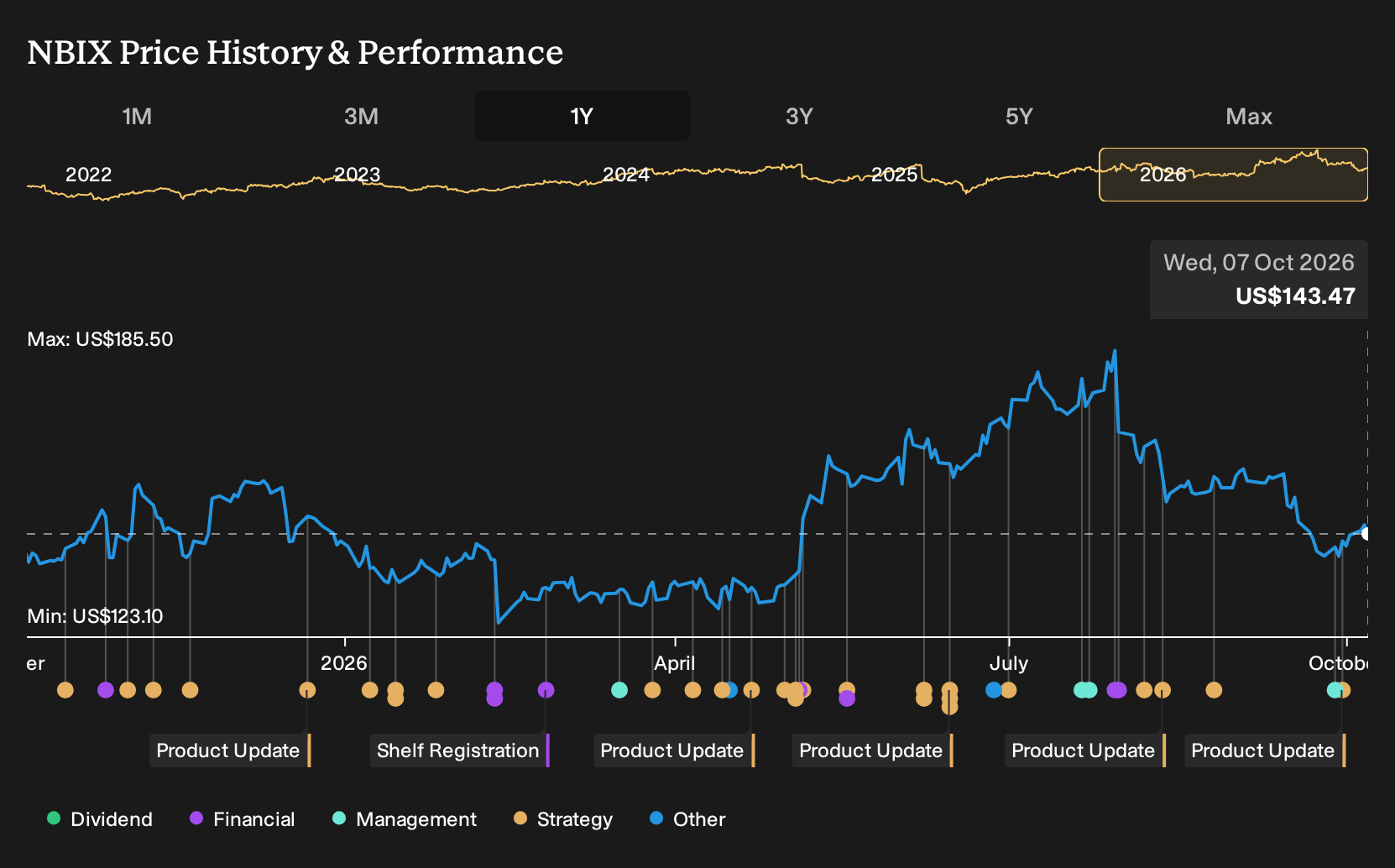
Uncover why Neurocrine Biosciences' fair value indicates a 45% potential upside to its current price, which could narrow quickly.
Exploring Other Perspectives
One alternate view on Neurocrine Biosciences leans hard into competition risk. The most cautious analysts were only penciling in about US$5.1b of 2029 revenue and US$1.1b in earnings before this VYKAT XR data wave. That more guarded story may shift, and you should compare both narratives before deciding what feels reasonable.
Explore 2 other Neurocrine Biosciences fair value estimates, including one that suggests it could be worth just $207.29!
Decide For Yourself
Disagree with existing narratives? Extraordinary investment returns rarely come from following the herd, so go with your instincts.
- A great starting point for your Neurocrine Biosciences research is our analysis highlighting 4 key rewards that could impact your investment decision.
- See our latest analysis for Neurocrine Biosciences. The report includes a comprehensive fundamental analysis summarized in a single visual, the Snowflake, making it easy to evaluate Neurocrine Biosciences' overall financial health at a glance.
Looking For More Investment Ideas Beyond Neurocrine Biosciences?
If the Neurocrine Biosciences story has you thinking more broadly about where to put fresh capital to work, it can help to scan other companies with clear financial traits using the Simply Wall St Screener.
- For investors who care most about quality at a reasonable price, start with a curated set of 29 high quality undervalued stocks that already combine stronger fundamentals with appealing valuations.
- If capital preservation and smoother portfolio swings matter to you, filter for 31 resilient stocks with low risk scores that score well on financial strength and lower risk metrics.
- When the focus is on balance sheet resilience and durable business models, shortlist a list of solid balance sheet and fundamentals (25 results) and use it as a watchlist for your next idea.
This article by Simply Wall St is general in nature. We provide commentary based on historical data and analyst forecasts only using an unbiased methodology and our articles are not intended to be financial advice. It does not constitute a recommendation to buy or sell any stock, and does not take account of your objectives, or your financial situation. We aim to bring you long-term focused analysis driven by fundamental data. Note that our analysis may not factor in the latest price-sensitive company announcements or qualitative material. Simply Wall St has no position in any stocks mentioned.
Have feedback on this article? Concerned about the content? Get in touch with us directly. Alternatively, email editorial-team@simplywallst.com