
- PRICING
- LIVE QUOTES
- LEARN
- HELP


EN
What Morningstar (MORN)'s Envestnet Portfolio Rollout Means For Shareholders
- Morningstar Wealth previously announced that its Morningstar Public/Private Select Series will be offered through Envestnet’s Fund Strategist Portfolios program, with Morningstar overseeing asset allocation and Envestnet handling technology, implementation, and tax management.
- The move brings Morningstar’s public and private market portfolio design directly into an existing advisor workflow, which can influence how frequently advisors adopt outsourced portfolio solutions.
- We will now look at how Morningstar’s broader investment narrative could be shaped by deeper Envestnet distribution of its Public/Private Select portfolios.
Morningstar Investment Narrative Recap
To own Morningstar, you need to believe in a simple idea. The business has to keep turning its research, data, and indexes into tools that clients actually build workflows around. The Envestnet rollout of public and private Select portfolios and the launch of Morningstar Direct AI both speak directly to that execution test. In the near term, the key swing factor is whether these products convert into higher usage rather than just being interesting demos.
The biggest current risk remains that heavy investment in AI and data platforms does not translate into broad client adoption or pricing power, especially with Morningstar already carrying a high level of debt. If Direct AI or the Envestnet partnership fail to see meaningful uptake, expectations for revenue growth and margin improvement could prove too optimistic, and investors may continue to question the share price after a 1 year total return that has declined 11.1%.
The launch of Morningstar Direct AI looks most relevant here because it reinforces the same thesis behind the Public/Private Select push. Both lean on the idea that advisors and asset managers want to embed Morningstar into day to day decision making, whether through portfolio models on Envestnet or AI agents handling product design, distribution support, and manager research.
Operationally, Direct AI connects cleanly to the existing catalysts around AI integrations and data licensing. It builds on work like the PitchBook integrations and Lumonic 12.0 by offering a browser based interface and domain specific agents that aim to reduce manual work. The risk is clear. If users stick with legacy processes, Morningstar carries higher tech spend without the uplift in subscription revenue or efficiency that investors are hoping to see.
Morningstar's current analyst story centers on revenues reaching US$3.0b and earnings of US$534.0m by 2029, based on forecast revenue growth of 5.6% per year and an earnings step up of about US$112.4m from earnings today of US$421.6m.
Uncover why Morningstar's fair value indicates an 18% potential upside to its current price that could narrow quickly.
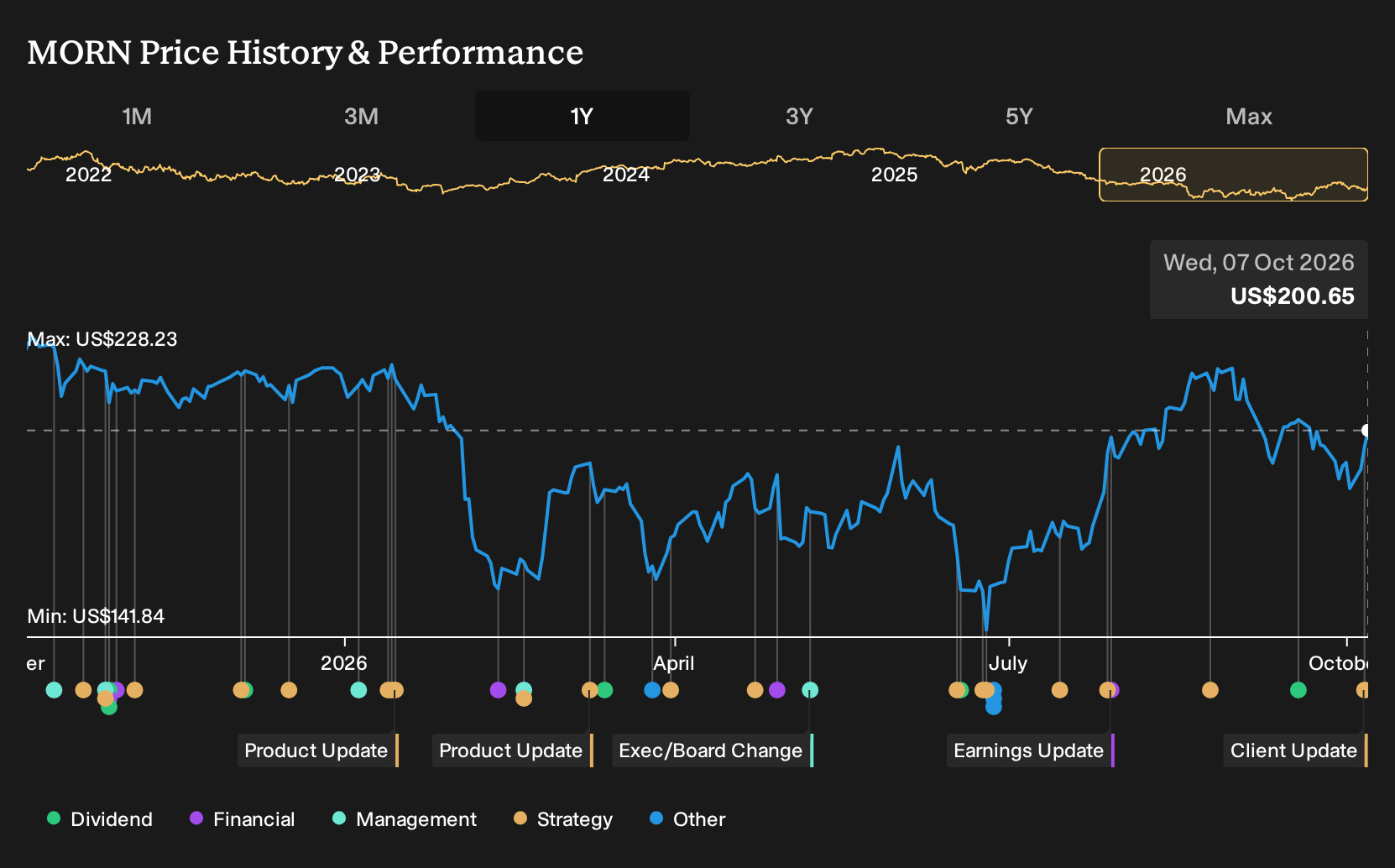
Exploring Other Perspectives
Six fair value estimates from the Simply Wall St Community span roughly US$161 to US$329 per share, which signals a wide gap in how private investors frame Morningstar. That spread reflects real business swing factors, from AI products like Direct AI and Envestnet distribution as potential catalysts, to adoption risk and shifting sentiment from insider sales and target cuts. Readers should expect opinions to diverge and treat these community views as a starting point for comparing alternative narratives.
Explore 5 other Morningstar fair value estimates, including one that suggests as much as 20% downside from the current price.
The Verdict Is Yours
Disagree with existing narratives? Extraordinary investment returns rarely come from following the herd, so go with your instincts.
- A great starting point for your Morningstar research is our analysis highlighting 3 key rewards and 1 important warning sign that could impact your investment decision.
- See our latest analysis for Morningstar. The report includes a comprehensive fundamental analysis summarized in a single visual, the Snowflake, making it easy to evaluate Morningstar's overall financial health at a glance.
Looking for more Morningstar style investment ideas?
If Morningstar has you thinking about where research, data, and recurring revenue can lead over a full cycle, it often helps to compare it with a broader watchlist of opportunities built on clear fundamentals.
- For investors who want income to do more of the heavy lifting, consider high yield opportunities that still clear quality checks through 8 dividend fortresses.
- If capital preservation matters most to you right now, focus on financial strength and low risk profiles by scanning a curated list of solid balance sheet and fundamentals (25 results).
- For those hunting for future leaders before they hit the spotlight, widen your opportunity set with a targeted 20 high quality undiscovered gems.
This article by Simply Wall St is general in nature. We provide commentary based on historical data and analyst forecasts only using an unbiased methodology and our articles are not intended to be financial advice. It does not constitute a recommendation to buy or sell any stock, and does not take account of your objectives, or your financial situation. We aim to bring you long-term focused analysis driven by fundamental data. Note that our analysis may not factor in the latest price-sensitive company announcements or qualitative material. Simply Wall St has no position in any stocks mentioned.
Have feedback on this article? Concerned about the content? Get in touch with us directly. Alternatively, email editorial-team@simplywallst.com