
- PRICING
- LIVE QUOTES
- LEARN
- HELP


EN
Has Twenty One Capital (XXI) Fallen Far Enough To Be Undervalued?
Twenty One Capital has seen its share price move sharply over the past year, which puts fresh attention on what investors are really paying for on its balance sheet. With the stock now trading at US$6.39, the open question is how well that market value lines up with the company’s book value.
- The share price has fallen 72.1% over the past year. This puts the focus squarely on whether the current valuation still reflects what the business is worth on paper.
- The business model, which leans heavily on how effectively it turns equity capital into future earnings power, may support a very different view of value than short term share price moves suggest.
- Twenty One Capital's multiple only means something next to the competition. See how Twenty One Capital's 1.0x P/B compares with its peers.
The issue now is whether Twenty One Capital’s current share price is adequately supported by its book value compared with the industry average.
If you want a broader sense of how the market is pricing assets on book value and fundamentals, a focused stock screen can help you line up comparisons next to Twenty One Capital, starting with solid balance sheet and fundamentals stocks screener (25 results).
Is Twenty One Capital Still Cheap on Book Value?
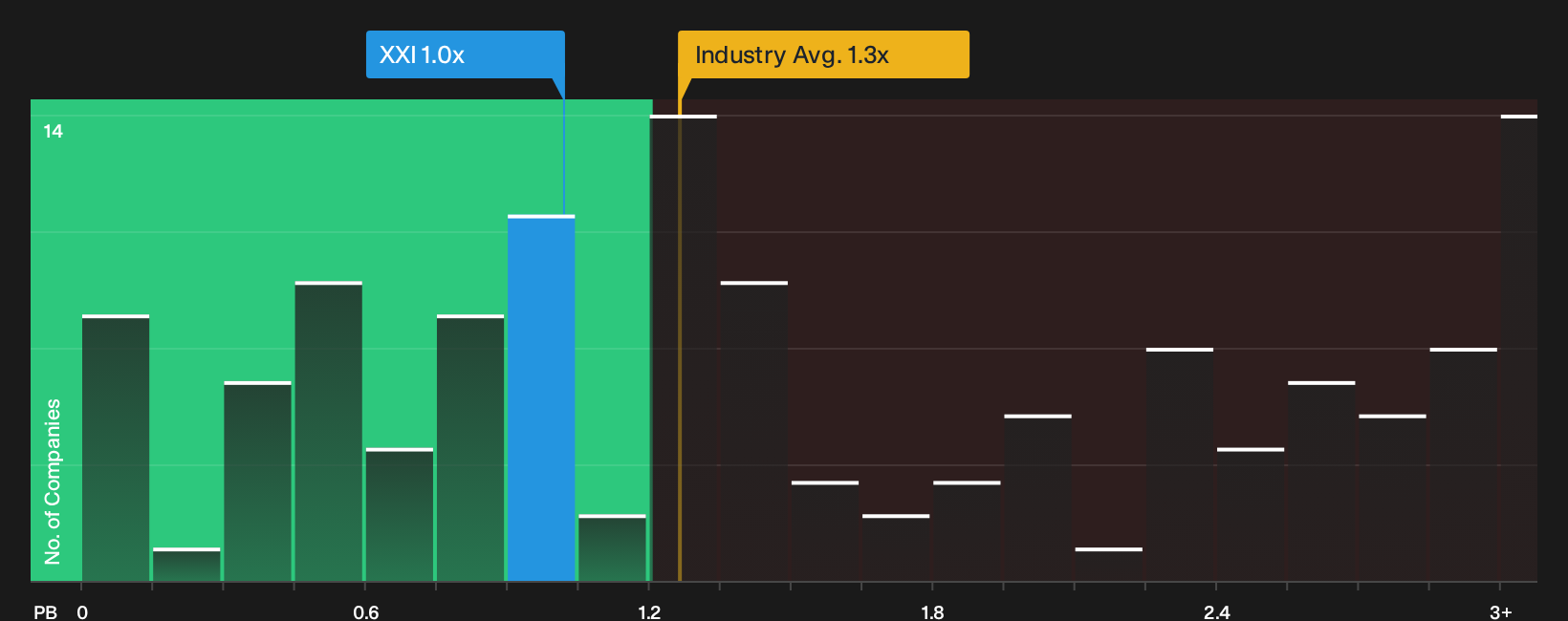
P/B fits Twenty One Capital because investors are really paying for the equity it can compound over time. On this yardstick, the stock trades at about 1.0x book value, using the current P/B ratio of 1.0x. That sits slightly below the Capital Markets industry average of about 1.3x, so the market is pricing the balance sheet at a small discount to typical peers in the sector.
The peer group as a whole changes hands at a much richer 9.9x book value, which puts Twenty One Capital’s valuation well under that broader pack. For a reader comparing options across the industry, that gap signals that expectations embedded in this share price are relatively modest compared with other capital markets businesses. This kind of pricing often reflects a mix of concerns about profitability and risk, so the key question is whether those issues are already fully reflected in a little-above-book valuation or not. Explore the numbers behind Twenty One Capital's P/B valuation.
The Twenty One Capital Narrative: What Would Justify Today's Price?
Twenty One Capital’s recent share price slide raises a simple question for readers: what needs to go right or wrong for this valuation to shift meaningfully from here? Narratives on Simply Wall St’s Community page take that puzzle and turn it into explicit scenarios that spell out which paths for growth, profitability and earnings would have to play out for the stock to be worth materially more or less than today’s price. Each scenario links its number to a specific view of where revenue momentum, margin structure and business risk could move next, so you can check those assumptions as fresh information comes through.
A clear, number-driven view on Twenty One Capital helps turn loose opinions into specific assumptions on growth, margins and execution that can be checked against future results. That kind of written narrative gives you a yardstick you can revisit as new data arrives and the share price reacts.
Share your own Narrative for Twenty One Capital and set out the assumptions behind your valuation.
One more thing about Twenty One Capital that deserves your attention
Price and book value only tell part of the story, because internal checks on Twenty One Capital have also picked up specific issues that could change how you weigh the whole opportunity. Take a closer look at 3 warning signs (1 major) before settling on a valuation.
This article by Simply Wall St is general in nature. We provide commentary based on historical data and analyst forecasts only using an unbiased methodology and our articles are not intended to be financial advice. It does not constitute a recommendation to buy or sell any stock, and does not take account of your objectives, or your financial situation. We aim to bring you long-term focused analysis driven by fundamental data. Note that our analysis may not factor in the latest price-sensitive company announcements or qualitative material. Simply Wall St has no position in any stocks mentioned.
Have feedback on this article? Concerned about the content? Get in touch with us directly. Alternatively, email editorial-team@simplywallst.com