
- PRICING
- LIVE QUOTES
- LEARN
- HELP


EN
3 U.S. Freight Stocks With Upside From Southeast Emergency Demand
When Gulf Coast refineries face possible damage and key Southeast freight hubs tighten up, the usual playbook for trucking and logistics stocks gets rewritten in real time. Sudden swings in diesel costs, port congestion and FEMA emergency loads can quickly reshape which operators struggle and which see a rush of business. This article walks through 3 U.S. freight and logistics stocks tied to this disruption story and explores how each might be affected.
The three stocks covered below are just a sample of the U.S. freight and logistics operators linked to Southeast disruption risk. The full screen surfaced 7 more companies with equally compelling narratives that are not detailed in this article. To go deeper, head straight into the U.S. Freight & Logistics Operators Exposed to Southeast Emergency and Disruption-Driven Demand screener to identify, filter, and analyze the highest conviction ideas for this theme.
ArcBest (ARCB)
ArcBest is one of the more interesting freight stocks in this theme because its mix of LTL, truckload and 3PL services naturally leans into disruption driven freight in the Southeast.
ArcBest generates about US$2.8b of revenue from its Asset-Based LTL operations and roughly US$1.5b from its Asset-Light logistics arm, all primarily in the U.S., and the stock carries a market value of about US$2.9b.
"Continued tightening in truckload capacity is pushing heavier shipments into ArcBest’s LTL and managed logistics network."
What happens to ArcBest’s margins if one quiet cost line suddenly starts moving faster than those new disruption driven freight volumes?
If that quiet cost line is really the swing factor here, read the full narrative for ArcBest to see whether accelerating disruption in freight masks it or makes it more pronounced.

Landstar System (LSTR)
Landstar System plugs directly into this disruption theme because its asset light freight brokerage model is built around flexible U.S. truck capacity and Jacksonville roots, which can matter when Southeast lanes tighten and shippers suddenly need emergency moves covered.
"Heavy haul has become a key focus area, with leadership hires, targeted equipment investment and dedicated sales efforts tied to sectors like data centers, energy and government."
What really moves the needle for Landstar System is how one less visible cost and pricing pressure shapes the payoff from all that disruption driven freight.
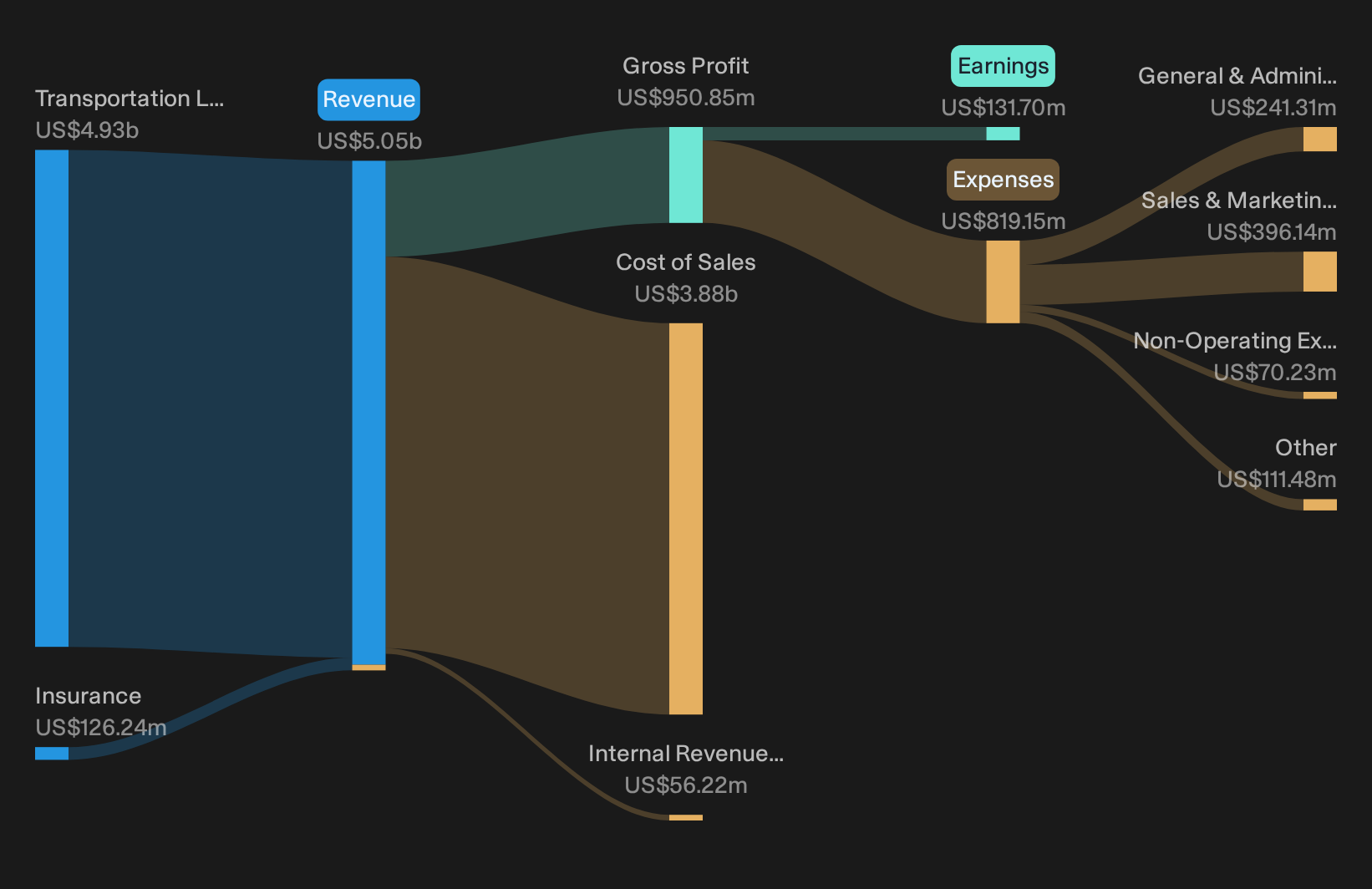
Landstar System runs a broad transportation logistics platform that generated about US$4.9b from that segment and roughly US$126 million from insurance, with a small internal revenue offset, and the stock carries a market value near US$5.7b.
That hidden pressure point is exactly where the story gets interesting, and the full narrative for Landstar System reveals how Landstar System’s model could turn tightening lanes into accelerating opportunity.
Universal Logistics Holdings (ULH)
Universal Logistics Holdings plugs into this disruption theme through its trucking and 3PL mix, which can flex around rerouted freight and short notice Gulf and Southeast demand. Its core business still lives in contract logistics for manufacturers and big-box retailers.
Universal Logistics Holdings runs a broad North American logistics platform, with about US$1.1b from Contract Logistics, US$209 million from Intermodal and US$246 million from Trucking, and the stock has a market value near US$447 million.
Investors watching the freight cycle are watching Universal Logistics Holdings because it combines dedicated logistics contracts with truckload exposure that can react to tight Southeast capacity. The real interest is how that mix behaves when disruption driven freight interacts with an early recovery backdrop.
"The transition of the truckload market into a more constructive early recovery phase creates scope for Universal Logistics Holdings to capture better pricing and equipment utilization, which could support revenue and earnings."
What really matters now is whether one pressure point in the cost and pricing equation quietly decides how much of that early cycle benefit actually reaches margins.
That pressure point is the swing factor, and the full narrative for Universal Logistics Holdings shows whether Universal Logistics Holdings is quietly building accelerating upside or letting recovery potential slip.

Seeking Alternatives Before Momentum Flies
Fresh ideas move first. Breakout stories build momentum while they are still under the radar for now, and information advantage drops fast, so scan new leaders and act promptly.
- Chase high yield without ignoring resilience by scanning curated income plays through the 8 dividend fortresses before others start crowding into the same payouts.
- Track early movers in critical metals by running the 33 best rare earth metal stocks and identify producers investors often overlook while demand stories are still forming.
- Explore future-facing infrastructure momentum by filtering through the 92 AI infrastructure stocks to find operators exposed to rising compute demand while valuations still appear reasonable.
This article by Simply Wall St is general in nature. We provide commentary based on historical data and analyst forecasts only using an unbiased methodology and our articles are not intended to be financial advice. It does not constitute a recommendation to buy or sell any stock, and does not take account of your objectives, or your financial situation. We aim to bring you long-term focused analysis driven by fundamental data. Note that our analysis may not factor in the latest price-sensitive company announcements or qualitative material. Simply Wall St has no position in any stocks mentioned.
Have feedback on this article? Concerned about the content? Get in touch with us directly. Alternatively, email editorial-team@simplywallst.com