
- PRICING
- LIVE QUOTES
- LEARN
- HELP


EN
What Will Get Silver’s Price Moving?
I asked if silver would hold above its critical support level in an August 13, 2026, Barchart article, where I concluded with the following:
Time will tell if silver can hold its critical technical support at $50.36 per share. Given its volatile history and current bearish trend, a false break and spike bottom could be on the horizon. Silver prices are likely to follow gold, which has also been in a bearish trend since its all-time high in late January 2026. Interest rates, the U.S. dollar and other fiat currencies’ strength or weakness, and sentiment will determine whether silver is close to a bottom and whether its long-term bullish trend will remain intact over the coming days, weeks, and months.
Nearby COMEX silver futures traded at $66.04 per ounce on August 12 and were lower, below $61.50, on October 5, 2026. So far, so good, as silver futures have not tested the critical technical support level as prices continue to consolidate.
Silver consolidates and is trendless in October 2026
Silver futures reached a new all-time high in October 2025 and experienced a parabolic rally that more than doubled its previous record peak. In January 2026, COMEX silver futures rose to $121.785 per ounce, where they ran out of upside momentum.
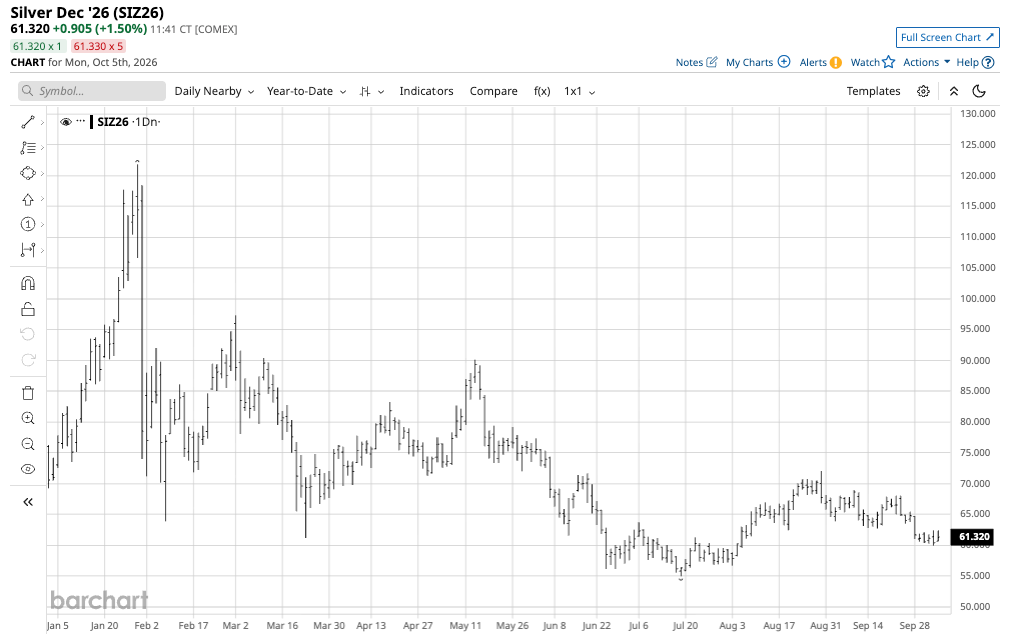
The continuous contract year-to-date chart shows the 54.8% decline that took silver futures from the January 29, 2026, high to its July 17, 2026, low of $55.00 per ounce. While silver remains in a bearish trend with lower highs and higher lows, the price has moved into a $12.065 consolidation range between $59.985 and $72.05 per ounce since August 6. At $61.32 per ounce, silver is not far above the range's low end, but it has settled into a trading range around $65, which has become a pivot point. Silver’s price action has become trendless after a substantial correction that cut the price by more than half.
The long-term trend remains bullish if silver can hold above the 1980 high
While silver’s 54.8% correction from late January through mid-July was ugly, the price remained above its long-term technical support level at the 1980 high.
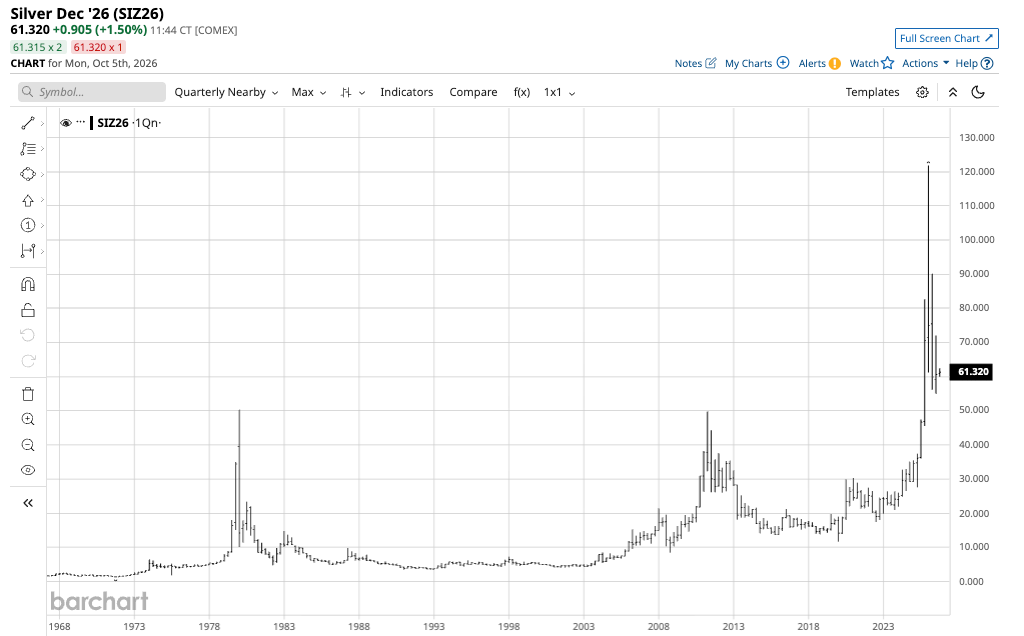
The long-term quarterly chart shows that it took 45 years for silver to eclipse the 1980 high. The move through $50.36 sent silver soaring to more than double that price. While silver ran out of upside momentum after the parabolic rally, the price has remained above the 1980 high, the previous long-term technical resistance that became technical support. Silver remains in a long-term bullish trend in October 2026, with the 1980 high as the line in the sand that could determine if the current consolidation leads to further gains or a continuation of the bearish price action since late January.
Silver is a highly volatile precious metal. After correcting from the 1980 high, silver’s price spent 22 years from 1984 through 2006 below $10, falling as low as $3.51 per ounce in 1993. Silver has a long and volatile history. In 2011, the price reached $49.82, 54 cents below the 1980 high, then ran out of upside momentum and fell to a low of $11.64 per ounce in 2020 when the global pandemic gripped markets. Meanwhile, silver futures made higher lows and higher highs from the 2020 low through the January 2026 record high, where it again ran out of upside momentum.
In October 2026, the $50.36 level is critical technical support for the long-term bullish silver trend.
The case for higher silver prices over the coming months
The bullish factors pointing to higher silver prices in October 2026 include the following:
- In 2026, silver is in its sixth consecutive year of a fundamental deficit with demand exceeding supply. The Silver Institute’s World Silver Survey 2026 reported a 40.3 million ounce deficit in 2025, rising to 46.3 million ounces in 2025. Fundamentals support higher silver prices.
- As long as silver’s price remains above the 1980 high, the critical technical support holds, and the long-term bullish trend remains intact.
- Stubborn inflation, high debt levels, and inflation-driven interest rate hikes erode fiat currencies’ purchasing power, supporting silver and other precious metals.
- Governments can print fiat currency at will, but silver and precious metals supplies are limited to mining activity and above-ground stocks.
- Silver is a highly speculative metal. While fundamental and technical factors remain bullish, sentiment will drive investment and speculative demand, which is critical to its price direction.
- Wars in Ukraine and the Middle East and the bifurcation of the world’s nuclear powers tend to be bullish for silver and other precious metals.
- Tariffs and sanctions are trade barriers that can distort commodity prices. The current environment has tightened silver’s balance sheet and made its location differentials highly volatile. The upcoming U.S. midterm elections could add market volatility, supporting precious metals prices.
- Silver’s trend since the 2020 low remains bullish, and trends are traders’ and investors’ best friend.
The case for higher silver prices remains compelling in October 2026. A continuation of the current consolidation above the $50.36 technical support level is a constructive factor that could lead to another rally.
The factors that could drive silver lower
The following factors could cause silver prices to fall from the current consolidation pattern:
- Silver has made lower lows and lower highs since January 29, 2026. Continued bearish price action in 2026 could lead to another lower low, testing critical technical support at $50.36 per ounce.
- The U.S. Federal Reserve raised the short-term Fed Funds Rate by 25 basis points at the September FOMC meeting, citing inflation and geopolitical uncertainty as reasons for tightening credit. Moreover, the U.S. 30-Year Treasury Bond futures fell below their critical technical support level at the October 2023 low of 107-04, reaching 101-26 in October 2026, the lowest level in nearly a quarter of a century, since June 2002. Higher short- and long-term interest rates increase the cost of carrying commodity inventories, and silver is no exception. Rising rates can push capital from stocks, commodities, and other assets to fixed-income products as yields climb.
- Markets reflect the economic and geopolitical landscapes, which remain highly volatile in October 2026. Any risk-off conditions would likely send silver prices lower, as they did in 2007 during the global financial crisis, 2020 during the global pandemic, and most recently, in April 2025 when the U.S. administration announced its “Liberation Day” tariff policies. Risk-off periods cause market participants to liquidate assets to meet margin calls and move to the sidelines across asset classes.
- Sentiment is critical for silver prices. Any shift from bullish to bearish sentiment could trigger waves of selling that take silver prices substantially lower.
In October 2026, bullish and bearish factors will pull silver's price in opposite directions. While fundamental and technical factors will shape silver’s price path, silver is a highly volatile commodity that can rise or fall to prices that defy reasonable, logical, and rational analysis.
Why silver could remain stuck in neutral
COMEX silver futures have been in a roughly $12 consolidation range since August 6 and were trading around $61.30 on October 5. Bullish and bearish factors dominate silver futures after it broke above technical resistance for the first time in 45 years, rallied 10.46 times from the 2020 low to the January 2026 high, then ran out of upside momentum and fell 54.8% to the July 2026 low. After a volatile period and mostly bullish price action since the 2020 and 2025 lows, silver is consolidating, which could be a healthy sign as long as overall markets avoid risk-off periods.
The current environment suggests that silver will remain in its consolidation trend throughout the rest of 2026 and into 2027. However, silver has a long history of challenging price action that causes plenty of aggravation for bulls and bears. For decades, silver has seen many false upside breakouts and downside breakdowns.
The optimal approach to silver trading or investing is to go with the flow, using a risk-reward plan that includes stops and profit horizons. It is acceptable to adjust profit horizons when silver’s price moves in the anticipated direction, but it is critical to adjust stop levels to protect profits and capital. When price moves against expectations, sticking to stop levels will protect capital. Trading with the flow in silver requires accepting short-term losses to pursue substantial gains as significant trends develop. When trends bend, stops protect against oversized losses, as silver market participants experienced in late January and early February 2026. It is virtually impossible to pick tops or bottoms in any market, and this is particularly true in the silver futures market. Discipline, a plan, and logical risk-reward dynamics are critical factors for success in silver trading and investing.
Many factors can move silver’s price, but the potential for short-term head-fake moves remains high as the price stays in its current consolidation range.
On the date of publication, Andrew Hecht did not have (either directly or indirectly) positions in any of the securities mentioned in this article. All information and data in this article is solely for informational purposes. For more information please view the Barchart Disclosure Policy here.