
- PRICING
- LIVE QUOTES
- LEARN
- HELP


EN
Morgan Stanley Remains Bullish on This ‘Undervalued’ Trillion-Dollar Stock
Morgan Stanley analyst Adam Jonas recently put a simple question to a room of about 40 clients. Who here owns SpaceX (SPCX) stock? “Not a single hand went up,” Jonas said.
SpaceX launches rockets, beams internet from orbit, and is racing to build artificial intelligence computing power. Few companies are as publicly discussed as SpaceX, yet the stock has failed to gain traction among seasoned investors. “It's been really, really quiet on SPCX lately,” Jonas added.
Notably, valued at a market cap of $2.26 trillion, SpaceX is among the world’s largest companies.
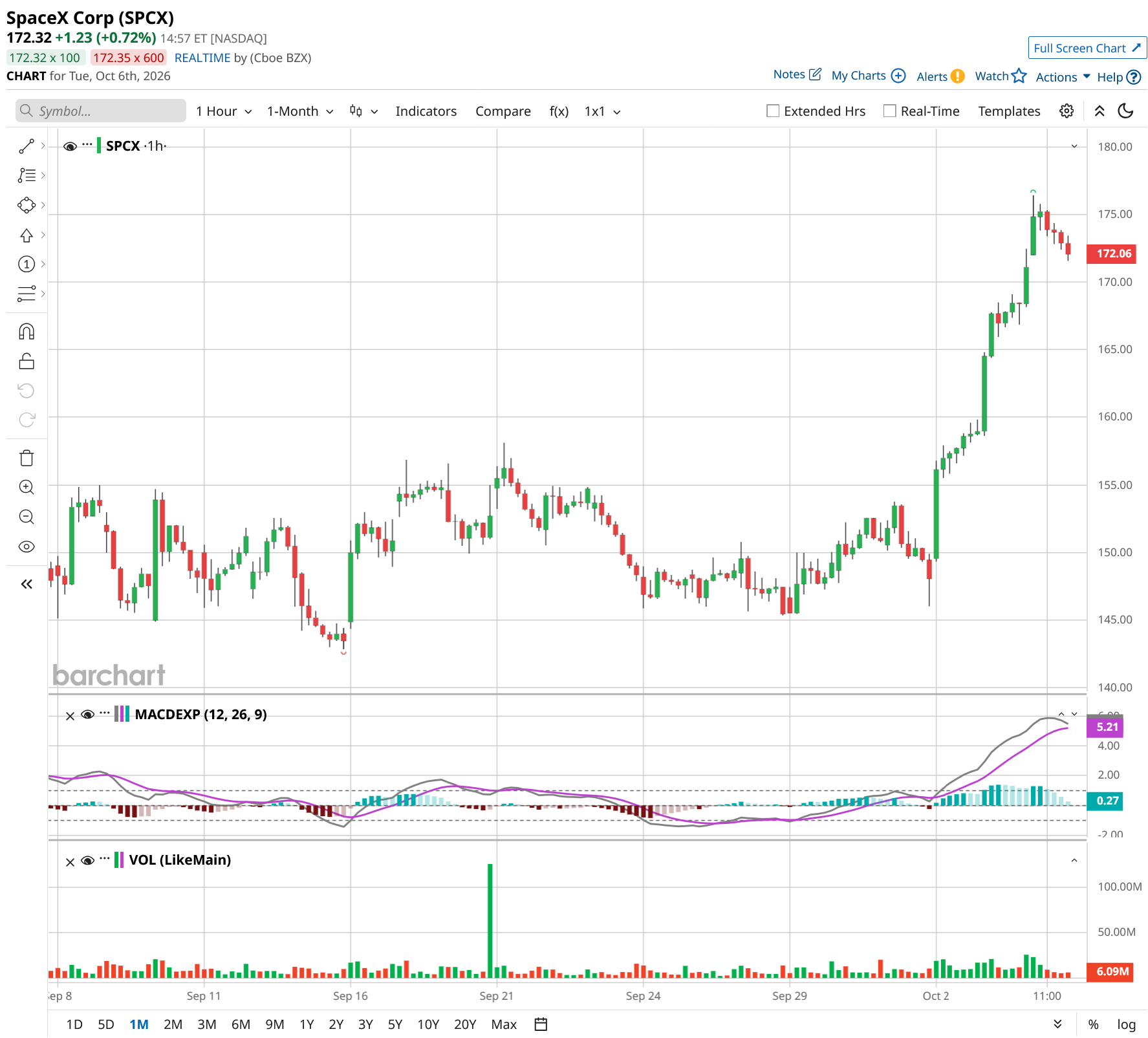
More Than a Rocket Story
SpaceX CFO Bret Johnsen laid it out at the Goldman Sachs Communacopia + Technology Conference on Sept. 10. The company builds its own engines, satellites, and software, then sells directly to customers.
“We really believe that we are building the infrastructure of the future,” Johnsen said.
SpaceX has three primary business segments, which include:
- Launch: Starship is the backbone. Flight 13 delivered demonstration Starlink satellites and made a precise ocean splashdown, letting engineers study the heat shield up close.
- Connectivity: Starlink broadband now operates in more than 170 countries.
- AI: SpaceX expects to end the year with a little over 2 gigawatts of terrestrial computing capacity, targeting 5 to 10 gigawatts next year.
The AI segment is growing at an enviable rate. Johnsen said SpaceX expects to hit $100 billion in annualized revenue by the end of this year. A new hosting deal adds about $1.11 billion a month starting Dec. 1, or roughly $13 billion a year.
“I would say we have even more conviction now,” Johnsen said.
Why Morgan Stanley Calls SpaceX Stock Cheap
According to Investing.com:
- Jonas reiterated his “Overweight” rating and $300 price target on SpaceX.
- The analyst emphasized that SPCX stock is “cheap and getting cheaper” once you factor in growth.
- At first glance, that sounds odd. SpaceX trades at about 30 times its estimated 2028 EV/EBIT.
- Put simply, that compares the company's value to its expected operating profit. Other megacap AI enablers trade closer to 16 times. So SpaceX looks nearly twice as expensive.
- But Jonas adjusts that number for how fast the company is expected to grow. On that basis, SpaceX trades at about 0.3 times, roughly 40% below the 0.5 times median for megacap peers.
- Even at his $300 target, SpaceX would sit near 0.6 times. That's in line with Amazon (AMZN) and below Alphabet (GOOGL) and Meta (META).
Jonas breaks SpaceX into pieces.
He values its Space and Connectivity businesses at about $127 per share. At $159, the stock already reflects most or all of that value. That leaves about $32 a share for the AI business.
Jonas said that equals roughly 3x 2028 EV/Sales for a neocloud-style business, meaning a company that rents out AI computing power. In other words, investors are paying very little for the AI story.
Jonas said valuing SpaceX is “more of an 'and' problem than an 'or' problem.” The businesses feed each other, so they have to be weighed together. He believes the market has already priced in common worries. Those include how Grok stacks up against other frontier models and Starlink Mobile's spectrum access.
For shares to fall to $100 within 12 months, he said, it would take a clear AI slowdown, a severe Starship testing setback, or a major dilutive event. Pricing for computing power may be the biggest swing factor.
Wall Street consensus assumes $17.60 per watt on 4.1 gigawatts. Every extra $10 per watt adds more than $40 billion in revenue, Jonas said. SpaceX's recent short-term Neocloud contracts are priced at $30 to $50 per watt.
Johnsen made a similar point in September. He said SpaceX expects $30 to $50 per watt next year and is at the high end of that range.
What Is the SPCX Stock Price Target?
Analysts tracking SPCX stock forecast revenue to increase from $44.70 billion in 2026 to $421.7 billion in 2030. Over this period, the space-tech giant is projected to swing from a loss of $0.09 per share to earnings of $10.52 per share. If SPCX is priced at 32x forward earnings, it could double from current levels within the next 40 months.
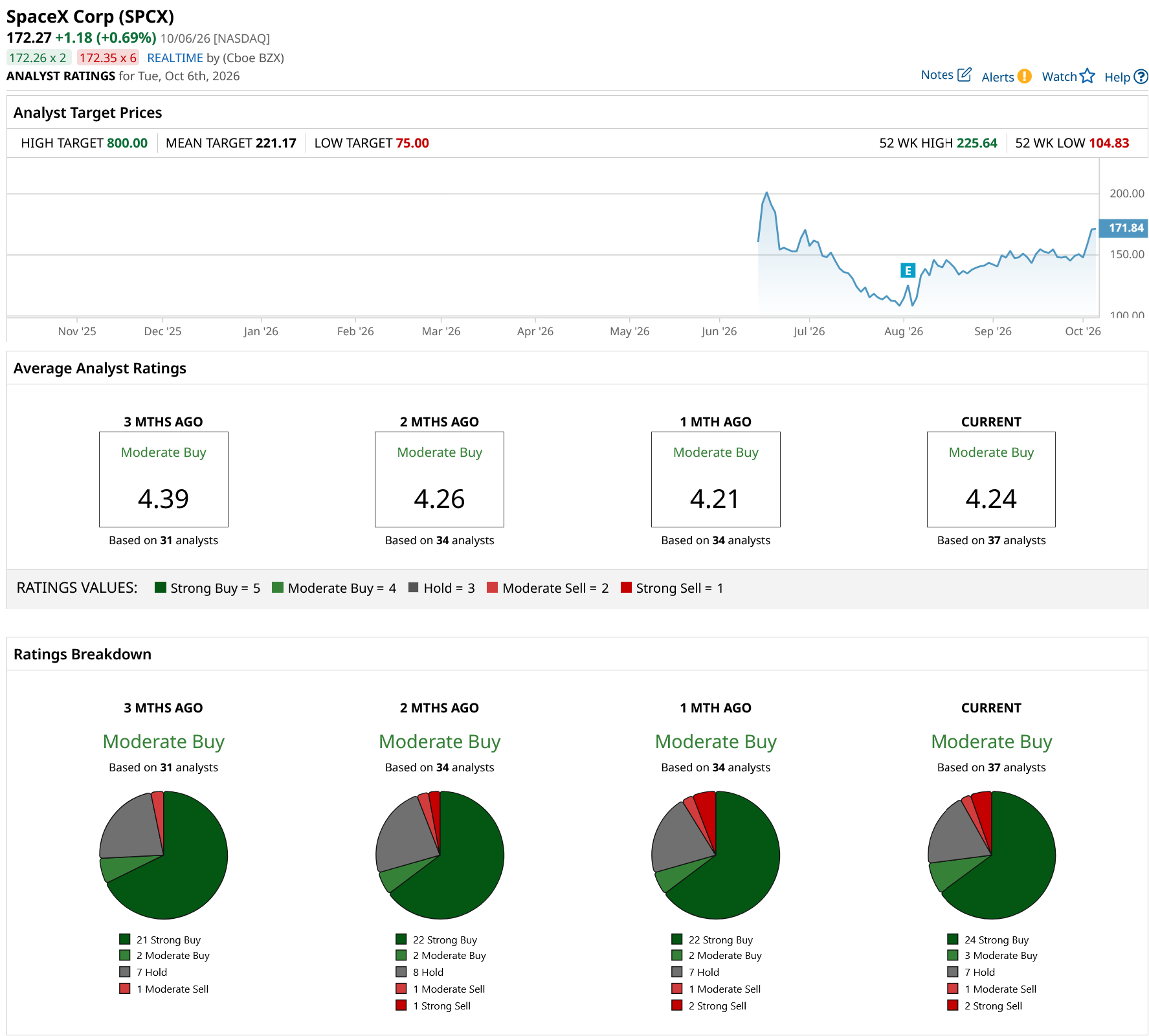
Out of the 37 analysts covering SPCX stock, 24 recommend “Strong Buy,” three recommend “Moderate Buy,” seven recommend “Hold,” one recommends “Moderate Sell,” and two recommend “Strong Sell.” The average SPCX price target is $221.17, above the current price of $172.
Like any investment, SPCX stock carries risks. Jonas flagged slower Starship reuse, weaker enterprise AI monetization, higher costs per watt of compute, longer time to power, funding needs, and regulatory delays as headwinds.
On the date of publication, Aditya Raghunath did not have (either directly or indirectly) positions in any of the securities mentioned in this article. All information and data in this article is solely for informational purposes. For more information please view the Barchart Disclosure Policy here.