
- PRICING
- LIVE QUOTES
- LEARN
- HELP


EN
Why You Need to Pay Attention to the Bond Market (and These ETFs) Right Now
Here’s a great observation I read recently from Jonathan Baird of the Global Investment Letter. He notes that investor allocations to bonds have plunged to near a 40-year low, right as the U.S. Treasury ramps up its reliance on short-term debt to finance soaring long-term yields.
It immediately brought me back to one of the worst buy-the-dip events in modern ETF history in which the iShares 20+ Year Treasury Bond ETF (TLT) dropped 40% in value, but its assets doubled from around $19 billion to $38 billion. All within about two years’ time.
That was my first clue that investors are still grappling with how to invest in and trade bonds.
As this table below shows, there’s a lot of room between the longest-term U.S. Treasuries (TLT invests in 20-30 year bonds) and T-bills (up to one year maturities). Here’s a few, including a “ladder” ETF in the Invesco E.W. 0-30-Year Treasury ETF (GOVI) and a pair that focus on the first fourth of the yield curve (up to seven years out of a possible 30).
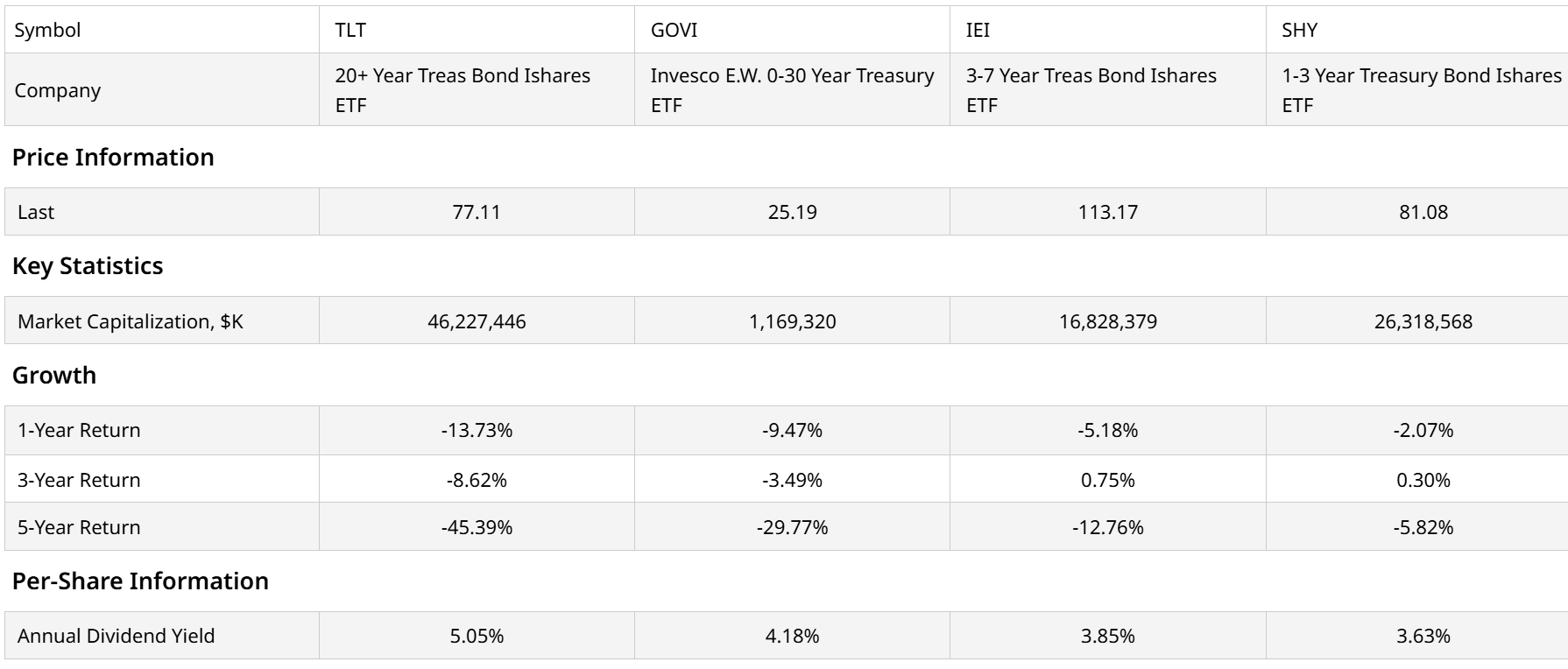
As we can see, there’s potentially an 8% annual return gap, give or take, between these two ends of the range. And, beyond Treasuries, there are many other varieties of bonds. That’s because your kids, friends, and co-workers are not the only ones who need to borrow money at times. Corporations (public and private), municipalities, foreign governments, and other entities do too. And the bond market is a resource for them. A bond, after all, is just a debt instrument.
But investors seem to be not so crazy about bonds. I suspect there’s a knowledge gap, and, with the support of the editors at Barchart, I’m going to do my darndest to try to close it.
Because in the ETF world especially, bonds and stocks are essentially just like each other. An ETF that invests in bonds still fluctuates in price to a degree high enough for investors to treat it as a “total return” investment – although more like a dividend stock ETF than an AI stock ETF.
Here’s the iShares 3-7 Year Treasury Bond ETF (IEI), which allocates from three- to seven-year bonds. It has been around for many years. Over the past five years, it traded in a range from $100 to $118, while paying an income rate that averaged about 3%. Currently, bonds in that area yield about 5%, so a much higher cushion.
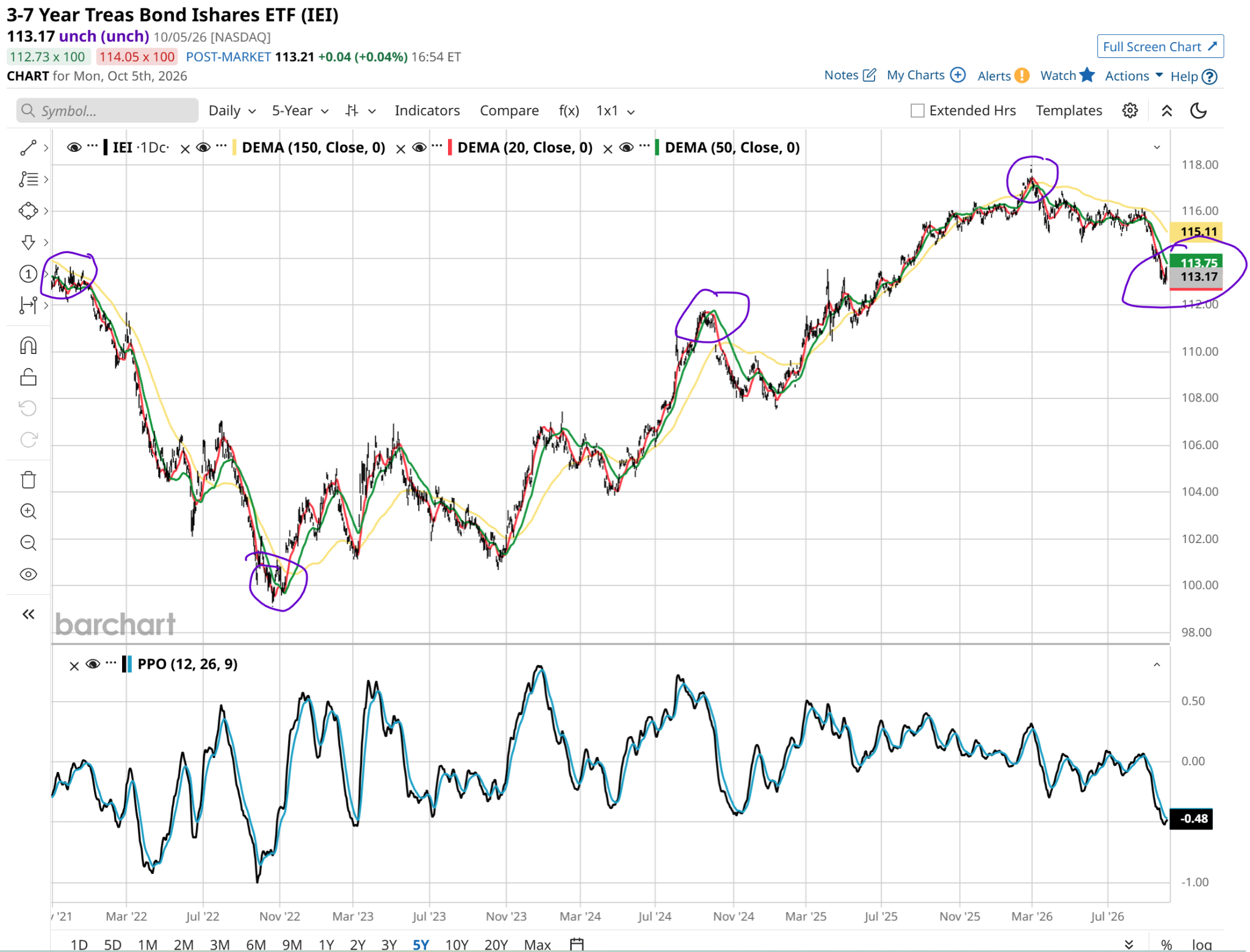
These are among the lowest-volatility bonds, but they still offer some “play” in terms of buying and selling. Sort of like a very low-volatility stock. Not shown, but the Consumer Staples SPDR ETF (XLP), a lower-volatility segment of the stock market, has traded in a price range of $66 to $90 over this same time frame.
After a four-decade bond bull market finally came to an end in 2022, sentiment shifted sharply bearish. But the real story is the behavior of investors and traders. When yields were pinned near zero, investors in 60/40 portfolios still funnelled 40% to bonds. Now, with 5-year and 10-year yields sitting at multi-decade highs near 5%, investors have almost entirely abandoned the space.
As Mr. Baird noted, an extreme in investor positioning is not a precise market-timing bell, but it is a massive signal telling us where to pay attention. When sentiment hits a 40-year low on an asset class that is actively handing me a 5%+ yield floor, my instinct is to think “trend shift brewing.” After all, when crowd sentiment creates extreme market distortions, we active risk managers go hunting.
How I Am Playing Higher Bond Rates
T-bill ETFs, shorter-term ones like the pair shown on the right side of that table above, and the iShares iBonds ETFs series, one of a few peer sets of ladder-building tools, are all part of my strategy. So are inverse ETFs like the Simplify Interest Rate Hedge ETF (PFIX) and the ProShares Short 20+ Yr Treasury (TBF), which can offset some of that persistent higher-rate environment we are firmly entrenched in currently.
The key is to ignore the crowd here. Bonds can be a total return venture, but they do not have to be. 5% is 5%. And I’m getting my fair share. Regardless of what anyone else thinks.
Rob Isbitts is a semi-retired CIO, former fiduciary investment advisor, and Barchart columnist. Check out his other work at ETFYourself.com (featuring the Fresh Charts weekly trading post), and ROAR.PiTrade.com, helping investors to better-manage their own portfolios.
On the date of publication, Rob Isbitts did not have (either directly or indirectly) positions in any of the securities mentioned in this article. All information and data in this article is solely for informational purposes. For more information please view the Barchart Disclosure Policy here.