
- PRICING
- LIVE QUOTES
- LEARN
- HELP


EN
If a Stock Market Crash Is Coming, Warren Buffett Says Investors Should Make This Important Move
Key Points
Generative AI continues to propel the market to new highs, but many investors are getting nervous.
Buffett's long-term investing strategy can offer important lessons in case the market dives sharply.
The last few years have been potentially life-changing for stock market investors. And you didn't need to do anything particularly complicated to earn massive returns. Just betting on the major indexes would have been enough, with the S&P 500 (SNPINDEX: ^GSPC) and Nasdaq Composite (NASDAQINDEX: ^IXIC) soaring by roughly 80% and 91%, respectively, over the last five years alone.
Much of this growth has been driven by optimism surrounding generative AI. But what goes up often eventually comes back down. And there are growing signs that sentiment could be shifting, with analysts at consulting firm Capital Economics expecting the "bubble" to begin to burst in 2027. Let's discuss how Warren Buffett's lessons could help investors navigate this increasingly uncertain stock market environment.
Missed AI’s "Act 1"? Act 2 Could Be 15x Bigger. Most investors think they missed the AI boat because they didn't buy Nvidia in 2005. But according to our analysts, we’re only at the end of "Act 1"—the R&D phase. "Act 2" is the global rollout. Continue »
Why is Wall Street getting worried?
Capital Economics believes AI will be transformative and increase company profits, but the research firm doesn't think the benefits will be as high as many analysts expect. And it isn't the only one getting nervous about the party ending soon. Goldman Sachs Chief Economist Jan Hatzius also recently warned that the AI investment boom won't last forever.
Global AI-related capital spending is expected to hit $1 trillion in 2026. And if this spending cycle dries up, it could directly lead to less revenue and profits for the hardware providers like Nvidia and Micron Technology, which have contributed to much of the stock market's recent growth.
Regular people are also seeing the writing on the wall through popular stock market valuation tools like the cyclically adjusted price-to-earnings (CAPE) ratio. This metric compares stock prices with average inflation-adjusted earnings over the last decade to provide a view of how expensive the market is relative to other points in history. And it now stands at 41.3. That's far above its average of 17.4 and a level that hasn't been seen since the late '90s dot-com bubble, when it hit a peak of 44.
Rising interest rates and bond yields also aren't helping the situation, because they increase the cost of capital while making risky tech stocks look less attractive relative to holding government debt.
What would Warren Buffett do?
Throughout his over six-decade-long investing career, Buffett had to navigate plenty of booms and busts in the stock market. His success has been attributed to a unique yet simple investing strategy that focuses on long-term holding and sustainable value creation. Buffett's quotes from the dot-com bubble era are particularly relevant for investors navigating a similar situation right now.
In 2000, he famously urged technology investors to be cautious after the huge returns they enjoyed in 1998 and 1999.
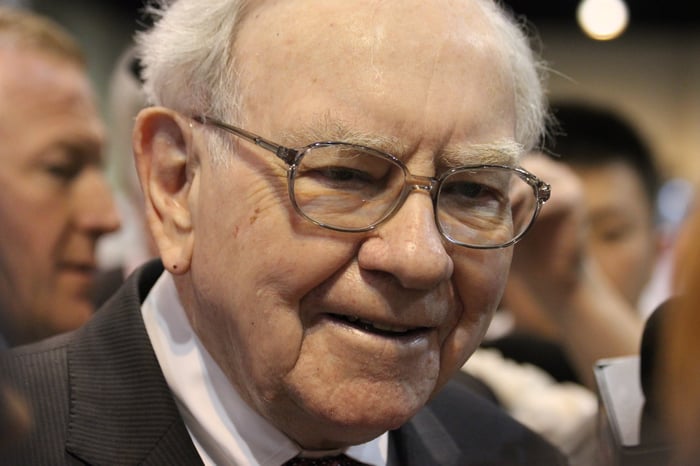
Image source: The Motley Fool.
"After a heady experience of that kind," he said, "normally sensible people drift into behavior akin to that of Cinderella at the ball. They know that overstaying the festivities ... will eventually bring on pumpkins and mice."
And he was correct. By the end of 2000, the market had fallen 9.1%, before dropping 11.9% in 2001 and 22.1% in 2002. Many of the hardest-hit technology stocks fared much worse -- going bankrupt or taking decades to regain their all-time highs achieved during the bubble.
What should investors do next?
It is important to note that Warren Buffett didn't sell everything during the dot-com bubble, even though he suspected a big crash was on the horizon. He generally believes that time in the market is a better long-term strategy than trying to time the market because it is difficult to know exactly when a crash will occur or how long it will last.
Investors can imitate Buffett by betting on fairly valued companies with stable, established business models instead of chasing the next big hype cycle. If nothing catches your eye, don't be afraid to sit on cash. Right now, Buffett's investment firm, Berkshire Hathaway, has $365.5 billion in liquidity, putting it in an excellent position to shop for deals if market valuations get cheaper over the next few months.
Will Ebiefung has no position in any of the stocks mentioned. The Motley Fool has positions in and recommends Berkshire Hathaway, Goldman Sachs Group, Micron Technology, and Nvidia. The Motley Fool has a disclosure policy.