
- PRICING
- LIVE QUOTES
- LEARN
- HELP


EN
How to Play Newly Listed Vylor (VYLR) Stock After the Corteva Spinoff
A new name has just landed on the stock market, and it comes with a rather unusual backstory. Vylor (VYLR) began trading on the New York Stock Exchange on Oct. 1, following its separation from Corteva (CTVA). But this was hardly a quiet corporate split. A U.S. District Court had just rejected California’s attempt to temporarily block the spinoff, allowing the separation to move ahead as planned. California had argued that the deal could leave valuable assets beyond the reach of potential PFAS-related environmental liabilities.
With the legal roadblock cleared, Corteva shareholders of record as of Sept. 24 received one Vylor share for every Corteva share they owned. Consequently, CTVA stock fell roughly 84% on distribution day, Oct. 1, as the value of its seed business moved into the newly independent company. The move had been in the works since May, when Corteva unveiled the Vylor name and said the spinoff was on track for the fourth quarter of 2026. But as the deadline approached, the separation faced a legal challenge that briefly put the planned timeline in doubt.
Now comes the more interesting part for investors—what exactly have they received?
Vylor is stepping into the public market as an advanced seed and genetics company, backed by a technology pipeline it values at roughly $19 billion. Its plans include seven new corn technology platforms starting in 2028, four soybean launches by 2035, and its Xpedite hybrid wheat system. The company is targeting $11.2 billion to $11.9 billion in net sales by 2029, alongside $3.3 billion to $3.7 billion in operating EBITDA.
So, with VYLR stock now trading on its own, is this a stock investors should buy, watch, or simply give time to prove itself?
About Vylor Stock
Vylor is an advanced seed and genetics company based in Johnston, Iowa, with more than a century of experience in agricultural innovation. The company develops next-generation seed technologies using elite germplasm, biotechnology, and gene editing to help farmers improve yields and manage evolving agricultural challenges. Its portfolio spans corn, soybeans, and wheat, supported by an expanding licensing business and multiple routes to market.
Following its separation from Corteva, Vylor is operating as an independent, publicly traded company. The company’s growth strategy is backed by an impressive technology pipeline, including 12 planned technology platform launches over the next decade, aimed at advancing agricultural productivity and resilience.
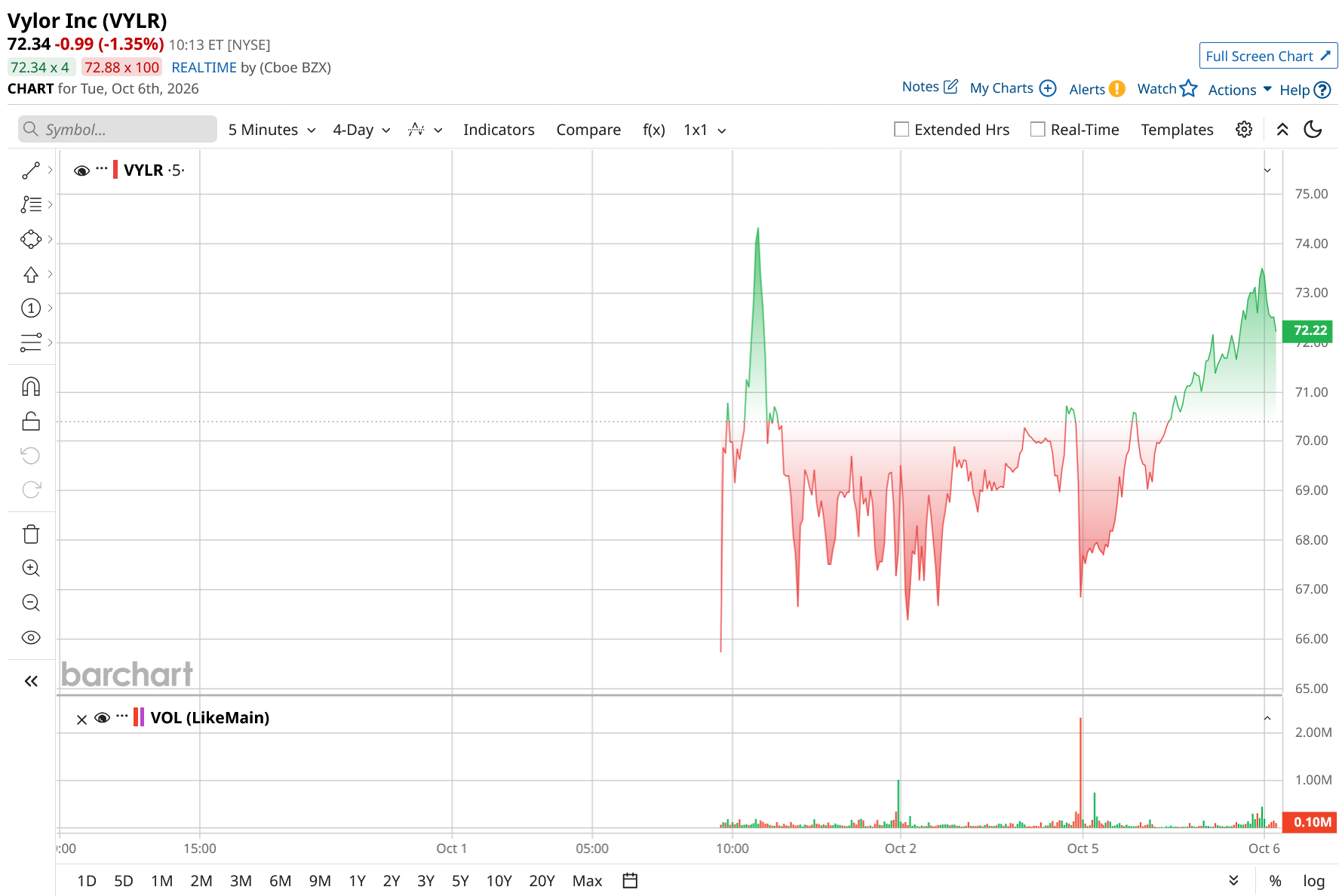
Vylor made its market debut with plenty of early momentum. The stock opened at $66 on Oct. 1 following its separation from Corteva and quickly climbed to an intraday high of $75. It ultimately settled at $68.26 by the end of its first trading session. Since then, the volatility has cooled somewhat, with VYLR currently trading around $72. That leaves the stock about 3% below its first-day peak.
A Snapshot of Q2 Numbers
The company generated $6.4 billion in net sales, while non-GAAP operating EPS rose to $2.30, up from $2.20 in the year-ago quarter. Income from continuing operations after income taxes came in at $1.2 billion, alongside $2.3 billion in operating EBITDA.
On the balance sheet, Vylor ended June 30, 2026, with $1.1 billion in cash and cash equivalents and $2.5 billion in long-term debt, giving investors a clearer picture of its financial footing ahead of the spinoff.
Vylor’s Seed Pipeline Could Drive Its Next Growth Phase
Vylor’s growth story is tied to what it can bring to farmers over the coming years, with corn, soybeans, and wheat at the center of its pipeline. In corn, the company plans to launch seven new technology platforms starting in 2028. One of the most notable is a trait designed to improve both yield and yield stability. Field trials across the Americas showed an average incremental gain of three bushels per acre, with improvements reaching as much as 10 bushels per acre. Vylor is also developing a gene-edited, multi-disease-resistant corn platform aimed at protecting yield potential while simplifying crop management.
Soybeans are another important piece of the puzzle. Vylor expects to introduce four new technology platforms by 2035, including a next-generation platform for Latin America designed to provide broad-spectrum insect control while maintaining strong yields and creating licensing opportunities.
Meanwhile, its Xpedite system for proprietary hybrid wheat is slated for a North American launch in late 2027. Multi-year trials have shown strong yields and resilience against challenges such as disease and drought.
Beyond seeds, the company expects its Vylor One licensing business to generate more than $500 million in gross licensing income in 2027, surpass $1 billion by 2035, and approach $2 billion by 2040.
Financially, Vylor is targeting $11.2 billion to $11.9 billion in net sales and $3.3 billion to $3.7 billion in operating EBITDA by 2029, with annual sales growth of roughly 3% to 4%.
What Are Analysts Thinking About VYLR Stock
Wall Street’s early view of Vylor is leaning positive, with analysts pointing to its strong position in seeds, proprietary genetics, and long-term innovation potential. BofA Securities initiated coverage with a “Buy” rating and a $78 price target, following Vylor’s separation from Corteva.
Analyst Matthew DeYoe described Vylor as the leading corn and soybean producer in North America and among the top 10 soybean players in Latin America. He believes its innovation, brands, and distribution network create high barriers to entry, while yield improvements can support pricing and earnings growth across different grain cycles. BofA also sees potential support from stronger grain markets in 2027, driven by expectations for a weaker U.S. harvest, firm demand, and production risks linked to a strong El Niño cycle.
Mizuho is even more bullish, initiating coverage with an “Outperform” rating and an $84 price target. The brokerage firm expects resilient seed demand as farmers continue prioritizing seeds over other agricultural inputs. It also highlighted Vylor’s proprietary germplasm and genetics, which can help differentiate its products, and its pure-play agricultural genetics focus, which gives the company a degree of scarcity value.
Mizuho further pointed to Vylor’s roughly $1 billion annual R&D spending, equal to about 10% of revenue, and the absence of generic risk as advantages for innovation beyond 2030. Licensing income, non-GMO hybrid wheat, gene-edited seeds, and crop-based biofuel feedstocks could provide additional long-term growth drivers.
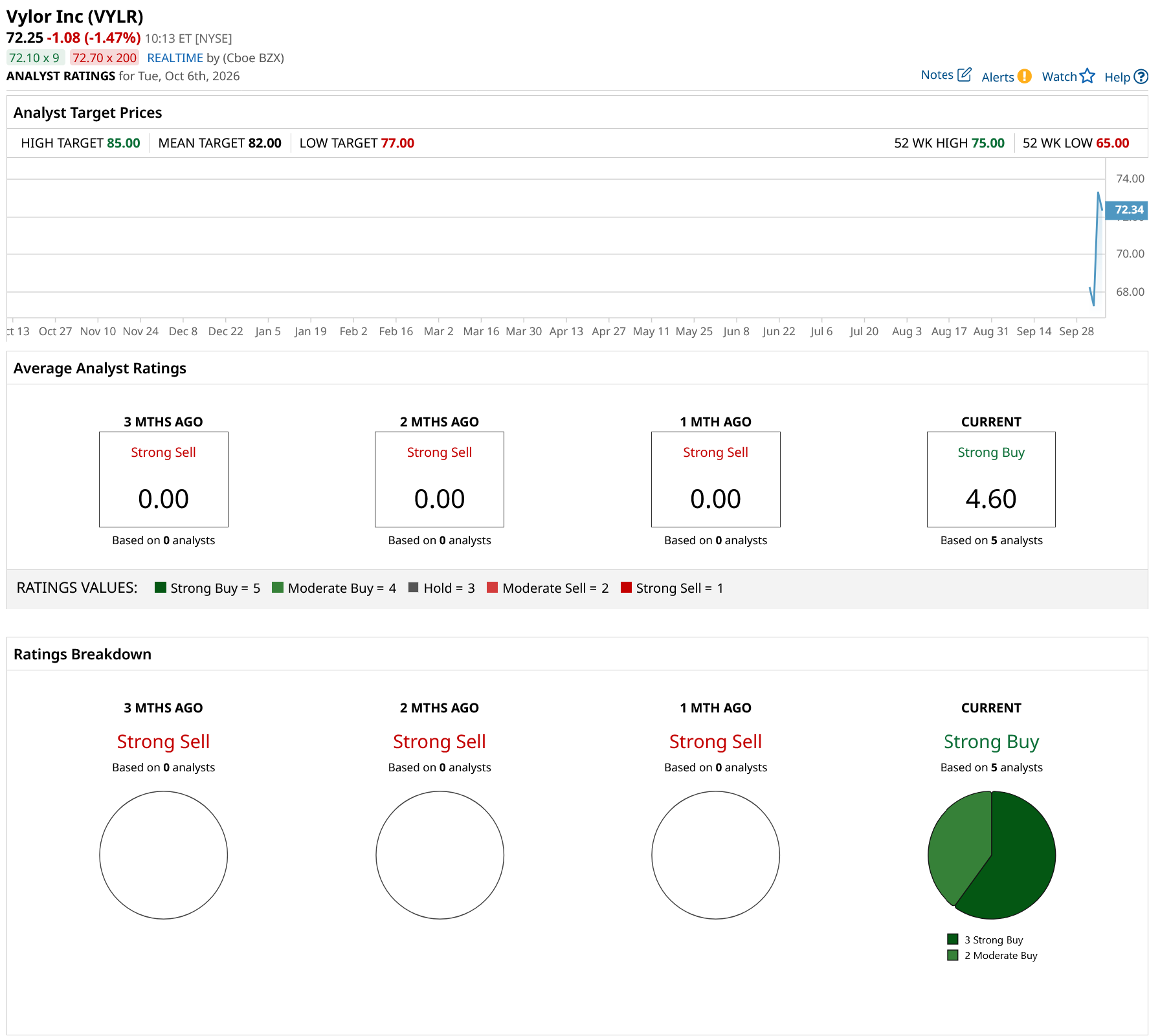
Overall, VYLR stock has a “Strong Buy” rating from the five analysts covering the stock. Among them, three have a “Strong Buy,” and the remaining two suggest a “Moderate Buy.” The mean price target of $82 implies upside potential of about 13% from here. The Street-high target of $85 means the stock could rally as much as 18%.
Final Thoughts
For investors, Vylor offers an intriguing mix of established seed strength, innovation, and ambitious long-term targets, but it is still a newly independent stock finding its footing. The bullish analyst outlook provides support, while the stock’s early volatility and execution risks warrant caution. Investors may want to watch VYLR closely or build a position gradually rather than chase its first-day momentum, particularly as its pipeline develops.
On the date of publication, Sristi Suman Jayaswal did not have (either directly or indirectly) positions in any of the securities mentioned in this article. All information and data in this article is solely for informational purposes. For more information please view the Barchart Disclosure Policy here.