
- PRICING
- LIVE QUOTES
- LEARN
- HELP


EN
Is Earnings Beat Altering The Investment Case For Parker Hannifin (PH)?
- Parker-Hannifin reported fiscal 2026 Q4 sales of US$5.8b with 9.8% growth and a 21% rise in adjusted EPS, and issued fiscal 2027 guidance indicating expectations for further organic sales and earnings expansion.
- The results indicate that Parker-Hannifin's motion control and aerospace exposure is contributing to record revenue, stronger profitability and a more cash-generative mix of longer-cycle programs.
- The focus now is on how this stronger margin profile and the new guidance may influence Parker-Hannifin's longer term investment narrative.
Compare Parker-Hannifin's premium P/E and industrial exposure with a curated set of peers by scanning the 39 power grid technology and infrastructure stocks positioned for similar long-cycle infrastructure demand.
Parker-Hannifin Investment Narrative Recap
Parker-Hannifin appeals to shareholders who buy into a long-cycle story. The thesis leans on motion control, aerospace and filtration staying critical to customers that prize reliability, safety and uptime. The fiscal 2026 Q4 beat and record US$5.8b quarter support that view, while the premium P/E and high debt mean the bar for execution is high.
The near term catalyst is whether management can turn the fiscal 2027 guidance into steady organic expansion while holding or lifting margins. The key risk is softer demand in core industrial end markets that leaves organic growth closer to recent slower trends, which could matter more than one strong quarter.
The most relevant update tied to this is Parker-Hannifin’s fiscal 2027 outlook. Management is guiding to 5.5% to 8.5% organic sales growth with adjusted EPS of US$34.25 to US$35.25. That keeps the focus on whether long-cycle aerospace programs and higher margin segments can keep offsetting more modest conditions in shorter-cycle industrial businesses.
This guidance also sits against a premium valuation, with the stock trading on a forward P/E near 28x to 30x and above several DCF estimates and peer multiples. If revenue, net margin or free cash flow delivery falls short of these guided ranges, the catalyst could flip, with the main issue becoming the risk of a derating rather than operational weakness alone.
Parker-Hannifin's current analyst script points to revenues of US$28.2b and earnings of US$5.2b by 2029, based on an assumed 9.4% yearly revenue growth rate and an earnings increase of about US$1.6b from US$3.6b today.
Uncover why Parker-Hannifin's fair value indicates a 19% potential upside to its current price that could narrow quickly.
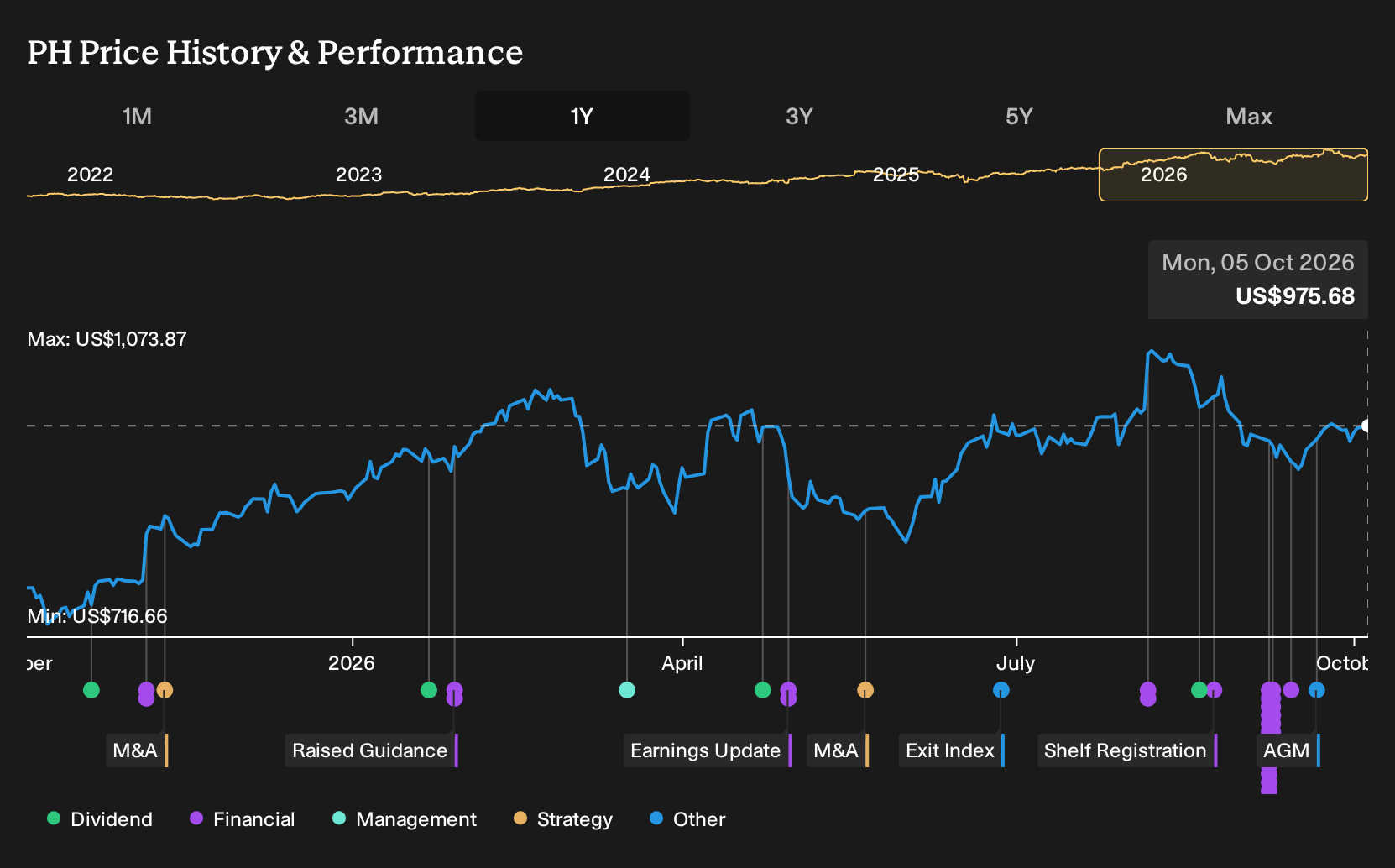
Exploring Other Perspectives
One alternate view on Parker-Hannifin leans hard into disruption risk. These bearish analysts worry that electrification and software centric automation could chip away at traditional hydraulics, which is why they were only pencilling in about US$26.7b of revenue and US$4.9b of earnings by 2029. That is well below the consensus script. It shows how far opinions can spread, so treat this quarter as a fresh input and explore several forecasts before deciding what fits your own expectations.
Explore 3 other Parker-Hannifin fair value estimates, including one that suggests it could be worth just $931.82.
Decide For Yourself
Disagree with existing narratives? Extraordinary investment returns rarely come from following the herd, so go with your instincts.
- A great starting point for your Parker-Hannifin research is our analysis highlighting 2 key rewards and 2 important warning signs that could impact your investment decision.
- See our latest analysis for Parker-Hannifin. The report includes a comprehensive fundamental analysis summarized in a single visual, the Snowflake, making it easy to evaluate Parker-Hannifin's overall financial health at a glance.
Looking for more ideas beyond Parker-Hannifin?
If Parker-Hannifin is on your radar and you want a broader watchlist, the Simply Wall St Screener can surface other stocks that fit different risk and income profiles so you can line up a few alternatives side by side.
- For investors hunting for potentially mispriced quality, scan a curated set of companies via 27 high quality undervalued stocks that combine fundamentals with what our model views as attractive pricing.
- If capital preservation matters most to you, filter for sturdier balance sheets and cleaner financial footing by reviewing the 31 resilient stocks with low risk scores that surfaces businesses with lower risk scores.
- Those looking further off the beaten path can cast a wider net across underfollowed opportunities through the 19 high quality undiscovered gems that highlight strong fundamentals with less crowd attention.
This article by Simply Wall St is general in nature. We provide commentary based on historical data and analyst forecasts only using an unbiased methodology and our articles are not intended to be financial advice. It does not constitute a recommendation to buy or sell any stock, and does not take account of your objectives, or your financial situation. We aim to bring you long-term focused analysis driven by fundamental data. Note that our analysis may not factor in the latest price-sensitive company announcements or qualitative material. Simply Wall St has no position in any stocks mentioned.
Have feedback on this article? Concerned about the content? Get in touch with us directly. Alternatively, email editorial-team@simplywallst.com