
- PRICING
- LIVE QUOTES
- LEARN
- HELP


EN
Amid the Weakness, Data Center Trade Prologis Stock Offers an Incredible Deal
From a fundamental perspective, it’s easy to see why Prologis (PLD) has been a solid performer for much of this year. However, this resilience has largely gone to waste, with PLD stock now sitting at a pedestrian year-to-date performance of only 0.33%. It’s gotten so bad that the ticker ranks as a 72% Strong Sell by the Barchart Technical Opinion indicator.
The red ink might be an overreaction. As a logistics specialist with a growing data center business, Prologis seems armed for the long haul. Given this frame of mind, the roughly 8% decline in the trailing month for PLD stock might seem more like an opportunity for contrarianism. At the same time, it’s easy to see the other side of the argument — plenty of tech names haven’t lived up to the billing recently.
So, is Prologis really an opportunity or merely a clever bull trap? I think it’s more of the former than the latter.
Here’s my 20-second elevator pitch. Right now, PLD stock is structured in a rare quantitative setup that has historically led to higher prices as an average tendency. However, when things go bad, they go bad in a hurry. Given this risk-reward profile, a bull call spread — which defines a maximum upside while limiting downside risk to an upfront cost — may offer a psychological asymmetry that some speculators may find advantageous.
If you want to skip ahead, I believe the 135/140 bull spread expiring Dec. 18 (which is about 11 weeks away) presents an intriguing wager.
Why the PLD Stock 135/140 Spread?
So, a legitimate first question is likely going to be, why the 135/140 bull spread expiring 11 weeks out? Mechanically, there’s a very good reason for choosing it. The second-leg strike is the lowest strike price that you can select for a multi-leg options strategy for the December monthly chain that offers an asymmetrically favorable payout.
That just means a payout that’s higher than 100%. The lowest available strike is $135, with the highest payout in this transactional setup clocking in at only 68.07%. I don’t like this deal because, while it may have a higher probability of success, you are risking more money than you can hope to profit. That makes the trade asymmetrical against you.
I could be wrong about this but according to some very smart people who ran complex risk-management calculations, generally speaking, the superior strategy will be to eschew high probability for high (i.e. favorably asymmetrical) payouts.
I think you can Monte Carlo simulate the numbers yourself (if you’re so inclined) but the basic theory is that, in the market, you’re always going to be touched up in a bad way. So, when you do lose, you want to lose small. Conversely, of the few times that you do win, you want to win big.
Don’t quote me on this, but apparently, that’s a better approach from a risk management and efficiency standpoint than trying to “probabilize” your way to success.
Probability Does Matter But It’s Not What You Think
So, are we saying that probabilities don’t matter and that we can risk manage our way to success? Honestly, that's where the debate gets interesting. Some folks say that risk management is the gold standard. Others have a different opinion.
Personally, I believe that probability is the gold standard because risk managing a wrongly “probabilized” trade will only make the mistake more efficient, if that makes sense. However, the controversial hot take I have is that while the mechanics of probability are mathematical, the applications of probability are philosophical.
That is to say, there is no question that the mathematical formulas present the outcomes they claim to present. The real question is whether or not that particular formula was appropriate for the security at that specific moment in time.
Remember, PLD stock (or any other equity) is not a static instrument. If Prologis appears like a terrible idea right now, it is not destined to be that way forever. In fact, securities often transition from one state to another.
So I don’t really care that PLD stock is weak right now. The question is, will it stay weak indefinitely? Based on the historical data, there’s likely a turnaround coming and that’s the real reason why I’m excited about the December 135/140 bull spread.
We’ve Seen This Play Out Before
In the last two months, Prologis stock printed 10 weekly candlesticks, with only three of them achieving net positive price action. Basically, within the defined period, 70% of the unit-wise volume incurred net drawdowns. This quantitative setup is rare, having only materialized eight times on a rolling basis over the trailing five years.
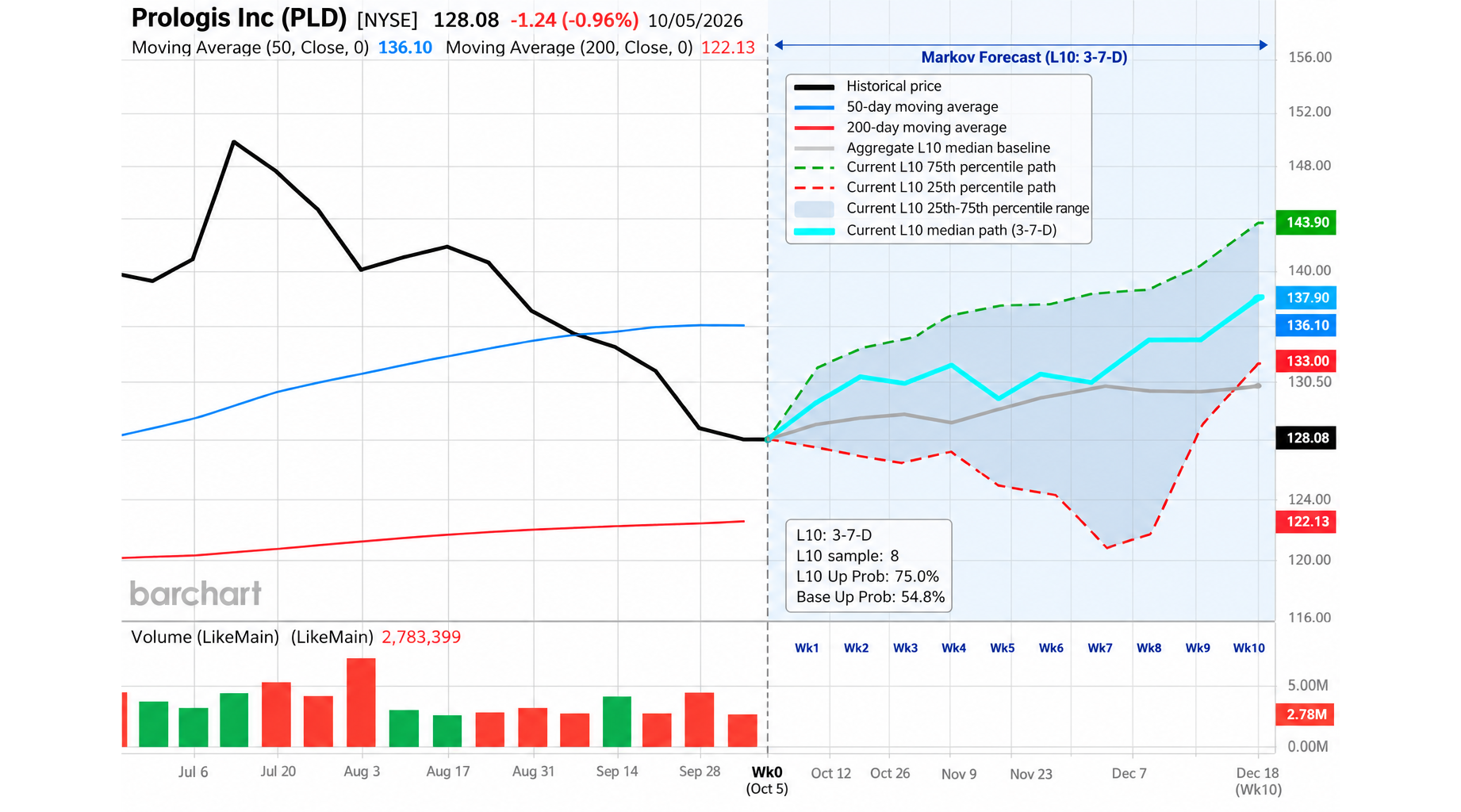
But do you know what typically happens when this setup flashes in the chart? PLD stock tends to swing higher with enough frequency that there’s roughly a 50/50 chance that the ticker reaches or exceeds the $140 strike price 11 weeks out. It’s not that much of a stretch, then, to suggest that there’s historical precedence for Prologis to trigger the necessary strike on the Dec. 18 expiration date.
Now, the major caveat is that when things go wrong with this setup, they go disastrously wrong. And that’s why the bull call spread format is so enticing for speculators. With the upfront cost being known and capped, you can’t lose more than the net debit per spread.
What you gain, though, is a max payout of over 170%. Assuming that these probabilities were indeed accurately calibrated, the expected value of the bull spread would be $65.03. That implies an expected return of a little over 35%.
As a piece of extreme speculation, there’s a real possibility that PLD stock options could be favorably mispriced. For risk-takers, you’ll want to keep close tabs on this name.
On the date of publication, Josh Enomoto did not have (either directly or indirectly) positions in any of the securities mentioned in this article. All information and data in this article is solely for informational purposes. For more information please view the Barchart Disclosure Policy here.