
- PRICING
- LIVE QUOTES
- LEARN
- HELP


EN
Eli Lilly (LLY) Just Drew Fresh Attention, So What Is The Market Weighing?
Eli Lilly (LLY) just expanded its collaboration with Gate Bioscience to pursue additional molecular gate therapeutics, a research heavy area that often attracts long-horizon investors who focus on pipelines rather than near term swings.
Eli Lilly’s share price has cooled in recent months, with a 7-day share price return of 3.52% down and a 90-day share price return of 7.48% down, even as the 1-year total shareholder return sits at 36.13% and the 5-year total shareholder return at 411.92%, which suggests long term holders have been rewarded.
Scan Eli Lilly’s latest move in molecular gate therapeutics against a curated field of peers, and see which health-focused compounders are already lining up in 33 healthcare AI stocks
Eli Lilly’s Gate deal lands right as enthusiasm around the stock has cooled. Is this the market fading a story, or a business still reinvesting at full tilt? And how does that gap show up in today’s valuation?
Most Popular Narrative: 23% Undervalued
Eli Lilly’s most followed narrative pegs fair value meaningfully above the recent $1,143.12 close, framing today’s price as a discount rather than a premium and putting real weight on how its pipeline could reshape future cash flows.
Eli Lilly already runs one of the fastest-growing drug businesses on earth, and its most powerful drug is not even approved yet.
This is the most important section. Lilly has a next-generation weight loss drug called retatrutide currently completing its final round of clinical trials. It works differently from everything on the market today. Current drugs activate one or two biological signals in the body to suppress appetite and manage blood sugar. Retatrutide activates three simultaneously, making it meaningfully more powerful than anything currently approved.
See why 76 investors see Eli Lilly as 23% undervalued.
According to AHaron, the narrative anchors on a fair value of $1,477.03 per share, built using a 7.5% discount rate and a long run view of Eli Lilly’s earnings power. That sits above both the current price and the $1,328.83 consensus target, which helps explain why this storyline frames the stock as undervalued even after a strong multi year run.
The gap between price and that appraisal rests on a few simple ideas. Eli Lilly has grown earnings rapidly in recent years, with profit up 93.6% over the past twelve months and an average 35.4% per year over five years, while net margins have shifted from 25.9% to 33.5%. Forecasts in the statements still call for earnings growth of 17.04% per year and revenue growth of 11.1% per year, which is lower than the hyper growth phase described in the narrative but consistent with a large, established drug maker that already generates $79.7b in annual sales.
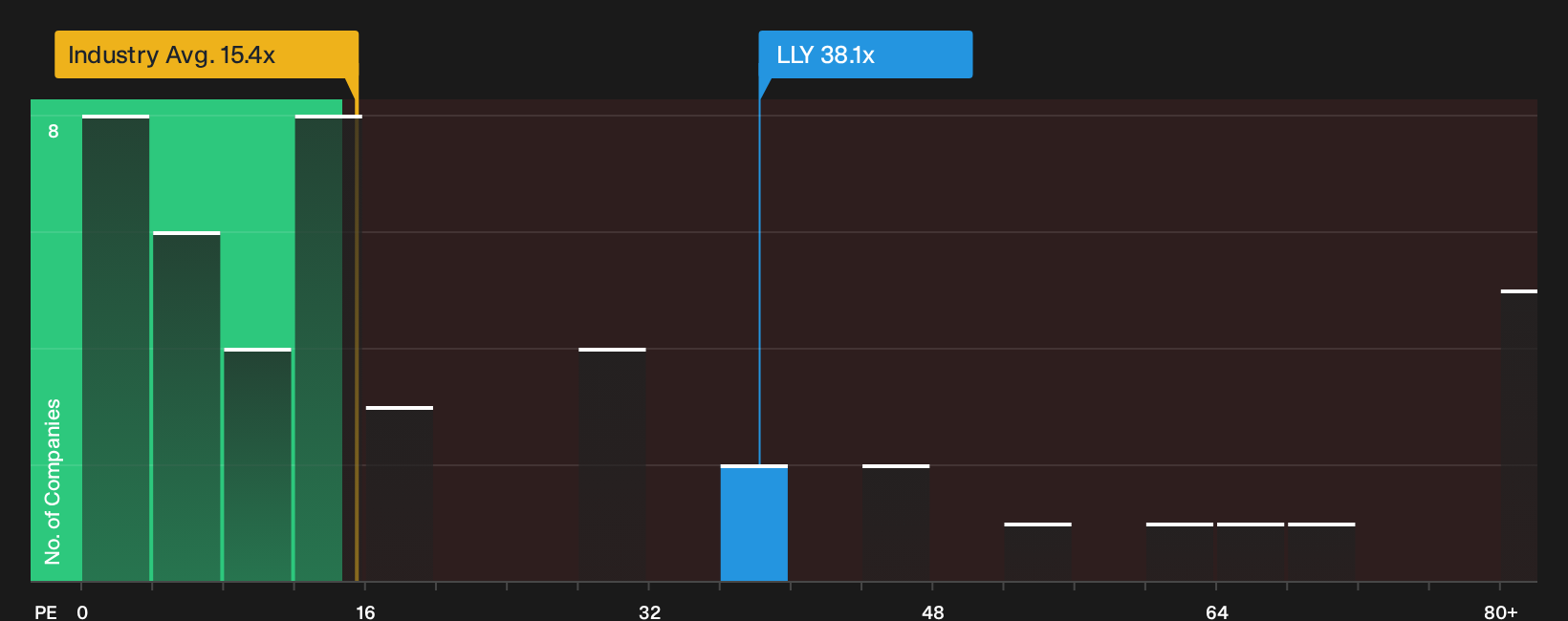
That mix produces a tension investors need to weigh. On one side, Eli Lilly looks expensive on a simple P/E screen at 38.1x, especially when compared with the wider US pharmaceuticals group at 15.4x. On the other, the firm is trading 31.4% below the future cash flow value of $1,667.32 from the SWS DCF model and sits below the fair P/E of 47.5x implied by regression against peers, suggesting the higher multiple lines up with above average returns and growth.
Balance sheet structure and management incentives sit in the background of that debate. Return on equity is a very high 78.84%, although that figure is flattered by leverage and the business is flagged as having a high level of debt and no lower risk funding through customer deposits. At the same time, the board is 92% independent with seasoned oversight, and earnings quality is assessed as high, which can matter when investors are deciding how much weight to put on DCF style valuations and multi year narratives for a research heavy group like Eli Lilly.
Result: Fair Value of $1,477.03 (UNDERVALUED)
Still, Eli Lilly’s story can change quickly if retatrutide or orforglipron stumble on safety or uptake, or if obesity drug pricing pressure deepens further.
Find out about the key risks to this Eli Lilly narrative.
Another View on Eli Lilly’s Valuation
A different lens on Eli Lilly comes from its P/E ratio. The shares trade on 38.1x earnings, far above the US pharmaceuticals group at 15.4x and below both peer levels at 46.6x and a 47.5x fair ratio. That mix points to potential multiple risk if sentiment cools again.
Investors weighing that premium can stress test their own case against the detailed valuation breakdown in See what the numbers say about this price — find out in our valuation breakdown.
Next Steps
If this Eli Lilly setup feels finely balanced, consider acting quickly and examine both the potential upside and downside for yourself with the full breakdown in 3 key rewards and 1 important warning sign
Looking for more investment ideas beyond Eli Lilly?
If Eli Lilly feels like only one piece of your portfolio puzzle, use the Simply Wall St Screener to identify other opportunities before the crowd.
- Target potential mispricing by scanning a curated pool of quality candidates through the 27 high quality undervalued stocks.
- Strengthen capital preservation by focusing on companies with resilient finances using the 31 resilient stocks with low risk scores.
- Hunt for overlooked opportunities with solid fundamentals by running the 19 high quality undiscovered gems.
This article by Simply Wall St is general in nature. We provide commentary based on historical data and analyst forecasts only using an unbiased methodology and our articles are not intended to be financial advice. It does not constitute a recommendation to buy or sell any stock, and does not take account of your objectives, or your financial situation. We aim to bring you long-term focused analysis driven by fundamental data. Note that our analysis may not factor in the latest price-sensitive company announcements or qualitative material. Simply Wall St has no position in any stocks mentioned.
Have feedback on this article? Concerned about the content? Get in touch with us directly. Alternatively, email editorial-team@simplywallst.com