
- PRICING
- LIVE QUOTES
- LEARN
- HELP


EN
Stablecoin Banking Launch Might Change The Case For Investing In Fiserv (FISV)
- Fiserv announced that its digital asset platform is now live with financial institution clients, supporting Bank of North Dakota’s Roughrider Coin stablecoin on Solana with issuance, custody, reserve and settlement services.
- The launch gives more than 90 North Dakota banks and credit unions a new way to handle interbank transfers, illustrating how Fiserv can plug stablecoin rails into existing banking and payments workflows without replacing core systems.
- Attention now turns to how Fiserv’s investment narrative evolves as its digital asset platform starts handling stablecoin transactions for regulated banks.
Scan how Fiserv’s new stablecoin rails compare with other regulated digital money plays by reviewing our curated list of 18 cryptocurrency and blockchain stocks.
Fiserv Investment Narrative Recap
To stay in Fiserv as a shareholder, you need to believe this is a payments and banking software provider that can turn flat to modest revenue trends into better earnings through cost efficiency, product mix and platform modernization. The key near term swing factor is execution on cost programs and portfolio clean up, while revenue pressure in both Merchant and Financial Solutions stabilises.
The new stablecoin rails support the modernization narrative but do not change that near term catalyst. The biggest risk still sits with revenue and margin guidance already trimmed for 2026, plus activist pressure for deeper cuts that could distract management or introduce execution missteps if implemented too aggressively.
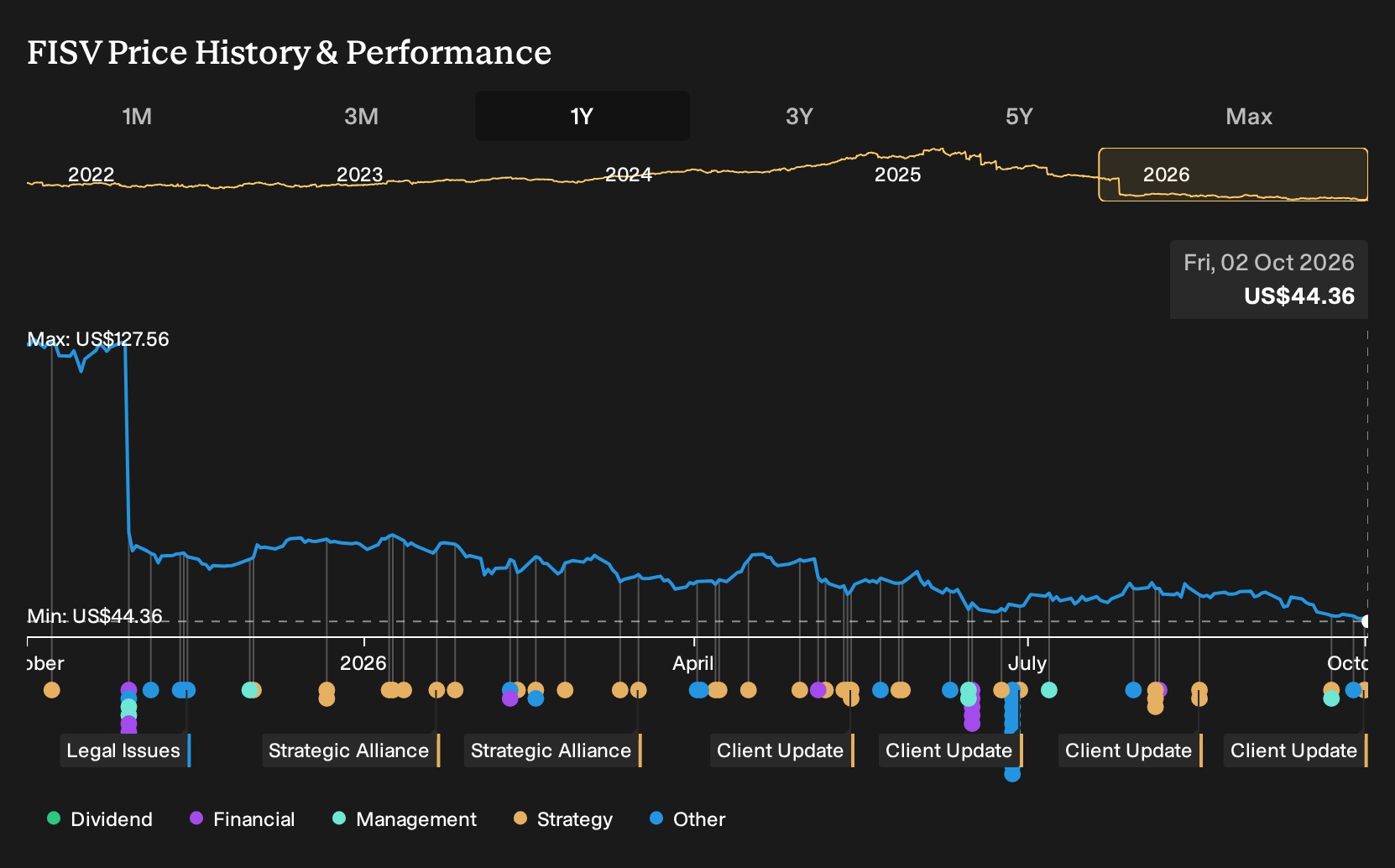
The Jana Partners letter from late September is the most relevant backdrop for this stablecoin launch. You now have a business rolling out a digital asset platform, while an activist is publicly pushing for US$1.25b in cost cuts, faster restructuring and a broad review of the portfolio after a share price decline of more than 50% over 12 months.
That tension puts execution under the microscope. Fiserv is trying to commercialise new services such as the Roughrider Coin platform at the same time as it works through Project Elevate, guidance resets, possible divestments and board level scrutiny. For you, the question is whether management can deliver operational savings without starving Clover, AI products and digital money initiatives of the investment needed to support future earnings growth.
What The Current Forecasts Assume For Fiserv
Analysts are effectively modeling Fiserv as a steady revenue story. Consensus calls for the top line to remain fairly flat over the next three years, while profit margins are expected to move from 13.4% today to 14.5% by 2029. That combination points to earnings doing more of the heavy lifting than sales, which matters if you are trying to work out how much room the business has to invest in digital money projects like Roughrider Coin while still meeting cost reduction targets.
On current estimates, earnings today are about US$2.8b and are projected to reach US$3.1b by 2029. That implies an earnings increase of roughly US$0.3b, even with muted revenue assumptions. The spread between the most optimistic forecast of US$4.0b and the most cautious at US$2.2b highlights how much disagreement there is about execution on margin targets and portfolio clean up. For you, that dispersion is a reminder to stress test your own view on how far Project Elevate and any additional restructuring can reasonably go without undercutting platforms that are meant to carry future profit.
To line up with the current analyst targets, you would also be accepting a shift in how Fiserv is valued. The consensus framework assumes the stock trades on a P/E of 13.1x in 2029, compared with 8.7x today and against an industry P/E of 17.1x. That means the story is not only about earnings growth but also about the market applying a richer multiple if the company can deliver higher margins and keep cash returns on track.
Fiserv's narrative projects US$21.3b revenue and US$3.1b earnings by 2029. Earnings would need to rise by about US$0.3b from US$2.8b today to reach that level.
Uncover why Fiserv's fair value indicates a 31% potential upside to its current price that could narrow quickly.
Exploring Other Perspectives
For Fiserv, the sharpest contrast comes from the bearish focus on earnings pressure. The lowest analysts were modeling revenue of about US$20.0b and earnings of roughly US$2.2b by 2029, which is well below consensus. Those figures reflect worries that projects like this stablecoin rollout absorb cash without easing longer term margin strain. You now have fresh information. Treat both narratives as starting points and explore how your own view might shift.
Explore 13 other Fiserv fair value estimates, including one that suggests as much as 13% downside from the current price.
Form Your Own Verdict
Don't just follow the ticker. Dig into the data and build a conviction that's truly your own.
- A great starting point for your Fiserv research is our analysis highlighting 3 key rewards and 1 important warning sign that could impact your investment decision.
- See our latest analysis for Fiserv. The report includes a comprehensive fundamental analysis summarized in a single visual, the Snowflake, making it easy to evaluate Fiserv's overall financial health at a glance.
Looking For More Investment Ideas Beyond Fiserv?
If this Fiserv update has sharpened your thinking, use that momentum to look across the wider market. The Simply Wall St Screener can help you quickly narrow a long list of companies into a handful that match your risk appetite, income needs, or value focus.
- If capital preservation and smoother returns matter most to you, start with a basket of 31 resilient stocks with low risk scores that score well on resilience and downside control.
- For readers hunting for quality at a reasonable price, there is a tailored collection of 27 high quality undervalued stocks that combine stronger fundamentals with more modest valuations.
- Income focused investors can zero in on companies that aim to pay out meaningful cash through a curated set of 7 dividend fortresses that clear a 5% yield hurdle.
This article by Simply Wall St is general in nature. We provide commentary based on historical data and analyst forecasts only using an unbiased methodology and our articles are not intended to be financial advice. It does not constitute a recommendation to buy or sell any stock, and does not take account of your objectives, or your financial situation. We aim to bring you long-term focused analysis driven by fundamental data. Note that our analysis may not factor in the latest price-sensitive company announcements or qualitative material. Simply Wall St has no position in any stocks mentioned.
Have feedback on this article? Concerned about the content? Get in touch with us directly. Alternatively, email editorial-team@simplywallst.com