
- PRICING
- LIVE QUOTES
- LEARN
- HELP


EN
How New $550 Million Loan Will Impact Quaker Houghton (KWR) Investors
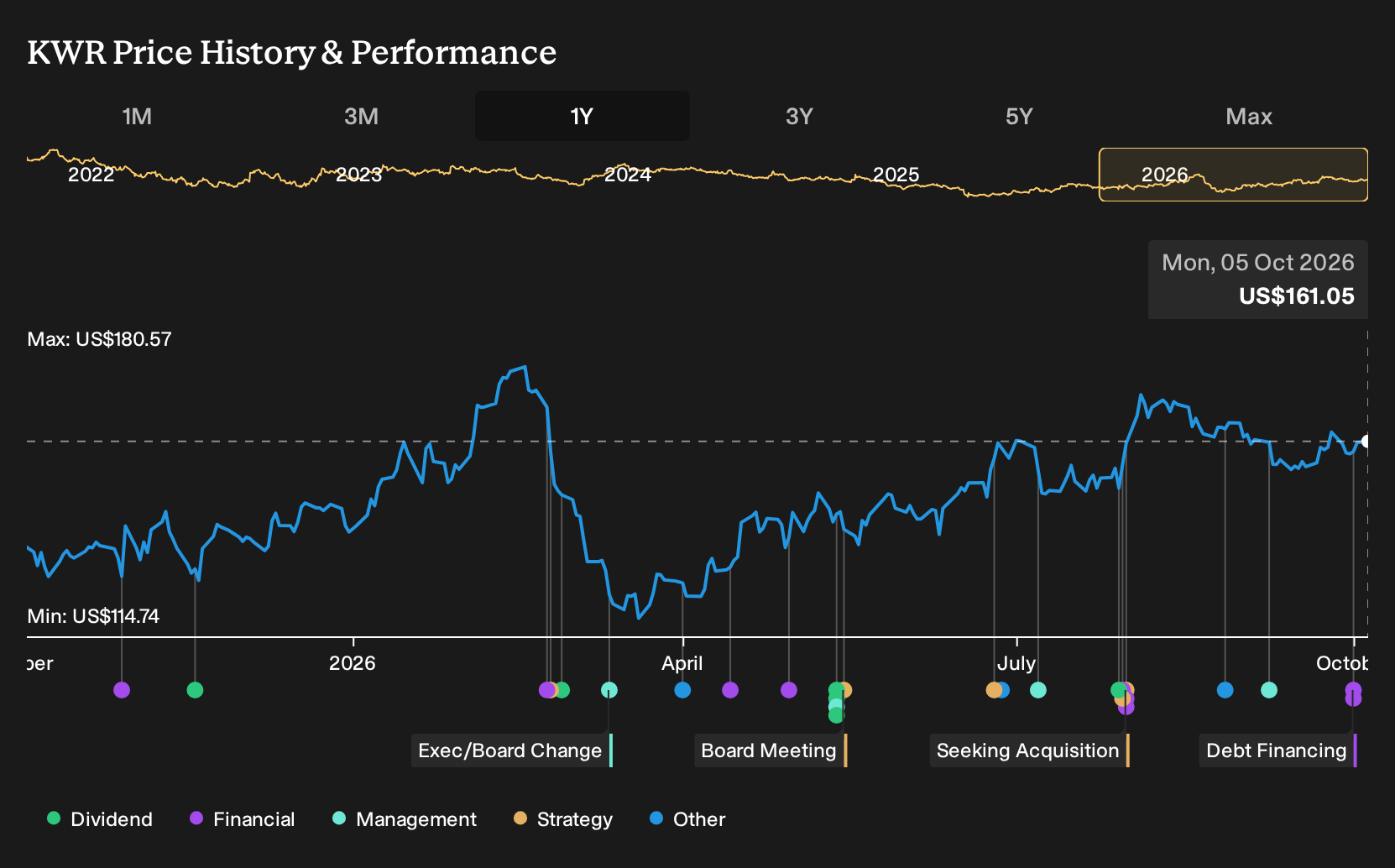
- Quaker Chemical has put in place a new 7 year, US$550 million Term Loan B facility that amends its 2019 credit agreement, refinances the prior U.S. Term Loans, runs to October 2033 and is priced at Term SOFR plus a 1.750% margin with minimal quarterly amortization.
- The package hardwires mandatory prepayments tied to excess cash flow, asset sales and new debt, which tightens capital allocation discipline and could influence how Quaker Chemical balances debt reduction, investment in projects like its Asia Pacific build out and potential acquisitions.
- We will look at how Quaker Chemical's investment narrative lines up with this new US$550 million Term Loan B refinancing move.
Quaker Chemical Investment Narrative Recap
To own Quaker Chemical, you need to be comfortable with a fairly simple idea. The thesis leans on higher value chemistries, Fluid Intelligence services, and Asia Pacific expansion offsetting raw material and logistics cost pressure, while a multi year efficiency program lifts EBITDA margins. The biggest swing factor in the near term remains execution on those structural savings and stabilizing Americas profitability after earlier earnings softness.
The new US$550 million Term Loan B by itself does not radically change that operational story. It lengthens debt maturity and hardwires prepayments, which can support discipline but does not remove the key risk that higher crude linked inputs and elevated regional operating costs could still weigh on gross margin progress and cash generation.
The October 2026 Term Loan B refinancing is the clearest reference point here. It replaces prior U.S. term borrowings with a US$550 million facility that runs to 2033 and carries a Term SOFR based coupon plus a 1.750% margin, with very low scheduled amortization. That profile keeps liquidity focused on running the business, funding the Zhangjiagang plant ramp, and supporting Asia Pacific volume opportunities.
Prepayment triggers around excess cash flow, asset sales, and new debt tighten the link between operations and balance sheet repair. If Quaker Chemical lifts margins through its transformation and network optimization efforts, those clauses can accelerate deleveraging. If raw material costs or Americas inefficiencies limit free cash flow, those same terms could constrain how aggressively the company pursues further projects or bolt on deals.
What The Term Loan Means Against Consensus Targets
Quaker Chemical's refinancing sits against analyst expectations that frame what the balance sheet may need to support over the next few years. The consensus view assumes annual revenue growth of 4.6%, profit margins rising from 4.9% today to 9.5% in three years, and earnings landing at US$215.8 million by 2029 versus US$97.5 million today. Those figures shape how investors think about the capacity to fund Asia Pacific expansion, absorb prepayment requirements, and still move the capital structure toward lower leverage over time.
On these numbers, the earnings profile analysts use implies more than a doubling of net income relative to current levels, along with a P/E moving from 28.4x today to 18.8x on the 2029 estimate. That future multiple sits below the 22.2x P/E cited for the broader US chemicals sector. This suggests the forecast already incorporates some progress on efficiency and mix while leaving the valuation framework more conservative than the industry reference. For a lender in a Term Loan B syndicate, a path that targets higher margins and a lower forward P/E can look supportive, provided the execution risk that underpins those earnings is fully understood.
The same analyst roadmap also pins 2029 revenue at about US$2.3b, which gives a sense of the scale that Quaker Chemical is expected to run through its Zhangjiagang facility and other regional hubs. That anticipated top line, paired with higher margins and tighter cost control, is what would need to interact with the loan's excess cash flow sweeps and asset sale clauses. If free cash generation lines up with these consensus figures, the Term Loan B could reasonably be paid down over time without crowding out investment in Fluid Intelligence offerings or Asia Pacific volume gains.
Quaker Chemical's narrative projects about US$2.3b of revenue and US$215.8 million of earnings by 2029. This rests on assumed yearly revenue growth of 4.6% and an earnings increase of roughly US$118 million from US$97.5 million today.
Uncover how Quaker Chemical's fair value indicates a 20% potential upside to its current price, which could narrow quickly.
Exploring Other Perspectives
Some of the most optimistic analysts saw Quaker Chemical’s refinancing capacity as a possible acquisition catalyst, with forecasts before this amendment already pointing to about US$2.3b of revenue and roughly US$216.2 million of earnings by 2029. You may read that as permission to be upbeat. Others might rethink that view once this tighter Term Loan B structure beds in, so treat this as one angle and compare it with several alternative opinions before deciding what feels reasonable to you.
Explore 2 other Quaker Chemical fair value estimates, including one that suggests as much as 24% upside from the current price!
Decide For Yourself
Disagree with existing narratives? Extraordinary investment returns rarely come from following the herd, so consider your own analysis carefully.
- A great starting point for your Quaker Chemical research is our analysis highlighting 2 key rewards and 2 important warning signs that could impact your investment decision.
- See our latest analysis for Quaker Chemical. The report includes a comprehensive fundamental analysis summarized in a single visual, the Snowflake, making it easy to evaluate Quaker Chemical's overall financial health at a glance.
Looking For More Investment Ideas Beyond Quaker Chemical?
Quaker Chemical may or may not fit what you want right now, so it can help to line it up against a broader watchlist built around clear balance sheet, income, or valuation filters using the Simply Wall St Screener.
- If capital preservation is high on your list, start with a 31 resilient stocks with low risk scores that keep volatility and financial stress in check.
- For investors who care most about quality at a reasonable entry point, compare Quaker Chemical against a 31 high quality undervalued stocks that combine solid balance sheets with strong cash flows.
- If you are hunting for under-the-radar opportunities, broaden your search with a 19 high quality undiscovered gems that still show healthy fundamentals.
This article by Simply Wall St is general in nature. We provide commentary based on historical data and analyst forecasts only using an unbiased methodology and our articles are not intended to be financial advice. It does not constitute a recommendation to buy or sell any stock, and does not take account of your objectives, or your financial situation. We aim to bring you long-term focused analysis driven by fundamental data. Note that our analysis may not factor in the latest price-sensitive company announcements or qualitative material. Simply Wall St has no position in any stocks mentioned.
Have feedback on this article? Concerned about the content? Get in touch with us directly. Alternatively, email editorial-team@simplywallst.com