
- PRICING
- LIVE QUOTES
- LEARN
- HELP


EN
Yamagata Bank (TSE:8344) Has Fresh Attention, So What Is The Market Weighing?
Alliance announcement puts Yamagata Bank stock in focus
Yamagata Bank (TSE:8344) moved into the spotlight after its board approved a memorandum of understanding with Daiwa Securities to explore a broad business alliance focused on securities accounts and consulting services.
The new alliance talks land on top of a powerful run in Yamagata Bank’s shares, with a 30-day share price return of 22.76% and a 90-day share price return of 46.84%. The 1-year total shareholder return of 254.31% and very large 5-year total shareholder return signal strong longer term momentum that recent news may be reinforcing rather than creating.
Capitalize on the momentum around Yamagata Bank by lining it up against 14 high quality undervalued stocks that our filters surface for strong fundamentals and potential mispricing.For Yamagata Bank, the sharp multi month rerating can be interpreted either as investors finally catching up with the underlying franchise or as sentiment racing ahead of itself. The valuation work comes next.
Preferred Price-to-Earnings of 23.3x: Is it justified?
Valuation now becomes the key debate for Yamagata Bank, because a share price of ¥5,690 sits on a P/E of 23.3x that the SWS framework flags as good value against its closest peers but expensive versus the wider Japanese banking sector.
The P/E ratio compares the current share price with the last year of earnings per share and is often used for mature, profitable lenders where earnings are a primary driver of value. For a regional bank like Yamagata Bank, this metric helps you see how much investors are currently willing to pay for each unit of profit relative to similar institutions.
Against its directly comparable peer group, the stock trades in line. The assessment states that a P/E of 23.3x is good value compared with a peer average of 23.3x, which points to a market that is neither giving a clear discount nor applying a premium relative to that subset.
The picture shifts when you step back to the broader JP Banks industry. Here the SWS checks flag Yamagata Bank as expensive, since its 23.3x P/E is set well above the wider industry average of 16.1x. That gap suggests investors are currently assigning richer terms to its earnings than to many other Japanese banks, and that any future change in expectations around profit quality or growth could matter more sharply for this stock.
See what the numbers say about this price — find out in our valuation breakdown.
Result: Price-to-earnings of 23.3x (OVERVALUED).
Still, the investment story around Yamagata Bank could be challenged if alliance talks with Daiwa Securities stall, or if sector wide P/E levels compress sharply.
Find out about the key risks to this Yamagata Bank narrative.
Another view on Yamagata Bank’s value
A second lens tells a different story. Our DCF model points to a future cash flow value of ¥1,348.6 per share, while Yamagata Bank trades at ¥5,690. On this measure, the stock screens as overvalued. This raises a simple question for you: Is the current price baking in too much optimism about the future alliance and earnings power, or is the model missing something important about this franchise?
Look into how the SWS DCF model arrives at its fair value.
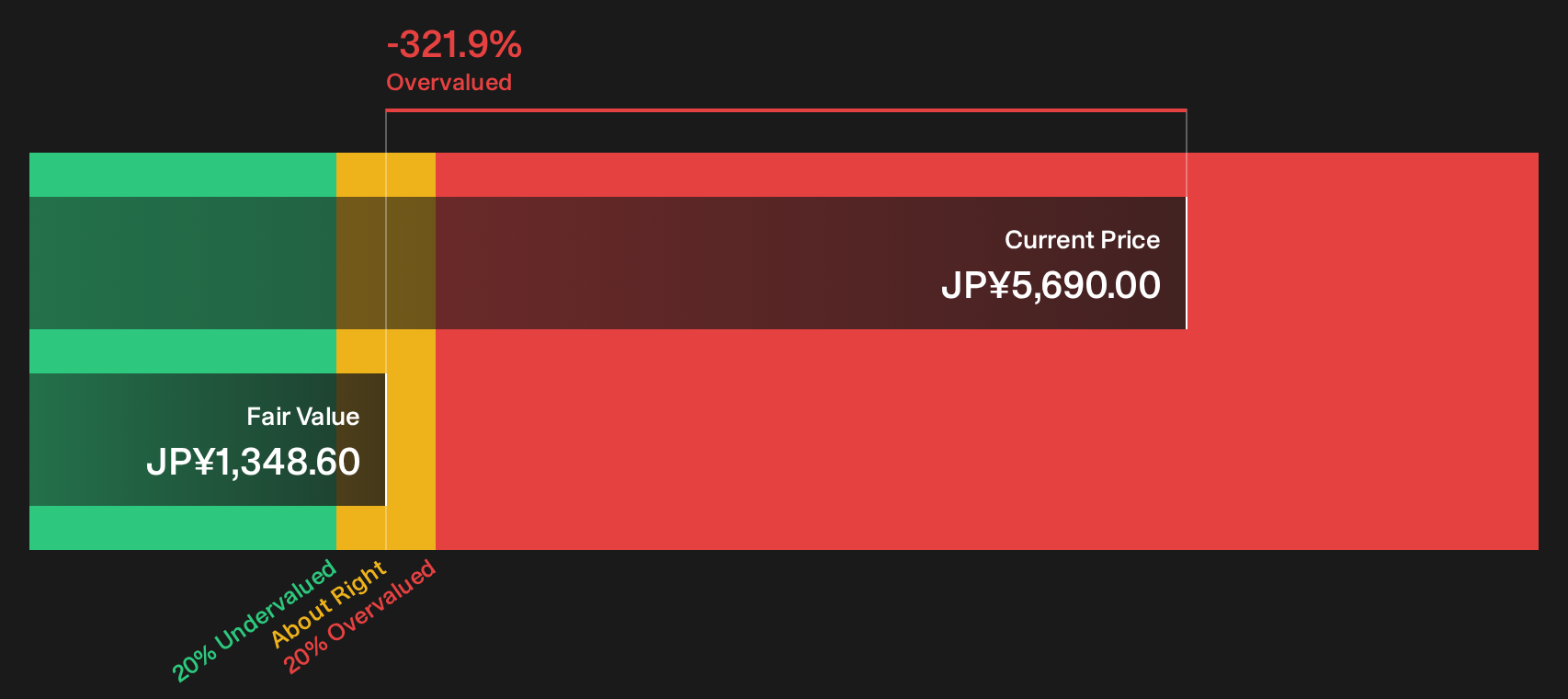
Simply Wall St performs a discounted cash flow (DCF) on every stock in the world every day (check out Yamagata Bank for example). We show the entire calculation in full. You can track the result in your watchlist or portfolio and be alerted when this changes, or use our stock screener to discover 14 high quality undervalued stocks. If you save a screener we even alert you when new companies match - so you never miss a potential opportunity.
Next Steps
Sentiment around Yamagata Bank is clearly split, which is exactly why fresh eyes on the data matter right now. Move quickly, review both the upside and the red flags, then weigh the 1 key reward and 2 important warning signs
Looking for more investment ideas beyond Yamagata Bank?
If Yamagata Bank has your attention, do not stop there. Put other opportunities through the same lens and keep your watchlist working hard for you.
- Target potential mispricing by lining up banks and other sectors against a curated set of 14 high quality undervalued stocks that combine quality fundamentals with appealing valuations.
- Prioritise resilience by filtering for businesses with strong finances using a focused list of solid balance sheet and fundamentals (23 results) that quickly surfaces healthier balance sheets.
- Get ahead of the crowd by scanning a curated pool of 75 high quality undiscovered gems where fundamentals already look compelling but attention is still limited.
This article by Simply Wall St is general in nature. We provide commentary based on historical data and analyst forecasts only using an unbiased methodology and our articles are not intended to be financial advice. It does not constitute a recommendation to buy or sell any stock, and does not take account of your objectives, or your financial situation. We aim to bring you long-term focused analysis driven by fundamental data. Note that our analysis may not factor in the latest price-sensitive company announcements or qualitative material. Simply Wall St has no position in any stocks mentioned.
Have feedback on this article? Concerned about the content? Get in touch with us directly. Alternatively, email editorial-team@simplywallst.com