
- PRICING
- LIVE QUOTES
- LEARN
- HELP


EN
Levi Strauss (LEVI) Names A New CFO, Is The Stock A Bargain?
Why Levi Strauss is back in focus
Levi Strauss (LEVI) has moved back onto investors’ radar after the company appointed John Vandemore as Chief Financial Officer and Executive Vice President, following Harmit Singh’s planned retirement.
The leadership handover, effective November 1, 2026, places a long-tenured finance executive in charge of the denim group’s financial operations. For shareholders, the key question is how this change could influence capital allocation, profitability priorities, and the risk profile of Levi Strauss over the next few years.
Levi Strauss shares, which last closed at US$19.87, have seen momentum cool, with the 30-day share price return down 5.65% and the 90-day share price return down 19.42%. The 3-year total shareholder return is up 58.8% against a 16.09% decline over the past year, so news of an incoming CFO with long consumer experience lands at a moment when investors are reassessing both growth potential and execution risk.
Compare Levi Strauss with a curated set of peers by scanning 31 high quality undervalued stocks that pair solid cash flows with balance sheet strength in consumer-focused businesses.
Levi Strauss now trades at a clear gap to both analyst targets and intrinsic value estimates. Is that discount a cushion after the recent pullback, or a signal that the fair value line sits elsewhere?
Most Popular Narrative: 29.5% Undervalued
On the most followed view, Levi Strauss is worth $28.20 a share, which sits well above the last close at $19.87, so the CFO change lands against a backdrop where many see a gap between price and underlying brand momentum.
Levi's decisive shift to a Direct-to-Consumer-first business, now representing over half of sales, is delivering higher margins (DTC EBIT up 400bps YTD), greater control over brand experience, and faster innovation cycles, driving sustained improvements in net margins and future earnings.
See why 40 investors see Levi Strauss as 30% undervalued.
Result: Fair Value of $28.20 (UNDERVALUED)
Still, the bullish Levi Strauss story starts to wobble if tariff costs climb faster than pricing power, or if denim demand softens just as non-core brands step back.
Find out about the key risks to this Levi Strauss narrative.
Another take on Levi Strauss valuation
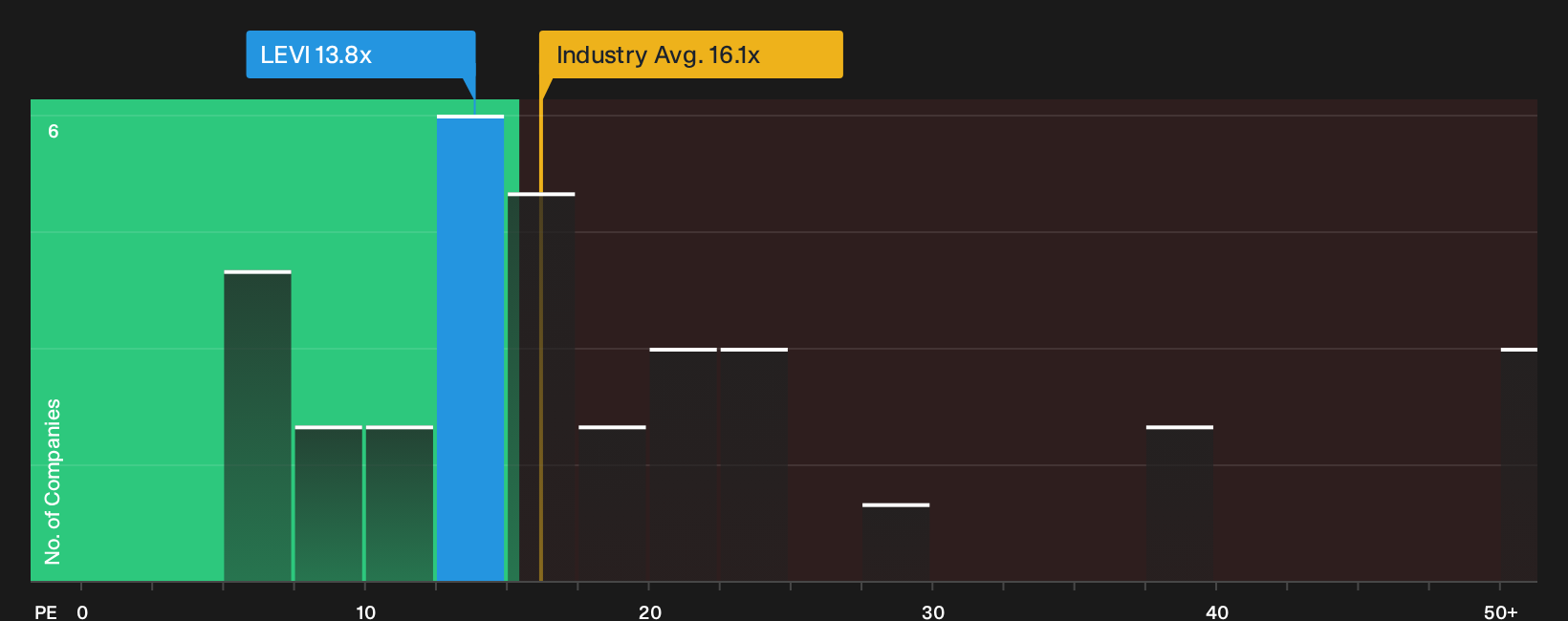
Those fair value estimates painting Levi Strauss as 29.5% undervalued lean heavily on analyst forecasts and future earnings. A simpler yardstick, the P/E ratio, tells a different story. LEVI trades on 13.8x earnings versus 19.7x for peers and 16.1x for the wider US Luxury industry.
The fair ratio for Levi Strauss sits at 19.8x, which is well above the current multiple. That gap suggests the market is pricing in more risk or less growth than peers and the fair ratio imply. The open question for you is whether that discount still reflects caution or starts to look like mispricing.
See what the numbers say about this price — find out in our valuation breakdown.
Simply Wall St performs a discounted cash flow (DCF) on every stock in the world every day (check out Levi Strauss for example). We show the entire calculation in full. You can track the result in your watchlist or portfolio and be alerted when this changes, or use our stock screener to discover 31 high quality undervalued stocks. If you save a screener we even alert you when new companies match - so you never miss a potential opportunity.
Next Steps
Mixed on Levi Strauss so far, or leaning one way? Move quickly from headline impressions to your own view by weighing the 5 key rewards and 1 important warning sign.
Looking for more investment ideas beyond Levi Strauss?
If Levi Strauss has sharpened your focus on valuation and quality, do not stop here. Cast the net wider and pressure test your thinking across other opportunities.
- Target reliable cash generators by scanning companies that combine earnings strength with attractive pricing using the 31 high quality undervalued stocks.
- Build a steadier portfolio by reviewing a 31 resilient stocks with low risk scores that emphasizes resilience when markets turn choppy.
- Hunt for overlooked potential by checking a 19 high quality undiscovered gems that filters for quality fundamentals before the crowd catches on.
This article by Simply Wall St is general in nature. We provide commentary based on historical data and analyst forecasts only using an unbiased methodology and our articles are not intended to be financial advice. It does not constitute a recommendation to buy or sell any stock, and does not take account of your objectives, or your financial situation. We aim to bring you long-term focused analysis driven by fundamental data. Note that our analysis may not factor in the latest price-sensitive company announcements or qualitative material. Simply Wall St has no position in any stocks mentioned.
Have feedback on this article? Concerned about the content? Get in touch with us directly. Alternatively, email editorial-team@simplywallst.com