
- PRICING
- LIVE QUOTES
- LEARN
- HELP


EN
Erie Indemnity (ERIE) Could Be 16% Undervalued Following Its Recent Pullback
Erie Indemnity (ERIE) has drawn fresh attention after a period of weaker share performance, with the stock down about 14% over the past month and roughly 15% over the past 3 months.
Across a longer window, momentum has been fading for Erie Indemnity, with the 1-year total shareholder return down 29.26% and the 3-year total shareholder return down 23.86%, even though investors who held on for five years still show a 26.67% gain on a total return basis.
Scan how Erie Indemnity’s recent pullback compares with other insurers by checking our hand picked 31 resilient stocks with low risk scores that aim to pair resilient balance sheets with steadier returns.
After a drop that leaves Erie Indemnity at about $221 and an internal fair value gauge implying roughly a 16% gap, the real puzzle now is where that spread belongs once you line up the valuation work.
Preferred P/E of 20x for Erie Indemnity: Is it justified?
On a rough intrinsic view, Erie Indemnity looks slightly cheap, with the SWS DCF model suggesting a fair value of about $262.74 against a last close of $221.09. Yet the market is still assigning the stock a P/E of 20x that sits well above peers.
The P/E ratio compares the current share price to earnings per share and, for insurers, it often reflects what investors are willing to pay for the stability and quality of profit streams rather than fast revenue expansion.
For Erie Indemnity, earnings have grown by an annual rate of 18.3% over the past five years and Return on Equity sits at 23.4%, which signals strong profitability. However, earnings declined 7.7% over the most recent year and net profit margins eased from 15.7% to 14%.
Against that backdrop, a 20x P/E is materially higher than both the US Insurance industry average of 10.6x and a peer average of 12.1x, so the current multiple looks demanding compared with what the wider sector is paying for earnings of similar businesses.
See what the numbers say about this price — find out in our valuation breakdown.
Result: Price-to-earnings of 20x (OVERVALUED).
Still, the narrative for Erie Indemnity can shift quickly if profit margins compress further or if investors decide that rich P/E premiums are no longer comfortable.
Find out about the key risks to this Erie Indemnity narrative.
Another View on Erie Indemnity’s Value
There is a twist once you flip the lens from the 20x P/E to the SWS DCF model. On that framework, Erie Indemnity screens as undervalued, with an estimated future cash flow value of about $262.74 compared with the current share price near $221.
That split between a demanding earnings multiple and a discount on cash flow raises a simple question for investors: Which signal deserves more weight for Erie Indemnity right now, the premium P/E or the DCF gap?
Look into how the SWS DCF model arrives at its fair value.
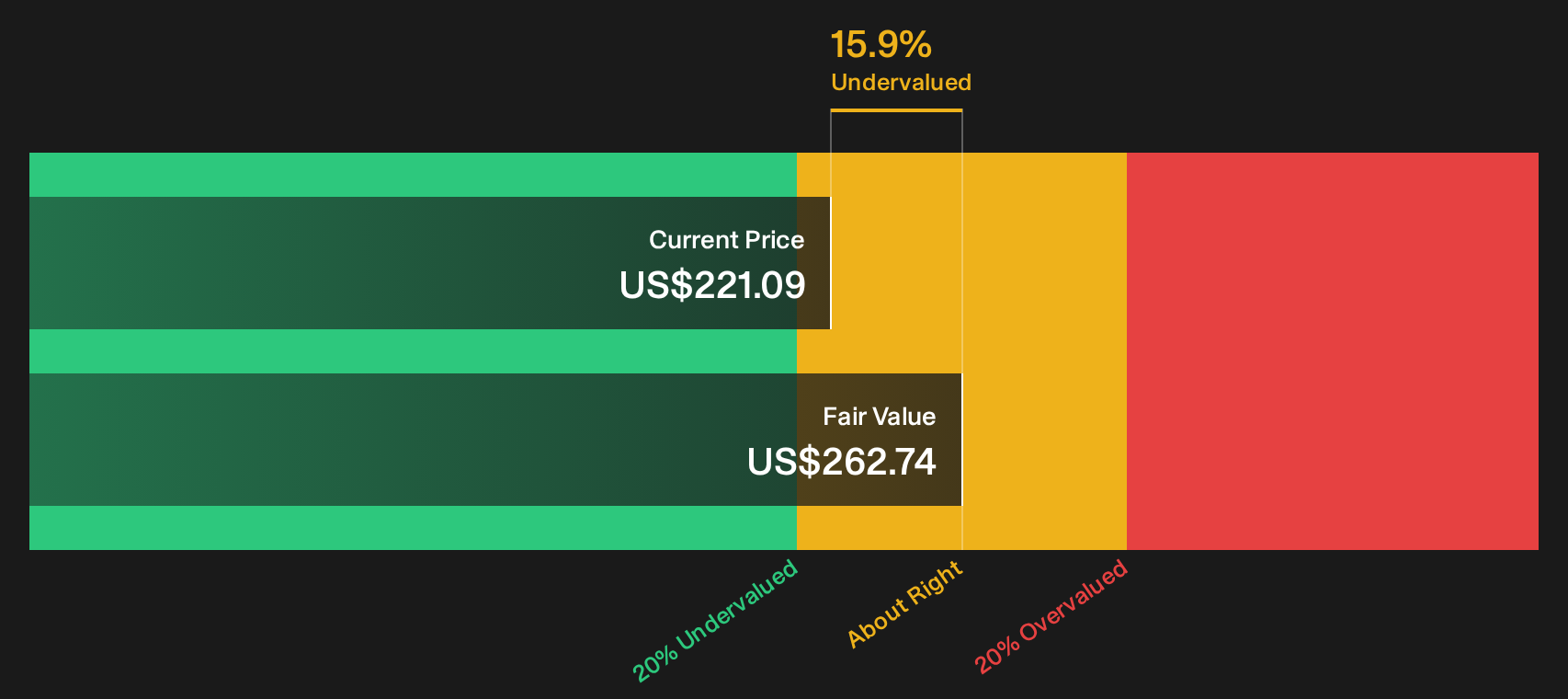
Simply Wall St performs a discounted cash flow (DCF) on every stock in the world every day (check out Erie Indemnity for example). We show the entire calculation in full. You can track the result in your watchlist or portfolio and be alerted when this changes, or use our stock screener to discover 31 high quality undervalued stocks. If you save a screener we even alert you when new companies match - so you never miss a potential opportunity.
Next Steps
Sentiment around Erie Indemnity is clearly mixed, which is exactly why it helps to run the numbers yourself and pressure test the story from every angle. If you want to see what has investors optimistic right now, start with the 2 key rewards.
Looking for more ideas beyond Erie Indemnity?
If you stop with Erie Indemnity, you risk missing other opportunities that could fit your goals even better, so broaden your watchlist before the next move.
- Target potential mispricings by scanning our hand picked 31 high quality undervalued stocks that highlight companies with solid fundamentals trading at compressed valuations.
- Strengthen your income stream by reviewing a focused 7 dividend fortresses built around higher yields and consistent payout records.
- Upgrade portfolio resilience by checking a curated list of solid balance sheet and fundamentals (26 results) featuring businesses with sturdier finances and cleaner balance sheets.
This article by Simply Wall St is general in nature. We provide commentary based on historical data and analyst forecasts only using an unbiased methodology and our articles are not intended to be financial advice. It does not constitute a recommendation to buy or sell any stock, and does not take account of your objectives, or your financial situation. We aim to bring you long-term focused analysis driven by fundamental data. Note that our analysis may not factor in the latest price-sensitive company announcements or qualitative material. Simply Wall St has no position in any stocks mentioned.
Have feedback on this article? Concerned about the content? Get in touch with us directly. Alternatively, email editorial-team@simplywallst.com