
- PRICING
- LIVE QUOTES
- LEARN
- HELP


EN
A huge wave of AI investment is surging upstream! Japan's semiconductor equipment sales surged 50%, and Bernstein reveals semiconductor investment implications under the blowout of AI computing power
The Zhitong Finance App learned that the “Global Semiconductor Device Tracking” research report recently released by Wall Street financial giant Bernstein shows that a huge wave of investment in semiconductor stocks (that is, AI semiconductors) around the topic of AI computing power is spreading from the procurement of AI computing power resources from cutting-edge AI laboratories and cloud computing companies to semiconductor manufacturing equipment stocks related to AI computing power infrastructure. The Bernstein analyst team said that the wave of stock market investment surrounding AI semiconductors is spreading rapidly to the upstream chip manufacturing industry, and semiconductor equipment companies are expected to become an important force in undertaking the latest round of huge AI computing power capital expenditure and semiconductor profit growth cycle.
Bernstein cites that semiconductor equipment supplier sales in the Japanese market reached 545 billion yen in August, up 50% year on year. Among them, front-end manufacturing, assembly, and test equipment increased by about 37%, 22%, and 98%, respectively; the three-month moving average sales continued to rise, and the expansion in demand for display equipment was supported by stronger medium-term demand. Meanwhile, Micron's revenue for the latest fiscal quarter increased by about 379% year over year to $54.229 billion. The revenue guidance for the next quarter rose further to US$61.5 billion and fluctuated up and down US$1.5 billion, indicating that storage demand is being transformed into strong revenue, and Micron's management said that in the future it will significantly expand production capacity to drive the expansion of memory chip supply; the Philadelphia Semiconductor Index rose 2.4% on October 2, reflecting the market's continued focus on semiconductor profit growth against the backdrop of a surge in US bond yields.
Advances in the world's most advanced AI agent/AI model technology, represented by Meta Muse, OpenAI Astra, and Anthropic Claude since this year, can be described as providing an important technical foundation for large-scale commercial expansion of AI applications to various industries and the continued surge in AI computing power demand — in particular, the scope of intelligent applications is expected to simultaneously improve AI superaccelerators such as AI GPUs/TPUs with high-performance HBM/DRAM/NAND memory chips and high-speed optical interaction in data centers Requirements for core AI infrastructure resources such as devices.
Judging from the AI inference system architecture, the GPU and the dedicated accelerator are responsible for model calculation, the CPU is responsible for converting the inference results into actual operation, and the memory and storage are responsible for storing and retrieving task states. Long contexts and multiple rounds of calls increase pre-populated computation and KV cache requirements; browsers, code sandboxes, retrieval, and task orchestration increase server CPU load; file, database, persistent memory, and cache layers extend requirements to server DRAM, enterprise SSDs, and high-speed networks. Nvidia's technical materials have described AI agent reasoning as an extremely large system project spanning GPU HBM, CPU DRAM, local NVMe and remote storage, as well as internal high-speed optical interconnections that are critical for data transmission.
According to Anthropic management, the memory chip components of AI data center server clusters and AI GPUs are still the clearest supply bottlenecks at the AI computing power industry chain level. Market research agency TrendForce predicts that in 2026, server DRAM contract prices will increase by about 270%, and enterprise-grade SSD prices will increase cumulatively by about 235%; HBM contract prices may still rise 70% to 140% in 2027, that is, they will continue to double. These data reflect the combined effects of the continued expansion of AI computing power demand and the increase in memory chip prices. TrendForce estimates also show that shipments of NVL72 racks covering Blackwell and Vera Rubin platforms are expected to increase by more than 50% year on year in 2027; the accompanying market research shows that the output value of related systems is expected to rise from about US$226 billion in 2026 to US$711 billion in 2027, a sharp increase of 214% year over year.
Looking at engineering logic, intelligent systems expand a question and answer to planning, search, tool call, code execution, and result verification. Multiple rounds of reasoning increase computational requirements. The management of the US semiconductor equipment giant Application Materials clearly stated earlier that smart applications urgently require AI accelerators such as large AI GPUs and more CPU-intensive computing architectures, and increase DRAM and NAND requirements to provide additional growth impetus for wafer manufacturing equipment.
Therefore, the semiconductor equipment side can be described as benefiting from the joint promotion of “demand for expansion of production” and “process upgrading”. Advanced logic chips have a fully surround gate structure, high-rise 3D NAND, and HBM stacking and advanced packaging, improving technical requirements for precision deposition, selective etching, chemical mechanical polishing, and defect control. Demand continues to grow, which may not only drive new production lines, but also increase the need to upgrade existing production lines.
These leading semiconductor equipment companies, headquartered in Japan, are favored by Bernstein because their product advantages cover key processes in AI chip manufacturing. For example, Tokyo Electronics, one of the world's leaders in semiconductor equipment, the strongest competitor in applied materials, has an extensive forward equipment layout, benefiting from investments in storage and advanced logic, and the depreciation of the yen may also enhance its pricing competitiveness. The reason why Japanese semiconductor equipment is the focus of Bernstein's observation is that Japanese suppliers account for about a quarter of the global wafer manufacturing equipment market and have a prominent competitive position in many key processes. Furthermore, Bernstein continues to be optimistic about a number of semiconductor equipment superleaders in the US and Chinese markets, including Applied Materials, Ke Lei, Fanlin Group, North China Chuang, and China Micro.
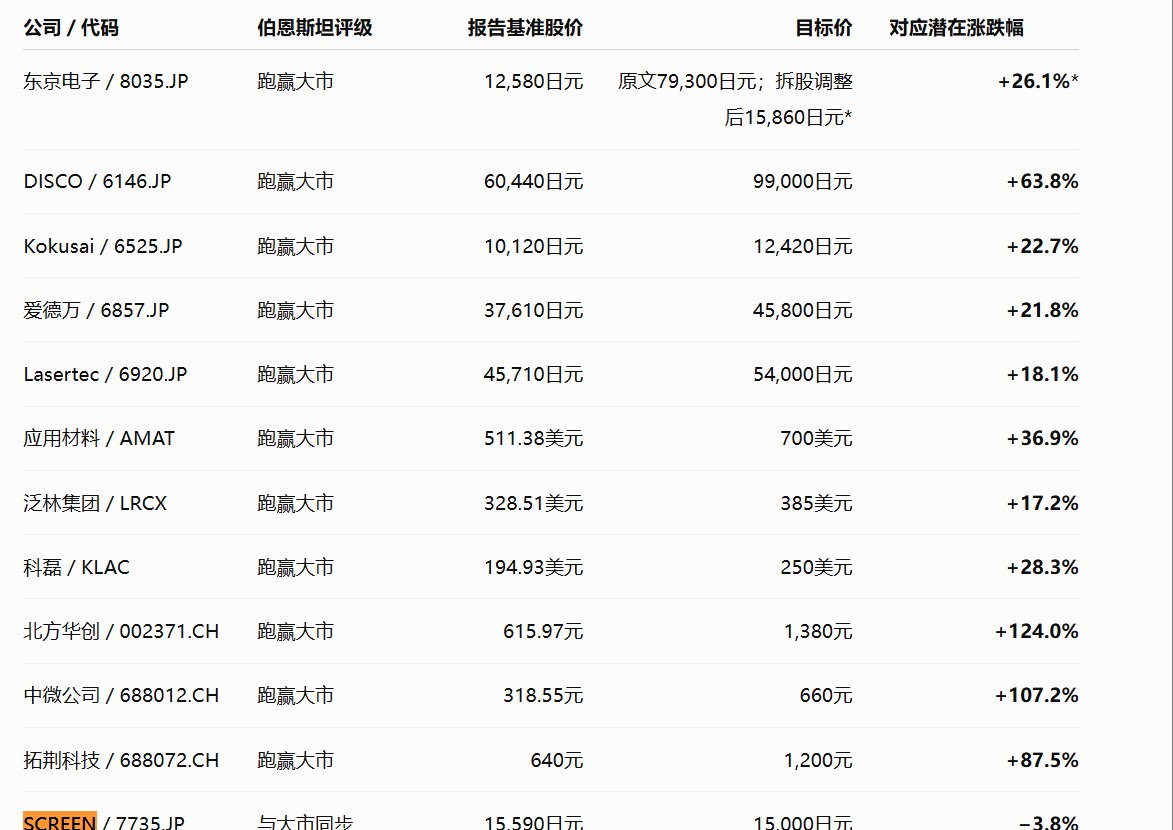
On the subject of AI computing power, Bernstein said that the core investment value of semiconductor equipment companies comes from the common demand of various chip routes for advanced manufacturing capabilities: competition between GPUs, customized AI chips, HBM, and server memory can jointly increase investment in deposition, etching, processing, inspection and testing. As a result, Bernstein maintained the “outperforming the market” rating of 11 companies, forming a semiconductor sector investment portfolio and stock selection framework of “global production expansion+increased process complexity + increased share share of advantageous manufacturers”.
The following table fully lists the stock investment ratings and target prices given by the Bernstein analyst team, and the corresponding upward space for these individual stocks over the next 12 months; the calculation benchmark uniformly uses the closing price of October 1, 2026 as listed in the report, rather than the real-time stock price.
Japan's semiconductor equipment sales have grown at a whopping 50%: a huge wave of AI investment is reaching the fab
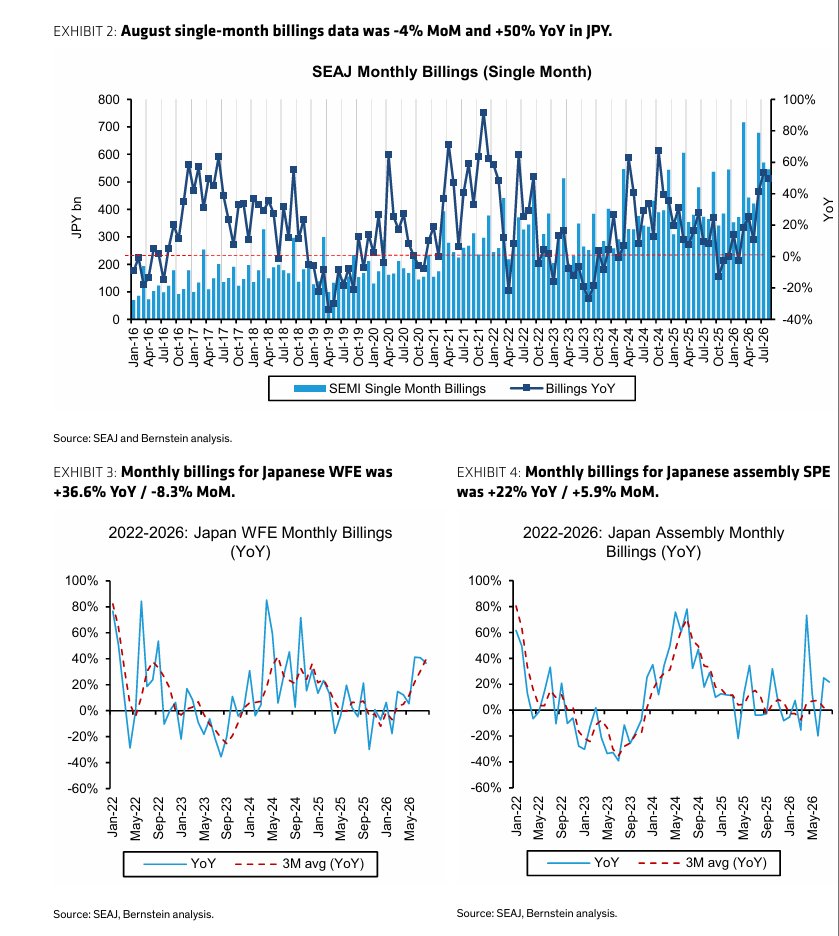
What the Bernstein analyst team focused on was a set of equipment sales data with global industry observation value, not procurement intentions that have not yet been fulfilled. The report uses August statistics released by the Japan Semiconductor Manufacturing Equipment Association (SEAJ) on September 30, and also observes single-month and three-month moving averages to distinguish short-term fluctuations and trends: in August, Japanese suppliers had semiconductor production equipment (SPE) sales of 545 billion yen, a crazy 50% year-on-year increase and 4% month-on-month decline; the dollar caliber increased 39% year over year. Average three-month sales increased 47% year over year and 7% month on month in yen terms, 35% year on year and 10% month on month in dollar terms, continuing the upward cycle that began in mid-2023.
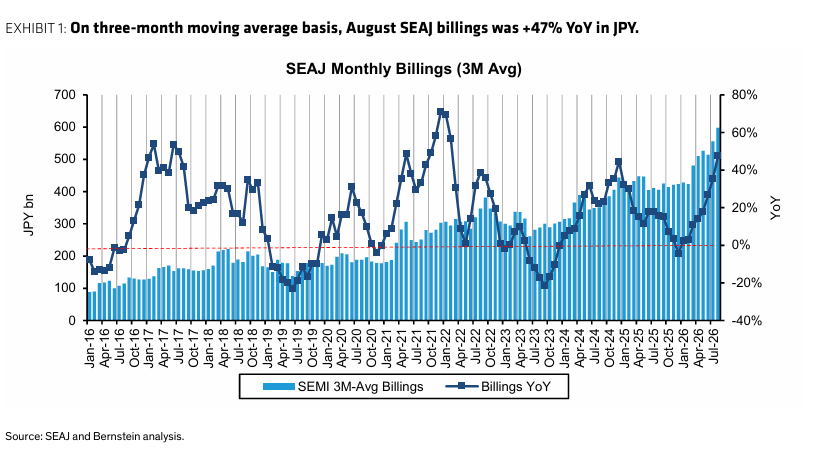
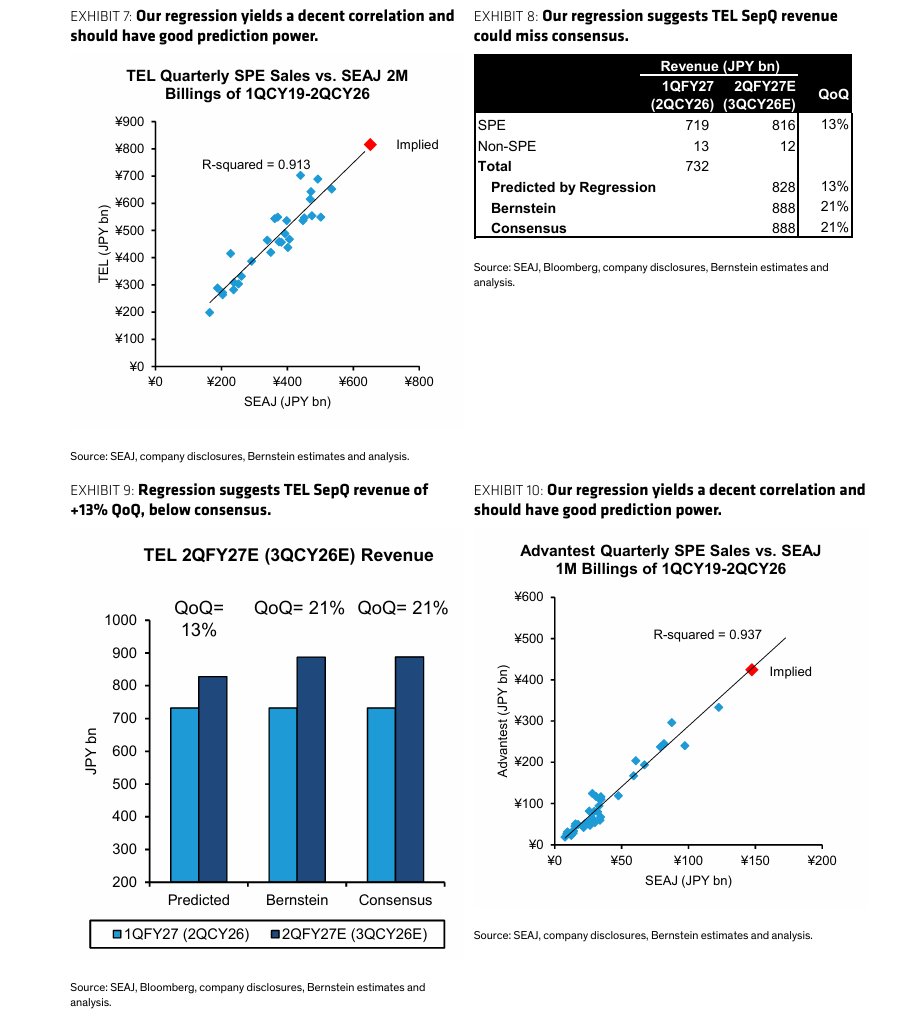
Bernstein said that these data all positively indicate that growth was not only brought about by the yen conversion, nor can the economy be reversed because of a month-on-month decline. Looking at the breakdown, Qiandao wafer manufacturing equipment increased 36.6% year on year and decreased 8.3% month on month; assembly equipment increased 22% year on year and 5.9% month on month; test equipment increased 98% year on year and 17% month on month; test equipment increased by an average of about 14% month on month over three months. Qiandao maintained high year-on-year growth, packaging continued to expand, and testing nearly doubled, forming the most important industrial chain structure signal in this report.
According to the latest forecasts of Bernstein's analyst team, the agency predicts that the global wafer manufacturing equipment (WFE) market will grow by 26.3% and 32.6% in 2026 and 2027, respectively; according to the combined forecasts of these two years, the market size in 2027 will expand by about 67.5% compared to 2025, which means that the multi-billion dollar semiconductor equipment industry is facing two consecutive years of significant expansion. Bernstein stressed that the net capital expenditure for the 2026 fiscal year, as shown by Micron's strong performance outlook, reached 27.37 billion US dollars, and the newly disclosed capital expenditure plan for the first half of fiscal year 2027 was about 25 billion US dollars, providing specific support for storage manufacturers to continue to expand manufacturing investment.
The reason why the Bernstein Research Report's research on semiconductor equipment focuses on the Japanese market is mainly due to the large-scale expansion of production by global fabs, which have greatly benefited Japanese semiconductor equipment suppliers, which occupy a high weight in the Japanese stock market and have an important influence in the global semiconductor industry chain.
Bernstein said that there is a strong business match between Japanese equipment companies and the recovery in storage capital expenditure: Tokyo Electronics is the fourth largest semiconductor production equipment supplier in the world, covering six major product fields, benefiting from DRAM and advanced logic investments, and may expand its share and profit margin with pricing competitiveness after the depreciation of the yen; DISCO has a share of about 85% in the field of grinding and cutting equipment, and recent growth comes from HBM and Cowos, and can also benefit from hybrid bonding, 3D stacking, and backside power supply-related processes; Kokusai's batch Atomic layer deposition (Batch ALD) is mainly used in NAND, and is expected to expand adoption with advanced processes such as full surround gates (GAA).
In addition, Lasertec has about 50% of mask inspection share and has an exclusive supply position in the field of exposure wavelength inspection (Actinic Inspection). The penetration of the new A200hit equipment into fab applications is expected to drive the expansion of the serviceable market. Bernstein is very optimistic about the new A200hit product expanding the application of EUV wavelength detection; Edwin is benefiting from testing intensity, average equipment sales price and product portfolio upgrades with the report's share of about 65% of HBM testing equipment and Nvidia's AI GPU testing supply position. From an engineering perspective, the more complex the chip structure, the more layers, and the higher the total value after packaging, the stricter the requirements for precision processing, defect detection, and test coverage during the manufacturing process, so equipment expenses can simultaneously benefit from increased production capacity and increased process investment per unit production capacity.
From production expansion dividends to “complexity dividends”: semiconductor equipment leaders take over the huge wave of AI investment
Bernstein's recommended coverage of semiconductor equipment investment further shows that this round of semiconductor equipment investment opportunities has the characteristics of market expansion across regions and processes, and shows the “complexity dividend” of semiconductor devices exclusively prepared in the semiconductor sector — that is, the more complex the architecture, stacking, and packaging of AI infrastructure chips such as AI chips/memory chips/optical chips, the higher the equipment capacity required for manufacturing and verification; expensive chips and multi-core packages also increase failure costs, making fuller inspection and testing more economically valuable.
In the US market, the logic of applied materials includes long-term WFE growth, service business growth, and capital return; Fanlin Group (LRCX) also benefits from technological transitions such as GAA, advanced packaging, HBM, and NAND upgrades; and Kelei has received valuation premium support through structural growth in the process control field, enduring competitive advantage, relatively low substitution risk of Chinese domestic production, and disciplined capital allocation.
In terms of the Chinese market, Bernstein said that North China Huachuang covers physical and chemical vapor deposition, dry etching, heat treatment and cleaning, and serves logic, DRAM and NAND customers; with dry etching as the core, it is expanding into deposition fields such as ALD, LPCVD, and epitaxial; Tuojing Technology is further expanding wafer-to-wafer and chip-to-wafer hybrid bonding equipment based on various types of thin film deposition equipment. The three are jointly driven by domestic substitution and share growth, so the growth of Chinese equipment companies includes localization factors independent of the growth rate of global aggregate demand. The report only maintains “in sync with the big market” for SCREEN (7735.JP), which is listed and traded on the Japanese stock market: although the valuation is low, the intensity of cleaning has not increased significantly, competition is strong, and the sharp decline in China's share of revenue may affect profit margins. These all positively indicate that Bernstein values profit flexibility brought about by technological upgrades and increased share, rather than making a uniform bullish judgment based on the “semiconductor equipment” label alone.
How can energy transfer token requirements to equipment expenses? Meta's Muse uses an independent cloud virtual machine to continuously execute tasks, and OpenAI's GPT‑6 Astra enhances computer operation and multi-step professional work capabilities. Both together point to AI shifting from a single question and answer session to continuous task completion; it is worth noting that in the opinion of Wall Street analysts, these are the latest judgments that can support the expansion of smart applications, and there is no need to use “AGI has already been realized” as an argument premise.
Derived from the underlying engineering mechanism, a task will repeatedly go through planning, inference, tool calls, code or browser execution, feedback verification, and retesting to expand the total number of input, output, and inference tokens, and increase the execution environment for simultaneous operation; GPU and AI ASIC undertake model calculation, CPU undertakes scheduling and tool execution, HBM undertakes high-speed model data access, server DRAM carries operating status, and SSD and network support data, persistent memory, and hierarchical caching. Subsequently, continued increase in utilization and customer usage increased to drive cloud vendors to purchase more servers, and chip vendors then increased wafer, advanced packaging, and test production capacity based on demand visibility, which ultimately led to equipment procurement. A realistic example is that Anthropic and Akamai signed a seven-year $11.6 billion agreement specifically for CPU workloads; Akamai expects related capital expenditure of about US$5.5 billion and an additional US$1.7 billion in 2026 to pre-order key components, including internal memory.
Therefore, the “task scale × execution depth × concurrent demand” of intelligent devices can be described as the core variable connecting application prosperity and device expansion; tokens do not correspond to a fixed ratio of computing power, but as long as the total number of tasks and concurrent demand increase beyond the improvement in single-task efficiency, computing power and manufacturing investment will still expand. The increase in investment in AI chip/memory chip production capacity, large-scale expansion of advanced packaging, and nearly doubling of semiconductor test equipment observed by Bernstein are in line with this AI capital transmission chain relating to the accelerated expansion of semiconductor equipment spending.
Statistics from Goldman Sachs, another Wall Street financial giant, show that although US hedge funds sold most industries in September, they received a strong inflow of semiconductor equipment and software, but in the week ending September 30, there was a net outflow of 2.63 billion US dollars from general technology funds, and net inflows of 1.13 billion US dollars and 468 million US dollars respectively, which is enough to show that the direction of global capital allocation has diverged. Goldman Sachs's latest opinion also clearly mentions that investors' interest in AI deployment tools, cybersecurity, AI data-neutral core infrastructure and intelligent commercial applications, and semiconductor devices benefiting from the expansion of AI computing power requirements is expanding. The investment implications given by the Bernstein Report can be described as echoing the capital flow of Goldman Sachs statistics — AI semiconductors still have solid support for industrial growth, the semiconductor equipment industry chain is beginning to become one of the important links for institutions to capture the growth of manufacturing investment, and the full spread of the application layer also provides an incremental source for the next round of computing power demand.
Bernstein's estimated earnings per share for applied materials in the research report rose sharply from $12.76 in 2026 to $18.30 in 2027, and the corresponding price-earnings ratio fell from 40.1 times to 27.9 times; DISCO's estimated earnings per share rose from 1,830.28 yen to 2,336.94 yen, and the corresponding price-earnings ratio fell from 33.0 times to 25.9 times. These recent increases in profit expectations highlight the digestion of valuations brought about by profit growth under strong stock price and profit forecasts. Bernstein maintained a “outperforming market” rating for 11 leading semiconductor equipment companies covering the Chinese, US, and Japanese markets, and formed an investment portfolio and stock selection framework of “global production expansion+increased process complexity + increased share of advantageous manufacturers”.