
- PRICING
- LIVE QUOTES
- LEARN
- HELP


EN
Marvell Technology Holders Are Up 212% And The Case Never Cleared
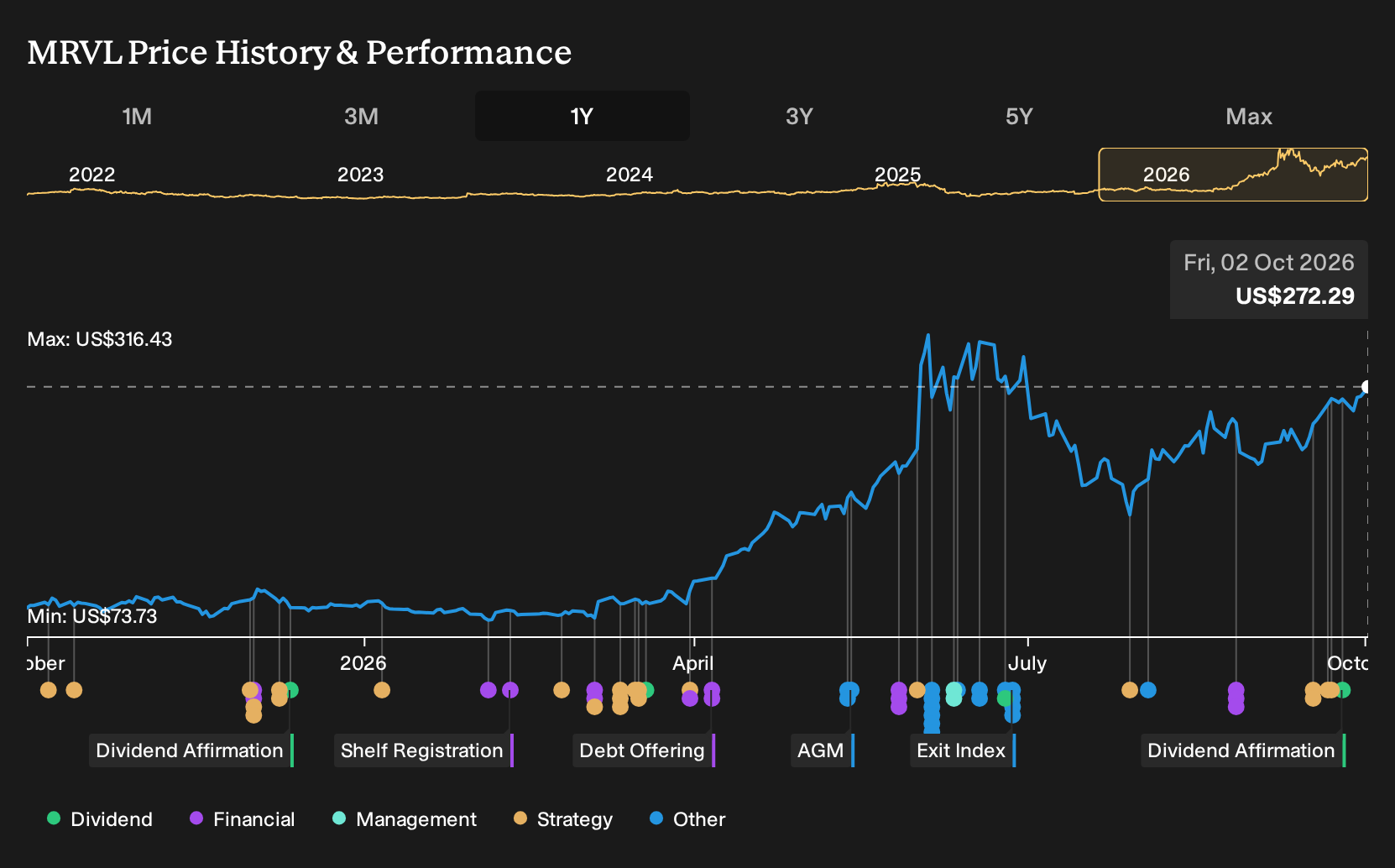
If you only skimmed the headlines about Nvidia’s Jensen Huang calling Marvell Technology the "next trillion-dollar company," you might assume the share price story was always obvious. Holding Marvell Technology over the past year would have returned 211.7%, including dividends. If an investor had bought on 1 October 2025, facing loud bull arguments and clear concentration risks, what exactly in the record would have justified taking that swing?
This theme extends beyond Marvell Technology. See which of 90 AI infrastructure stocks may still merit a closer look.
The Two Stories Investors Were Really Buying In Marvell Technology
The shares cost US$83.89 at the start of the period, and anyone looking at Marvell Technology had to choose between two sharply different stories built on the same AI data center theme.
On the optimistic side, the bull Narrative argued that custom silicon and optical interconnects would transform AI data centers. It suggested a Fair Value of US$133, a notional price implied by those assumptions. That view leaned on expected revenue growth of 23.5% a year and profit margins rising from a small loss to 85%.
The bear Narrative focused on concentration risk in data center customers and heavy spending, with a Fair Value of US$64.31 based on more cautious forecasts. That version still assumed revenue growth of 13.5% a year but only saw margins climbing to 19.6%, and it warned that hyperscalers developing their own chips could limit Marvell’s opportunity.
What The Marvell Technology Results Actually Tested
The clearest development for Marvell Technology was business performance. Quarterly revenue moved from US$2,006.1 million in Q2 2026 to US$2,739.3 million in Q2 2027, while net income excluding extra items rose from US$194.8 million to US$308 million and net margin edged up from 9.7% to 11.2%. That supported the bullish arguments about scale and profitability, but the very high margin targets in the original optimistic case still were not met.
The lesson is simple. When a story leans on margin expansion, keep checking the reported net margin against the promised destination, not just the revenue line or commentary about design wins.
What You Would Be Paying For In Marvell Technology Today
Marvell Technology now trades at US$268 after a 211.7% gain over the past year, and the selected Narrative’s Fair Value sits below that level. The argument still leans on Marvell’s role in AI plumbing, not headline accelerators, as the key differentiator.
For today’s price to hold up, a buyer has to assume that Marvell turns its AI interconnect position into sustained execution on multi-year optical and custom chip programs without meaningful delay or customer concentration setbacks.
"The core thesis for Marvell in 2026 to 2028 rests on a single structural insight: as AI clusters scale from a single rack to hundreds of XPUs operating as one coherent system, the value of the silicon that connects and controls those chips is converging with, and in some cases exceeding, the value of the chips themselves."
That disagreement has a full argument behind it. → Uncover the lower Fair Value this Narrative argues for
Before The Next Story Makes Headlines
By the time a rally makes headlines, you are reading about returns someone else has already earned. Why not go straight to the source and look for your own contrarian opportunity? These three companies trade below our estimated value.
- Company 1 - 32% below our estimate - targets higher beverage consumption as shoppers seek alternatives to sugary fruit juices.
- Company 2 - 27% below our estimate - secures utility-scale tracker orders as customers schedule long-duration clean energy capacity.
- Company 3 - 49% below our estimate - supplies reinforcing products as major infrastructure projects progress from planning to on-site work.
Those are three of them. See the full list of 28 companies trading below our estimate →
This article by Simply Wall St is general in nature. We provide commentary based on historical data and analyst forecasts only using an unbiased methodology and our articles are not intended to be financial advice. It does not constitute a recommendation to buy or sell any stock, and does not take account of your objectives, or your financial situation. We aim to bring you long-term focused analysis driven by fundamental data. Note that our analysis may not factor in the latest price-sensitive company announcements or qualitative material. Simply Wall St has no position in any stocks mentioned.
Have feedback on this article? Concerned about the content? Get in touch with us directly. Alternatively, email editorial-team@simplywallst.com