
- PRICING
- LIVE QUOTES
- LEARN
- HELP


EN
Learn Why The Bull Case For Con Edison Stock Could Change Following Wells Fargo Upgrade
- Consolidated Edison has drawn fresh attention after Wells Fargo upgraded the utility, highlighting the company’s role in supplying electricity and gas to millions of New Yorkers and its position as a steady operator within an increasingly volatile market backdrop.
- The upgrade describes Con Edison as a potential ballast for portfolios that have leaned heavily into AI and technology, shifting focus back to regulated infrastructure, predictable demand for energy service, and the real economy output that comes from keeping New York homes and businesses powered.
- Attention is now on how Consolidated Edison’s perceived defensive role against tech-heavy exposure could influence the broader investment narrative.
What Is Consolidated Edison's Investment Narrative?
To own Consolidated Edison, you have to be comfortable owning a heavily regulated, capital intensive utility whose job is to keep New York running, not to chase headline growth. The business leans on relatively predictable demand from 9.5 million people and more than 340,000 businesses, with earnings that analysts expect to grow 7.9% per year and that rose 14.5% over the past year. That depends on steady execution, ongoing grid investment and constructive regulation rather than big price moves.
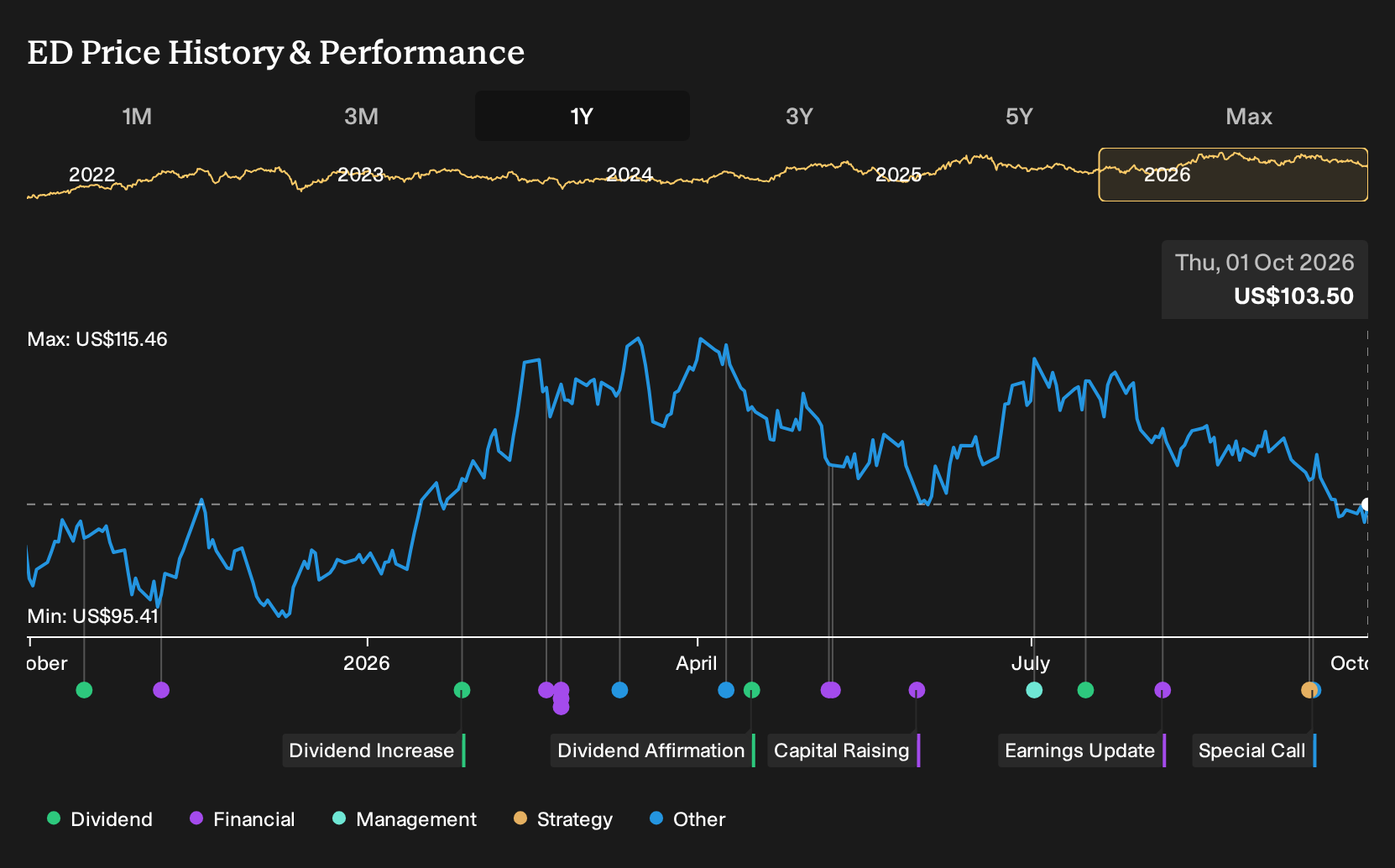
In the short term, the Wells Fargo upgrade mostly reinforces the existing narrative rather than rewiring it. The more tangible near term levers are Con Edison’s planned investor update on 6 October 2026 and how management frames capital spending, debt coverage and dividend sustainability, especially with debt and the 3.43% yield not fully covered by operating and free cash flows.
Yet there is a less comfortable side to that income story that only really shows up when you look at ...
There's only one way to know the right time to buy, sell or hold Consolidated Edison. Head to Simply Wall St's company report for the latest analysis of Consolidated Edison's Fair Value.
Exploring Other Perspectives
The Simply Wall St Community offers 2 fair value views on Consolidated Edison, clustered tightly between US$107.58 and US$110.22 per share. That narrow spread shows how closely some private investors see the current setup. Those assessments do not yet reflect the Wells Fargo upgrade or the upcoming 6 October 2026 investor update. You are seeing a pre catalyst snapshot that may shift once management refreshes guidance and capital plans. Use that as a prompt to compare several contrasting opinions rather than rely on a single narrative.
Explore another Consolidated Edison fair value estimate, including one that suggests it could be worth just $107.58.
The Verdict Is Yours
Don't just follow the ticker. Dig into the data and build a conviction that's truly your own.
- A great starting point for your Consolidated Edison research is our analysis highlighting 4 key rewards and 2 important warning signs that could impact your investment decision.
- See our latest analysis for Consolidated Edison. The report includes a comprehensive fundamental analysis summarized in a single visual, the Snowflake, making it easy to evaluate Consolidated Edison's overall financial health at a glance.
Looking For More Investment Ideas Beyond Consolidated Edison?
If Consolidated Edison looks like just one piece of your long term plan, it can help to scan for other businesses with different strengths that complement a defensive utility holding.
- For investors who want potential upside but still care about fundamental strength, consider screening for 19 high quality undiscovered gems that combine solid business quality with lower market attention.
- If steady income is high on your priority list, you can focus on companies with stronger yields and cash support by reviewing our 7 dividend fortresses aimed at income focused portfolios.
- To build around durability and financial resilience, start with our list of solid balance sheet and fundamentals (25 results) and look for businesses that pair sound leverage with consistent operating profiles.
This article by Simply Wall St is general in nature. We provide commentary based on historical data and analyst forecasts only using an unbiased methodology and our articles are not intended to be financial advice. It does not constitute a recommendation to buy or sell any stock, and does not take account of your objectives, or your financial situation. We aim to bring you long-term focused analysis driven by fundamental data. Note that our analysis may not factor in the latest price-sensitive company announcements or qualitative material. Simply Wall St has no position in any stocks mentioned.
Have feedback on this article? Concerned about the content? Get in touch with us directly. Alternatively, email editorial-team@simplywallst.com